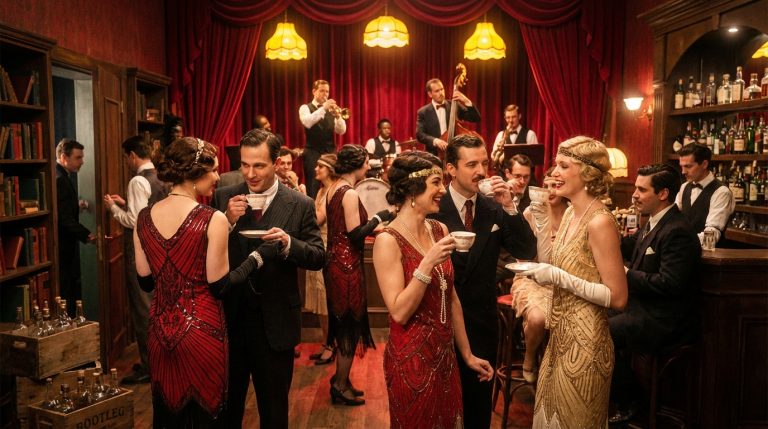
A face appears from the dark backstage, half-finished. One eye circled in chalky white, the cheek streaked with vermilion, the lips only outlined. Overhead, a naked bulb hums and flickers, washing everything in a tired, yellow haze. Brushes clink in a ceramic cup. Powder hangs in the air like distant smoke. For a moment, the performer is not a person, not yet a character. Just a canvas, waiting.
The history of makeup in performance is the story of how that waiting face became a ritual, then a craft, then an art. It is the story of people painting their skin to be seen across candlelit stages, gaslit music halls, silent film sets, rock concerts, and immersive worlds. From ancient masks and mineral pigments to HD foundation and prosthetics, performance makeup follows one thread: the need to make a body visible, readable, and emotionally legible from a distance. It exaggerates, distorts, flatters, or shocks, but always with one goal: to serve the story that unfolds under the lights.
Why performance makeup exists at all
Long before backstage mirrors, there was firelight and shadow. A face in front of a flame is not neutral. It shifts. Eyes sink back, noses grow sharp, mouths disappear. Early performers, priests, and ritual leaders understood that if a crowd was going to watch, they had to see. So pigment arrived.
Performance makeup exists to fight distance, light, and physics so that expression reaches the last row.
From this need grew three enduring purposes that shape every era:
- Visibility: making features readable from far away, through smoke, darkness, or harsh light.
- Character: signaling who someone is, not just what they look like. Age, virtue, power, danger.
- Transformation: allowing a performer to step out of daily identity and into someone, or something, else.
Every culture that developed public storytelling also developed some version of painted faces and masks. Sometimes those faces looked human. Often they did not.
Ancient origins: paint, ritual, and the first stages
Step back to a firelit circle, before formal theaters. A storyteller marks their body with clay and ash. White across the brow, red down the nose, black around the eyes. Not vanity. Code.
In many early societies, what we might now call stage makeup lived inside ritual. The same pigments used to bury the dead or honor deities colored the faces of those who performed myths.
Early performance makeup was not “costume” in our sense; it was a temporary identity, painted onto the skin with spiritual weight.
| Culture | Materials on the face | Purpose in performance |
|---|---|---|
| Ancient Egypt | Kohl, malachite, red ochre | Religious ceremonies, festivals, public processions |
| Ancient Greece | White lead, wine dregs, soot, masks over painted faces | Tragedy and comedy in amphitheaters |
| Ancient India | Plant dyes, lampblack, clay, jewelry fused with paint | Temple performances and storytelling traditions |
In Egypt, kohl rimmed the eyes of both men and women. It created the almond shape we now think of as iconic. On stage, heavily lined eyes caught the sun, the flicker of flame, making every glance more graphic. Green malachite around the eye or along the brow suggested divinity and protection. Cheeks gained warmth with red ochre. What we might call “beauty makeup” for daily life tipped easily into performance when priests reenacted myths and parades of gods moved through the city.
In Greece, theater was civic and sacred. The stone amphitheater swallowed small details. Masks, carved and painted, became the main device. Beneath them, faces were sometimes painted pale with white lead, then marked to echo the mask. The real face was not meant to be seen clearly, but the painted skin supported the illusion, especially in closer gatherings and smaller festivals.
The pattern repeats across continents: at the moment stories move from private to public, pigment follows.
Classical theater: codified faces and exaggerated features
By the time more formal theaters emerged, makeup had started to acquire rules.
Ancient Greece and Rome: masks first, makeup second
Greek theater relied on full-face masks with exaggerated mouths and brows. These masks were painted in simple but strong colors. Dark brows, defined hairlines, strong lip shapes. Under them, actors sometimes used pale base and darkened eye areas so that whatever showed through the eye holes felt intense, almost hollow.
Rome, which absorbed much of Greek stage practice, pushed toward spectacle. Performers playing gods or mythic creatures used colored powders on exposed skin: arms, hands, neck. Blue or red to signal the divine, dark tones to imply ferocity or “otherness” as the audience understood it.
Here, makeup was part of a larger hierarchy of signs: mask, costume, body.
Classical Asia: makeup as visual language
In East and South Asia, where mask and face paint traditions grew in parallel, makeup became its own writing system.
In Chinese opera, especially in later forms like Peking (Beijing) opera, the painted face, or “lianpu,” developed into a coded design. Foreheads, noses, cheeks, and chins became zones for meaning. Red could indicate loyalty and bravery. White could suggest treachery or cunning. Black might mark integrity and straightforwardness. The designs were not random patterns but templates passed down, refined, and instantly legible to a trained audience.
Opera makeup in East Asia treats the face like a flag: color blocks, sharp lines, and recognizable emblems that shout character traits to the back row.
In Japan, classical performance split its makeup approach across forms.
Kabuki introduced “kumadori,” the dramatic streaks of red, blue, and black over a white base. The white (rice powder or later zinc-based pigments) turned the face into a clean plane. Over it, bold strokes followed bone and muscle: sweeping lines over the brows, under the eyes, across the nose. Red suggested heroism, virtue, or fiery emotion. Blue or indigo often marked villains or ghosts. The shapes followed the anatomy of expression, making every frown or shout read like calligraphy.
Noh, by contrast, often used beautifully carved masks. When makeup appeared on the performer’s real face, it was usually very controlled: pale base, small corrections, clean lines. The goal was not flamboyance but refinement, a slightly unearthly calm.
South Asian classical forms, such as Kathakali in Kerala, brought extraordinary sculptural makeup to the stage. Rice paste, pigments, and paper or thin materials built out cheeks and jaws. Green faces for noble heroes, red and black for demon-like figures. The paint extended beyond the face onto the neck and chest, part mask, part living sculpture.
Medieval and early modern Europe: from mystery plays to candlelit stages
Move into medieval Europe and the setting shifts to church courtyards, wagons, and makeshift platforms. Mystery plays brought Bible stories to the public. Devils, angels, and saints needed to appear unmistakably themselves, even from far away.
Burnt cork darkened faces for devils. Flour or chalk created ghostly pale angels. Red pigment emphasized wounds, stigmata, suffering. There was little nuance; these were living icons, moral signals.
Under weak daylight or flickering torches little detail survived, so characters became blocks of meaning painted onto faces.
With the Renaissance and the slow emergence of indoor theaters in Europe, things started to change. Candlelight arrived. Then stronger oil lamps. Each new form of light demanded a new approach.
Commedia dell’arte and character exaggeration
In Italy, commedia dell’arte created a gallery of stock characters. Some wore half masks with stylized features. Others relied more on makeup. The braggart soldier, the cunning servant, the lovestruck youth: all signaled their identity before speaking.
Grease and soot darkened brows or stubble. Rouged cheeks suggested youthful energy or foolish excitement. Occasionally, noses or chins were highlighted or shadowed to tip a face into caricature.
Here we see an early version of what modern stage makeup still does: it takes a real face and pushes it gently into type.
The 18th and 19th centuries: glamour, greasepaint, and gaslight
By the 18th century, aristocratic fashion already involved powdered faces, rouged cheeks, and defined lips. The theater magnified that style. Actors were public figures, and their stage faces influenced daily fashion, just as daily fashion influenced the stage.
Candles provided warm, low light. Features blurred easily, especially when seen from balconies. Performers cemented a few habits:
– Pale base to stop skin from disappearing into the gloom.
– Heavy rouge placed high on the cheekbones to sculpt the face.
– Strongly darkened brows and lids to pull focus to the eyes.
Then came gaslight in the 19th century. Brighter, harsher, sometimes greenish. It flattened faces and highlighted imperfections brutally.
Gaslight did not flatter; it interrogated. So makeup artists started to paint not just for added emphasis, but to correct what the light stole from the face.
Greasepaint emerged as a response. A German actor, Ludwig Leichner, created one of the first commercial greasepaint sticks. These were oily, pigmented mixtures that could be applied smoothly, then blended. They held up to sweat and heat better than previous powders and creams.
Greasepaint allowed:
– Fuller coverage of the entire face and neck.
– Built-in shading and highlighting.
– More subtle gradations of tone than chalk and ash.
Performers could now construct older faces, gaunter cheeks, softer jaws. Pipesmoke, sweat, and crowded venues made durability a priority. These formulas thickened, clung, survived long acts and curtain calls.
Opera houses, music halls, circuses: everywhere performers pushed their faces into higher relief so that emotion traveled. The line between stage and spectacle blurred.
The birth of film: makeup meets the camera
When cameras arrived, they did not just record; they judged. Early film stock and lighting were unforgiving, especially black-and-white film. Faces washed out. Lips disappeared. Eyes turned into hollows.
Theatrical greasepaint looked heavy and crude on screen. Film demanded a new language.
On stage, makeup spoke to a crowd; on film, it whispered to a lens inches away.
Silent film developed its own look:
– Very pale faces to register against dark sets and costumes.
– Heavy darkening around eyes so expressions could be read on low-contrast film.
– Strong lip shapes, often with darker colors, to articulate mouth movement.
The actor Max Factor, originally a wig maker and cosmetic supplier for theaters, became central to this new craft. He refined greasepaint for film, creating flexible creams that could sit more naturally on skin under bright studio lights. He developed shade ranges and techniques that accounted for how color translated to monochrome.
Characters in early film often looked stylized compared to reality, but more controlled than theater. The line of an eyebrow, the cut of a cupid’s bow lip, the shadow under a cheekbone: each was tuned to the camera.
From silent to sound, from black-and-white to color
As sound arrived, sets grew more complex and lighting changed. When color film began to spread, everything shifted again. Suddenly the exact hue of a lipstick or a blush mattered. Colors that looked flattering in person could appear strange on early color stock.
Makeup artists experimented constantly:
– Yellow-based foundations to prevent faces from turning gray.
– Careful control of reds, which could flare too hot on screen.
– Matte textures to reduce shine under new lights.
By mid-20th century, film had fully separated its makeup approach from theater. Stage still used bold strokes and clear lines. Film moved toward the invisible: makeup that did a great deal but did not seem to do anything.
20th-century theater: realism, musicals, and character detail
While film was refining subtlety, stage makeup evolved in two parallel directions.
One path leaned into realism: plays set in drawing rooms, kitchens, offices. Here makeup artists learned to walk a thin line. The audience sat closer in many modern theaters, so the old mask-like face looked false. Yet distance still existed, so bare skin could go blank under light.
Stage makeup in realistic drama became about gentle exaggeration:
– Foundation slightly warmer and deeper than natural skin to prevent washout.
– Soft contour to keep features visible.
– Neutral but slightly deeper lips and brows.
– Thoughtful aging, bruising, or tiredness where the script demanded.
The other path celebrated spectacle. Musicals, opera, and large-scale productions continued the tradition of bold color and graphic shapes. In these settings, makeup became architectural. Glitter for showgirls and chorus lines, sharp eyeliner for expressive eyes, sculpted lips for the back balcony.
Stage makeup sits at the intersection of sculpture and painting; it uses light and shadow to carve a face that can survive a hundred meters of distance.
Rock concerts and cabaret added another layer. Performers like David Bowie treated their faces like shifting canvases, pulling influence from Kabuki, mime, glam rock, and fine art. Zigzags, metallics, stark contrast: performance makeup had become not just supportive but iconic in its own right.
Prosthetics and special effects: when the face stops being human
With advances in materials such as latex, foam latex, silicone, and gelatin, performance makeup could go far beyond contour and color. It could reshape the skull.
Horror films, fantasy epics, and science fiction projects pushed this side of the craft into prominence. Cheekbones could be built outward. Foreheads reshaped. Entire new species created.
For stage, prosthetics introduced new challenges: heat, sweat, repeatability. Long-running shows needed designs that could be applied night after night in a consistent way. Quick changes between scenes forced artists to think like engineers, planning edges, seams, and fastening methods.
| Material | Use in performance | Characteristics |
|---|---|---|
| Latex | Simple wounds, small appliances | Flexible, inexpensive, can cause allergies |
| Foam latex | Full-face creatures, exaggerated features | Lightweight, porous, expressive |
| Silicone | Realistic skin effects, subtle aging | Translucent, skin-like movement, heavier |
In theater such as “The Lion King” or “Wicked,” makeup and prosthetics collaborate with masks and headpieces. The performer remains visible; the design extends and reframes the human face rather than hiding it completely.
Television and HD: every pore on display
Television brought its own pressures. Studio lighting, early cameras, and multi-camera setups forced makeup artists to find ways to keep faces consistent from angle to angle. As cameras became sharper, flaws that film once blurred started to appear.
When high-definition cameras entered the scene, many traditional products failed. Powder sat on the surface like dust. Heavy foundations cracked and pooled in lines that the human eye barely noticed but the lens captured mercilessly.
HD made the face not just larger, but more intimate; makeup had to become nearly invisible while working harder than ever.
New formulations emerged:
– Finely milled powders that disappeared on camera.
– Silicone-based foundations that mimicked skin texture under sharp light.
– Primers to smooth the canvas before any pigment touched it.
Performance makeup for broadcast began to intersect with everyday cosmetic trends more than ever. Techniques such as contouring, then popularized on social media, had long existed on stage and set. They simply became widely visible.
Immersive theater and live art: makeup as moving scenography
As performance moved off the proscenium and into galleries, warehouses, and streets, makeup had to adapt again. In immersive work, the audience can stand close enough to see every brushstroke. There is no safe distance.
Makeup in these environments behaves almost like set design on the body:
– Colors can echo the palette of the room, binding performer and space.
– Textures, such as cracked paint, glitter, or gloss, can respond to the lighting design rather than fighting it.
– Long-duration wear demands products that can endure sweat, touch, and occasional accidental contact from audience members.
When the audience can look a performer directly in the face at arm’s length, makeup must withstand scrutiny while still reading as theatrical.
In some immersive works, makeup becomes a live ritual. Performers apply it in front of audiences as part of the piece. The transformation is no longer private, behind the mirror; it is part of the story. The line between backstage and onstage dissolves.
For set designers and directors, this opens new possibilities. A character might start the show barefaced and gradually accrue makeup, dirt, or glitter, tracking a psychological journey. Or characters might share a single mirror and a single palette, visually tying their fates together.
Codes and archetypes: recurring faces across history
Across these centuries and cultures, certain patterns repeat. They may look different, but their logic is alike.
Pale base appears again and again. In Kabuki, in Western opera, in Victorian theater, in mime. Light skin reads better in low or colored light. It also creates contrast for painted features.
Dark eyes, heavy brows, emphasized sockets: these shapes survive from ancient kohl-lined faces to smoky eyes in rock shows. The eye is the emotional center; makeup circles it like a frame around a painting.
Defined lips return, from Greek comic masks to film stars. The mouth is the seat of speech, song, and silent emotion. To mark it is to underline expression.
Bright color placed high on the face signals vitality, youth, or heightened emotion. Dark tones hollow cheeks, sharpen bones, suggest age or severity.
Performance makeup is less about beauty than about legibility; what matters is that an audience can read who someone is and what they feel in half a second.
The ethical context around these codes changes. Where once certain colors and exaggerations were used uncritically to mark “villains” or outsiders, contemporary designers must face the histories behind those choices. Blackface minstrelsy, caricatured ethnic features, and exaggerated gender codes leave a legacy that cannot be ignored.
Skilled contemporary artists interrogate these patterns instead of repeating them blindly. They ask: What does it say if I darken this feature? Why this color on this body? Does this choice reinforce an old stereotype, or subvert it?
Technology, materials, and the craft behind the magic
Under all the artistry lies chemistry. The history of makeup in performance is also a history of materials.
From crushed minerals and plant dyes to synthetic pigments and polymers, each era’s available materials set its limits.
Early powders: chalk, lead white, ground minerals. Strong color, often toxic, prone to cracking, very sensitive to sweat.
Oils and fats: tallow, wax, plant oils. Sticky, heavy, with a distinct smell. Durable but occlusive.
Modern creams and liquids: emulsions balanced for slip, coverage, and film. They sit more comfortably on the skin and handle heat better.
Silicones: films that resist water and sweating, blur texture, and move with expression. Their arrival reshaped HD makeup.
Glitters and special finishes: once made of glass or metal, now often plastic or biodegradable alternatives. On stage, they catch light with a precision that pigment alone cannot.
For the performance designer, understanding how these materials interact with lighting, costume, and set can make or break a show. A glossy black eye may look rich under incandescent light but turn into a void under certain LEDs. A carefully crafted bruise may vanish under a strong blue wash.
| Light type | Effect on makeup | Design consideration |
|---|---|---|
| Candle / very warm | Softens edges, warms reds, dulls blues | Use stronger shadow, avoid subtle cool tones |
| Halogen / tungsten | Warm, reveals texture moderately | Balance between stage and real life; moderate powder |
| Cool LED | Sharp, can make skin appear sallow | Correct with warmer base and careful blush |
| HD camera lighting | Shows pores, fine lines, product buildup | Use thin layers, high-quality blending, avoid heavy powder |
Makeup as ritual: the inner history behind the outer face
Alongside materials and styles, there is something more private: the ritual of application. For many performers across time, that ritual holds power.
The act of sitting at a mirror, tying back hair, laying down base, adding lines and color, is more than practical. It marks the passage from daily self into stage self.
In Kabuki, makeup is part of an inherited identity. Techniques are guarded, passed through families, repeated with devotion.
In some Western traditions, actors speak lines, hum melodies, or repeat small gestures as they paint. Eyeliner becomes a moment of focus. Lip color becomes the final switch.
The mirror before a show is not simply a reflective surface; it is a tiny stage where the first performance begins, with the performer as both artist and canvas.
For an audience, that ritual is usually hidden. In contemporary practice, some directors choose to reveal it intentionally. When a character applies makeup onstage, we witness the creation of persona in real time. The history of stage makeup is distilled into a few minutes: bare skin, then pigment, then someone new.
Where we are now: choice, hybridity, and responsibility
Today, performance makeup sits in a dense web of influences. Stage traditions, film craft, social media trends, fine art, and fashion all feed into the same kit. A designer can borrow a Kabuki-style eye, a silent film lip, a glam rock shimmer, and a prosthetic brow, then combine them into something new.
The palette has expanded dramatically. Skin tone ranges have broadened. Products exist for sweat-resistant work, for underwater performance, for aerial circus. Airbrush technology allows extremely thin, even layers. Non-toxic adhesives and removers protect skin over long runs.
At the same time, the history behind certain looks demands careful thought. Whiteface, exaggerated racial features, and markings tied to specific cultures carry weight that cannot be brushed aside.
A responsible contemporary approach requires:
– Awareness of theatrical and social history, including harmful traditions.
– Dialogue with performers about what goes on their skin and what it implies.
– Collaboration between makeup design and set, light, and costume, so that each supports the story rather than fighting it.
In immersive and interdisciplinary projects, makeup is no longer a late addition. It is part of the concept from the start. A character whose cheeks are dusted with coal ash might live in a set of charred wood and blackened steel. A chorus whose faces glow in UV-reactive paint might move through corridors of blacklight and reflective surfaces. The visual field is total; the face is one key element in that field.
The history of makeup in performance is not a straight line of progress, but a layered archive of choices, codes, and rituals that designers can either repeat or rewrite.
What has never changed is the core moment: a person stands in front of light and other people. Their face needs to carry what words and movement alone cannot. At that moment, a stroke of pigment is not decoration. It is signal, structure, and story, all resting on skin.