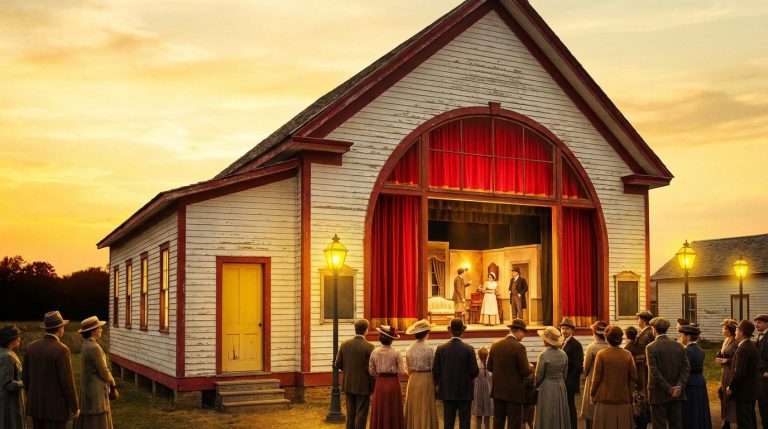
The crowd hushes. Torches spit and crackle against damp stone. Somewhere in the dark, a woman whispers a line everyone somehow knows, even if they have never read the play: “A rose by any other name would smell as sweet.” The air shifts. The words do not just tell a story. They rearrange how the room feels, how people breathe, how they think about love and names and the weight of reputation. One phrase. Fourteen simple words. And they are still alive centuries later.
Shakespeare did not just write plays. He hacked the language. He bent English into shapes it had never tried before, then left it that way for the rest of us. His turns of phrase, his metaphors, his habit of stitching new words together like fabric scraps into a costume have slipped into everyday speech so deeply that most people quote him without knowing it. If you describe a “green-eyed monster,” talk about “breaking the ice,” say that you are “in a pickle,” or call life “a laughing stock,” you are walking through his verbal set design. Modern English carries Shakespeare inside it like a hidden stage, constantly in use, rarely acknowledged.
How Shakespeare Rewired Everyday English
Shakespeare’s impact on modern English sits in three main areas: the words he created or popularized, the phrases that still circulate in speech and writing, and the way his rhythms and imagery shaped how English handles emotion, conflict, and character. He did not work in a quiet library. He worked in a crowded open-air theater, where language had to hit the back row, cut through gossip and birdsong, and stay in memory long after the actors bowed. The English we speak today still reflects that need for clarity, punch, and music.
- He invented or recorded hundreds of new words and combinations that we still use, such as “bedroom,” “lonely,” “gloomy,” “majestic,” “hint,” and “addiction.”
- He gave us enduring phrases like “wild-goose chase,” “break the ice,” “wear my heart upon my sleeve,” “to be or not to be,” and “seen better days.”
- He pushed English toward more flexible sentence structures and bold metaphors, influencing how writers and speakers express complex, often messy emotion.
- His dialogue helped define what sounds “natural” in English drama and film, shaping screenwriting, theater, and even casual conversation.
Shakespeare treated English like wet clay, not stone. He kept reshaping it, and the language never fully dried back into its old form.
Inventing Words: Shakespeare as Linguistic Set Designer
Imagine a bare stage. No elaborate flats, no digital projections, just timber, rope, and a crowd. The world had to be built almost entirely out of language. When the budget for physical spectacle runs thin, words pick up the slack. That pressure pushed Shakespeare to sculpt new terms the way a set designer builds impossible landscapes out of plywood and paint.
Coined, Borrowed, or Just Boldly Written Down
There is debate among scholars about how many words Shakespeare truly “invented.” He did not operate in a vacuum. Some expressions may have circulated in speech before he wrote them. What we do know: his plays and poems hold the first surviving written examples of many now-common English words.
Here are some of the terms we meet first in his works:
| Word | First recorded in Shakespeare | Modern sense |
|---|---|---|
| Bedroom | “A Midsummer Night’s Dream” | A room for sleeping, a private space, often with emotional context in drama and design. |
| Lonely | “Coriolanus” | Alone in a way that hurts, not just physically separate. |
| Gloomy | “Titus Andronicus” | Dark, shadowed, heavy in feeling or atmosphere. |
| Majestic | “Julius Caesar” | Grand, impressive in scale or bearing. |
| Addiction | “Othello” | Strong habit or dependence, often destructive. |
He also liked to glue words together into new compounds, or shift a word from one category to another. A noun might become a verb. An adjective might become a noun. It feels almost theatrical, like changing costume mid-scene.
For Shakespeare, grammar was not a cage. It was a scaffold. Something to climb, to stand on, to leap off from.
That freedom still echoes in modern English. We are comfortable turning “Google” into a verb, calling a short video a “reel,” or saying that a color “feels tired.” The language tolerates this play partly because writers like Shakespeare normalized the idea that English can stretch.
Words that Open Emotional Space
Some of his coinages do more than name objects. They carve out emotional or psychological niches. Take “lonely.” Before it entered English in this particular shade, people were certainly alone. They had solitude. They had isolation. But “lonely” carries a personal ache. It feels closer to how a character stands in the middle of a crowded stage and still seems separated from everyone else.
Similarly, “gloomy” does not just mean dark. It is not a simple lighting cue. It is light mixed with mood: a gray morning after a night of arguments, or a room where the curtains are drawn a little too long.
These words function like finely tuned lighting instruments in a theater. Instead of flooding everything with brightness or shadow, they give you gradients. They pull focus, shape feeling, and add subtlety to a scene, whether that scene is a stage set or a simple conversation.
Phrases That Became Everyday Props
Beyond single terms, Shakespeare planted longer expressions into English, many of which are now so ordinary that they pass unnoticed. They work like background props in a set: ordinary chairs, windows, and plates that quietly make the space feel lived in.
Lines You Know Without Knowing You Know Them
People who have never touched “Hamlet” still know “to be or not to be.” That soliloquy turned one character’s inner debate into a compact, almost geometric formula for existence and nonexistence. The phrase crops up in headlines, political debates, and jokes because it has become shorthand for any serious choice.
Other phrases work in smaller ways:
“Break the ice”
“Green-eyed monster”
“Wild-goose chase”
“Heart of gold”
“Foregone conclusion”
When you say “break the ice,” you are borrowing the image of smashing through a frozen surface so people can move again. It is physical, almost tactile. A “green-eyed monster” gives jealousy not just color but physical shape, a creature crouched inside someone. A “wild-goose chase” captures the frustration of pursuing something that keeps slipping away. These phrases turn abstract concepts into images that anyone can picture.
For a designer or director, this habit feels familiar. You turn fear into fog, love into warm side light, power into raised platforms. Shakespeare did it with speech. He built mental props that people still carry around centuries later.
How These Phrases Shape Tone
These expressions are not neutral. Each one carries a tone. “Foregone conclusion” feels fatalistic, as if events were pinned in place long before anyone acted. “Heart of gold” softens a character. It hints that beneath rough edges lies something warm and generous.
Modern English leans heavily on such phrases to shade tone without long explanation. You can say “He has a heart of gold” and skip paragraphs of backstory. The line pulls in centuries of usage, stage portrayals, and cultural memory.
Every time we quote Shakespeare, even casually, we borrow not only words but attitudes. A tiny fragment of stage light falls on whatever we are describing.
Rhythm, Cadence, and the Sound of Modern English
There is another layer to his impact that tends to slip under the radar: sound. The shape of his lines, the rhythm of stressed and unstressed syllables, the rise and fall of his sentences. English speakers have listened to these patterns for hundreds of years. They have seeped into what we expect “good” or “powerful” speech to sound like.
Iambic Pentameter as Verbal Architecture
Shakespeare built most of his verse in iambic pentameter: lines of roughly ten syllables, with a pattern that rises like a heartbeat: da-DUM da-DUM da-DUM da-DUM da-DUM.
“To BE or NOT to BE, that IS the QUESTion.”
The pattern is not rigid. It bends, breaks, stutters, or speeds up as characters lose control or gain command. You can hear a character’s emotional state in how strictly they stay inside the rhythm or how wildly they crash through it.
Modern English speakers, even if they cannot define iambic pentameter, have been formed by hearing it in Shakespeare, in church readings, in classic poetry, in speeches. That pattern now feels natural for utterances that carry weight. It is why a line like “We hold these truths to be self-evident” lands with such certainty. The rhythm feels grounded.
Shakespeare helped teach English that meaning is not only in what you say, but in how the sentence moves across the air.
In theater and film, writers keep echoing this. Emotional monologues often fall into similar cadences: not because of direct imitation, but because those rhythms have trained audiences to hear sincerity and conflict in that shape.
Sentences That Breathe Like Characters
Another subtle impact lies in how Shakespeare allowed sentences to stretch. Characters shift mid-line, change thought suddenly, contradict themselves. Clauses hang over the edge of one line and crash into the next. This gives the illusion of real thought happening in the moment.
Take Macbeth:
“Tomorrow, and tomorrow, and tomorrow,
Creeps in this petty pace from day to day…”
The repetition, the wandering syntax, the way the line mirrors exhausted footsteps. Modern English drama, from television scripts to immersive theater texts, borrows this broken, thinking-out-loud style. It gives characters interiority. It lets them sound like people grappling with something onstage, not just reciting a polished speech.
That texture has seeped into casual conversation too. We pause, restart, double back. When writers capture that with ellipses, fragments, and interrupted phrases, they are walking a path Shakespeare helped mark.
Metaphors: Turning Thought into Stage Pictures
In set design, you might turn grief into a house that is slightly too big for the person living in it, or guilt into a single overhead bulb with no shade. Shakespeare did the same work with metaphor. He took emotions, ideas, and relationships, and turned them into images that still frame how we talk.
Life, Stage, and Costume
One of his most cited metaphors is from “As You Like It”:
“All the world’s a stage,
And all the men and women merely players…”
That line did more than decorate a speech. It offered a simple model for thinking about identity, behavior, and social roles: as performances. Today, when people talk about “putting on a mask,” “playing a role,” or “stepping into character” in daily life, they echo this older framing. The metaphor invites us to see our choices as partly theatrical, partly scripted by culture, and partly improv.
He imposed a stage on the world and, in doing so, gave us a way to observe ourselves from the balcony.
Other metaphors work at different scales. Calling jealousy a “green-eyed monster” personifies an emotion, allowing it to be seen as something that visits, seizes, or leaves. It is not just an inner mood; it is a creature. That way of externalizing inner states lives on in everything from self-help language to animated films that draw emotions as characters.
Weather, Light, and Architecture in Speech
Shakespeare repeatedly linked inner weather to outer weather. Storms for anger. Mist for confusion. Clear days for clarity and reconciliation. This kind of mapping feels obvious now, but its repeated, vivid use helped engrave those associations into English.
Light and darkness carry moral weight in his lines: “Out, out, brief candle!” in “Macbeth” makes life a fragile flame in a drafty room. Modern English still uses light for hope and knowledge, shadow for danger and secrecy. Designers echo this constantly, sometimes consciously, sometimes because the association is so deeply baked into the culture.
Buildings appear as metaphors for bodies and minds: “crannied walls,” “ruined choirs,” “fortresses” of thought. This architecture of language pairs easily with physical design. When a production shows a crumbling set for a character breaking down, it is visually matching a verbal habit Shakespeare helped normalize.
Character, Psychology, and Interior Language
Before Shakespeare, English drama had moral types and strong figures, but his characters speak with a psychological depth that changed how the language handles inner life. Soliloquies, in particular, opened a corridor between private thought and public speech.
Talking to Oneself in Public
Hamlet talking alone on stage about death and action. Lady Macbeth whispering about horrific plans. Richard III smiling at the audience while plotting. These scenes invited people to listen to thoughts they were never meant to hear, wrapped in language that tries to pin down restless, conflicting impulses.
Over time, this influenced how English phrases internal conflict. We hear:
“I am in two minds about this.”
“Part of me wants to stay; part of me wants to run.”
“I am my own worst enemy.”
These ways of talking treat the self as divided, as if several characters live inside. Shakespeare’s characters model that. Their speeches rehearse options, argue with themselves, and reveal that the mind is not a single voice.
Modern English carries a strong habit of turning psychology into dialogue, even when no one is there to answer.
You see it in diary entries, social media posts, therapy sessions, and monologues written for indie films. That move from simple “I feel sad” to complex, layered self-argument owes a great deal to how Shakespeare stretched what dialogue could do.
Language for Ambivalence and Moral Gray
His plays live in moral gray zones. Heroes hesitate. Villains charm. Decisions hurt no matter which option one takes. The language that grows around this is full of “if,” “seems,” “think,” “perhaps,” and long sentences that circle a problem without resolving it.
This taught English to tolerate and even value ambiguous statements. Not everything must resolve into “good” or “bad.” People can be “noble but flawed,” “honest yet weak.” The vocabulary for mixed judgment grew richer because his characters needed it.
Modern English now supports subtle moral shading in a simple phrase:
“He means well.”
“She is complicated.”
“They did the wrong thing for the right reasons.”
Those shortcuts rest on a long history of plays and stories where characters were allowed to be internally tangled rather than flat symbols. Shakespeare is not the only source for this shift, but he sits near the center of its theatrical expression.
Structure, Genre, and the Way We Talk About Story
Shakespeare did not just shape sentences. He helped codify broad story forms in English: tragedy, comedy, history. When we refer to plot twists, archetypes, or character arcs, we often draw unconsciously from his patterns.
Star-Crossed Lovers and Tragic Flaws
Call a couple “star-crossed lovers” and you instantly frame their relationship as doomed by forces beyond their control. That phrase from “Romeo and Juliet” now acts as a label for a whole type of story. Every time someone compares a modern couple to Romeo and Juliet, they plug into that narrative: intense, young, obstructed by family or society, likely to end badly.
The phrase “tragic flaw,” used in talking about drama and film, connects sharply with characters like Macbeth (ambition), Othello (jealousy), or King Lear (blindness to truth). English criticism absorbed this vocabulary, and it migrated outward. Now people use it casually:
“Perfectionism is his tragic flaw.”
“Her kindness is her downfall.”
We map our lives using story language born on those wooden stages: arcs, rises, falls, climaxes, and tragic turns.
For someone working in performance or design, this matters. The moment you tag a space as “Macbeth-like” or “Lear-like,” you tap into these shared story structures. The audience feels it before a word is spoken.
Comedy, Wit, and Verbal Fencing
In the comedies, fast exchange defines attraction and intelligence. Beatrice and Benedick in “Much Ado About Nothing” do not simply say they like each other. They spar. The language is quick, layered, full of insult and affection at once.
Modern romantic comedy still measures chemistry in similar terms. Two people who finish each other’s sentences, trade barbs, and challenge one another feel “meant to be” because audiences have internalized that pattern. English evolved a whole style of flirtation based on witty conflict. It shows up in dialogue tags like:
“They bicker like an old married couple.”
“They have great banter.”
Shakespeare did not invent banter, but he burned it into the shared memory of English theater so strongly that it set a standard.
Shakespeare in Modern Media, Advertising, and Everyday Speech
His language does not stay locked in classrooms or old theaters. It pops up in film titles, advertisements, song lyrics, political speeches, and casual chats over coffee.
Borrowed Titles and Slogans
Many works borrow titles directly or partially from Shakespeare:
“Brave New World” (from “The Tempest”)
“The Sound and the Fury” (from “Macbeth”)
“Something Wicked This Way Comes” (also from “Macbeth”)
“North by Northwest” (from “Hamlet,” twisted slightly)
These titles carry tone and expectation. “Brave New World” suggests a shining future with hidden dangers. “Something Wicked This Way Comes” foreshadows approaching threat. When a marketing team pulls a Shakespeare phrase, they are tapping into a long cultural echo.
Advertisements sometimes echo lines too, often stripped of their original context. A perfume might allude to “a rose by any other name,” hinting at essence over label. A travel campaign could twist “all the world’s a stage” to suggest experiences as performances.
The commercial world raids the Shakespearean toolbox because those phrases already live in people’s ears.
Everyday Speech as Behind-the-Scenes Shakespeare
Walk through a city or sit on a train long enough, and you will likely hear his influence without realizing it. People say:
“They vanished into thin air.”
“It is Greek to me.”
“Fight fire with fire.”
“Too much of a good thing.”
“Fair play.”
Every one of these appears in his work. Each phrase shapes how English compresses meaning. “Vanished into thin air” gives a visual and textural element to disappearance. “Greek to me” adds a cultural image to confusion.
Most speakers are not consciously quoting. That is the point. The language has swallowed these lines so thoroughly that they function like any other everyday phrase. Shakespeare is backstage, pulling levers from centuries ago, while modern English delivers the lines like second nature.
Why This Matters For Artists, Designers, and Storytellers Now
For someone working in set design, immersive theater, or any art that choreographs audience experience, this history is not just academic. It shows how strong language can shape perception, space, and time.
Language as Invisible Scenery
In immersive work, audiences may stand inches from performers, surrounded by objects, sound, and light. Yet a single sentence can still redirect the entire emotional geometry of the room:
“All the world’s a stage.”
“Out, out, brief candle.”
“We are such stuff as dreams are made on.”
These lines do not simply refer to theater. They suggest that reality itself might be fragile, staged, or dreamlike. Spoken inside an installation, they resonate with the design: walls that flex, projections that blur, props that feel more real than the actors. Shakespeare’s phrases become invisible columns holding up the experience.
Every designer works with more than wood, fabric, and projections. They work with the long shadow of certain sentences.
His impact on English gives you a toolkit of culturally charged phrases and images. When used carefully, they can turn a simple object into a reference point. A single candle in an otherwise dark set does not just light the space. It quietly speaks “Macbeth” to anyone who remembers school readings or film adaptations.
A Caution: Imitation vs. Understanding
There is a temptation to plaster productions or artworks with Shakespeare quotes as a shortcut to depth. That often feels heavy-handed. The better approach is to understand how he treated language: as flexible, sensory, grounded in physical imagery, willing to risk new combinations.
Rather than copy his lines, you can emulate his method:
– Give abstract ideas concrete shape.
– Let characters think out loud in messy, believable ways.
– Invite rhythm into speech, so lines feel spoken from the body, not just the mind.
– Allow moral and emotional complexity instead of tidy labels.
Modern English already carries his influence. The question is not whether to “add” Shakespeare, but how conscious you want to be about the traces that are already there.
A Living Influence, Not a Museum Piece
Shakespeare’s impact on modern English is not frozen. New generations keep reading, performing, adapting, and arguing with his work. Films refit his plots into high schools, corporate offices, spaceships. Each adaptation shifts emphasis, foregrounds different lines, and lets certain words gain new shades of meaning.
His plays existed before standard dictionaries, before grammar rules fully settled. English was a rough stage still under construction. He moved fast inside that half-built structure, testing its beams, kicking at its walls, adding hidden doors.
We inherit a language that remembers those experiments in its bones.
Our everyday speech is staged on those renovations.
When someone today says they are “in a pickle” during a design crisis, or that a project has “seen better days,” they speak with centuries of echoes behind them. The line between casual quip and crafted verse blurs. English, once remolded in the heat of live theater, keeps its theatrical instincts.
For the artist, designer, or audience member who cares about experience, this is the quiet, persistent impact: Shakespeare tuned English for performance. That tuning still lets simple phrases hit like spotlights, metaphors rise like sets behind the actors, and a well-placed line rearrange the emotional architecture of a room.