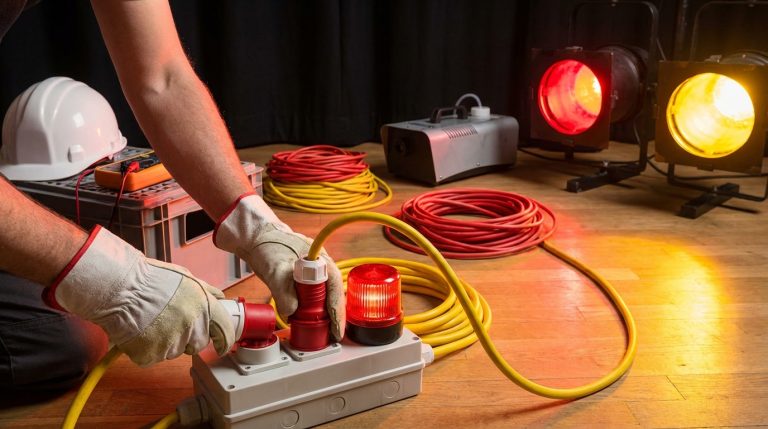
A single green work light hangs over the empty stage, making the dust in the air look like slow-motion snow. Spike tape scars the floor in neon lines. The set looms in half-shadow, waiting. Somewhere in the wings, a pencil hits a clipboard, a stopwatch clicks, and a calm voice says: “Ok. Places for top of show.”
That is the stage manager. The quiet gravity in the room. The person holding the show in one steady hand.
The short version: a stage manager is the CEO of the show. Not the most famous person, not the loudest, but the one who sees everything, knows everything, and keeps the whole fragile machine running. They translate chaos into cues, creative wishes into practical steps, and nerves into timing. When the audience gasps at a perfect blackout, or never notices a near-disaster averted at the last second, that invisible precision has a name: stage management.
The Stage Manager as “CEO”: What That Really Means
Think of the production as a living company. The director is creative lead. The producer is finance. Designers shape product and brand. But every company still needs the person who knows where everyone is, what happens when, and what goes wrong if this piece moves or that person is late.
That is why calling the stage manager the “CEO of the show” is not just flattery. It is a description of function.
They have three intertwined jobs:
They protect the show, they protect the people, and they protect the process.
They are the only role that truly spans all timeframes:
| Phase | Stage Manager’s focus |
|---|---|
| Pre-rehearsal | Prep: paperwork, schedules, communication, space readiness |
| Rehearsal | Tracking the evolving show, logistics, rules of the room, documentation |
| Tech & previews | Calling cues, coordinating departments, shaping show rhythm |
| Performances | Running the show consistently, crisis management, maintenance |
The title does not sit on a corner office door. It sits in the calling script. In the headset. In the callboard. In the trust other people have that when they walk into the building, the show will not fall apart.
The Invisible Architecture: How Stage Managers “Hold” a Show
A set designer shapes space with flats and platforms. A lighting designer sculpts with beams and shadow. A stage manager builds something less visible but just as real: the architecture of time.
Every rehearsal, every break, every cue, every preset, every note session fits inside a structure they maintain.
They turn a script into a sequence of lived moments, precise enough to repeat, flexible enough to survive reality.
They do this through a mix of disciplines:
– Timekeeping: calls, breaks, rehearsal timing, performance duration.
– Documentation: the prompt book, reports, blocking notes, cue sheets.
– Communication: daily reports, rehearsal notes, emails, group chats, headset traffic.
– Safety and welfare: conditions in the space, emergency response, human stress levels.
– Calling the show: live cueing of lights, sound, automation, and other departments.
None of this is glamorous. All of it is design. It is experience design for everyone who touches the production: cast, crew, creatives, audience.
Pre-Rehearsal: Building the Skeleton
Before a single actor crosses the stage, the stage manager is already working. The show at this point is like a body without bones: ideas, sketches, a script, maybe a mood board. The task is to start giving it a spine.
This is where the “CEO” analogy begins to feel literal. There is planning, resource management, risk assessment, all wrapped in tape and coffee.
The first list appears here, and it is simple:
- Read the script several times for logistics, not just theme.
- Talk to director, designers, producer about vision and constraints.
- Shape rehearsal schedule with production management.
- Prep the rehearsal room and base paperwork.
Notice what is missing: ego. The stage manager does not need everyone to know they have done all this. They need it to work.
Reading the Script Like an Engineer and a Poet
A good stage manager reads a script differently from a director.
The director might circle emotional beats. The stage manager circles “door slam,” “gunshot,” “window opens,” “phone rings,” “rain outside,” “fight,” “intimacy,” “quick change,” “child on stage,” “live flame.”
They are listening for the sound of problems before they exist. They are counting chairs, entrances, exits. They are marking anything that will need:
– A cue
– A prop
– A costume change
– A special effect
– A safety conversation
Every underlined word in that script is a promise that something will happen at a particular time in front of people. The stage manager is the one quietly asking: “How, exactly?”
This is not negative. It is creative realism. It protects the art from wishful thinking.
Paperwork as Design, Not Bureaucracy
It is easy to dismiss paperwork as dry. Bad paperwork is.
Good stage management paperwork is like good graphic design: it allows the eye and brain to understand complexity in one glance.
Common items include:
| Document | Purpose |
|---|---|
| Contact sheet | Who is in the project and how to reach them |
| Rehearsal schedule | Who is called when and for what |
| Scene breakdown | Which characters, props, and design elements appear in each scene |
| Props list | Every item handled or seen, and how it is used |
| Costume tracking | What each actor wears in each moment, and changes between |
The stage manager chooses how these look. Columns, fonts, colors, symbols. They are designing a control dashboard for the show.
Good design here saves hours of argument and confusion later. It keeps creative energy flowing where it belongs: on the stage.
Rehearsal: The Laboratory and the Courtroom
The rehearsal room is a strange hybrid space. It is part lab, part courtroom, part playground. Ideas are trying out shapes. Feelings spill across tape lines. Time is money. Everyone is a bit tired.
In this charged container, the stage manager is the one who holds the boundaries.
They are guardian of the room: atmosphere, pace, clarity, and safety all converge at their table.
The Rehearsal Table as Control Center
Picture the table: script in a three-ring binder, mechanical pencils, eraser dust, a laptop, a stopwatch, a thermos, perhaps a calm bowl of throat lozenges, strips of tape stuck to the edge like tiny flags. From here, the stage manager does several jobs at once:
– Tracks blocking: where each actor moves, when, and relative to others.
– Catches changes to the script in real time.
– Records tech needs that appear through rehearsal choices.
– Watches the clock: breaks, timing, late arrivals, end of day.
– Maintains the “temperature” of the room: tension, confusion, fatigue.
During run-throughs, they are already thinking like a show caller. Where will that light change go? When does the sound start so that it feels like it rises from under the actor’s last word? When must crew be backstage, ready?
This is also where real leadership lives. Leadership that is not loud.
Communication: Clear, Neutral, Consistent
After rehearsal ends, the creative team heads home with images in their head. The stage manager stays to write.
The daily rehearsal report is not glamorous, but it is the connective tissue between rehearsal and every department.
A strong report is:
Specific, factual, calm, and written so that a tired designer at midnight can understand exactly what needs to change.
For example, instead of: “Actors had trouble with chairs in scene 3.”
A stage manager might write:
“Scene 3: Blocking change. A3 now crosses DS right to chair 2 at ‘You know that is not what I meant.’ Chair 2 is currently too close to table; request 12 inches more clearance to allow for quick exit around SR side.”
This is design-level clarity. It respects the time of the person reading it.
This is also where your approach can go wrong if you are too soft. If you, as a stage manager, avoid writing hard notes because you do not want to upset anyone, the whole show pays for that later. The CEO cannot pretend problems are not there. They have to name them, cleanly and without drama.
Protecting People, Even When It Is Unpopular
There is romance in suffering for art. It is also lazy thinking.
A good stage manager will stop a rehearsal if a fight looks unsafe, or if someone is working through a clear injury, or if an intimacy moment has not been staged with consent. They will insist on breaks. They will push back if a schedule is becoming exploitative.
To some directors or producers, this can feel obstructive.
But a stage manager who always says “yes” to unreasonable pressure is failing at the most critical part of the job: protecting the humans who make the art.
The CEO of the show is responsible for the health of the company. In theater, that health is breath, muscles, back strain, anxiety, sleep.
If you are a director, and your stage manager pushes for more time between cues to reset, or for a shorter day after a grueling tech, listen. They are not sabotaging your vision. They are preserving the people who will carry it for dozens, maybe hundreds of performances.
Tech: Turning the Blueprint Into a Machine
Tech rehearsals are brutal and beautiful. The stage finally meets the show. The room goes dark. Scene shifts try their first full run. Lights wake up. Sound fills the air. The set feels taller. More dangerous. More alive.
This is the moment where the stage manager moves from rehearsal brain to operator brain.
Tech is where the stage manager pulls the scattered strings of light, sound, automation, and human movement into one cue-to-cue tapestry.
They sit at the tech table surrounded by designers, op stations, and tangled headsets. Every beat of the show must now be translated into buttons and words.
“HQ 37… stand by LX 37, SD 19, Fly 7… and… GO.”
The Prompt Book: Sacred Object of the Show
The prompt book is not just “the script.” It is the living artifact of the production.
Each page might hold:
– Dialogue and stage directions.
– Blocking symbols and diagrams in the margins.
– Cue numbers and where they are called.
– Warnings and standbys.
– Notes about safety, quick changes, special cases.
Over time, this book becomes the complete instruction manual for the show. Anyone who can read it and understand cueing should, in theory, be able to call the show.
Some stage managers practically do graphic design inside their prompt books. Colored tabs. Highlighters to distinguish departments. Different inks for different weeks of tech. The aesthetic is not about decoration. It is a functional beauty. It must be clear in a dark booth with a flashlight, under stress, with sweat on your hands.
If you are building a show that you want to tour or remount, invest time in this. Sloppy prompt books are like blueprints drawn on napkins. They collapse under pressure.
Calling Cues: Musicality and Nerve
Calling a show is the closest theater has to piloting a plane. You sit at the console, hand on headset switch, eyes on stage and script, ears tuned to actors and operators.
You do not simply say “Go” when something happens. You anticipate. You feel the phrase, the breath, the timing like a musician. You know that if you call a blackout one syllable late, a punchline dies. If you call a followspot early, an entrance loses its shock.
Cue calling has its own craft:
– Knowing who needs standbys, and how early.
– Speaking clearly, at a steady pace, with no panic in your voice.
– Adjusting to live variations while keeping the sequence intact.
– Taking responsibility when a call was off, and adjusting next time.
A good caller sounds like a metronome with empathy: precise, calm, but listening for the human tempo of the show.
If you are timid, the operators will not trust your calls. If you are arrogant, you will plow over real problems. The sweet spot is confident flexibility.
Tech as Negotiation Between Ideal and Possible
During tech, designers discover that some beautiful ideas collide in practice.
The sound designer wants a certain rise of music under a line. The lighting designer wants a slow cross-fade at the same time. The automation operator needs three seconds of inactivity to move a platform.
Reality has its own gravity.
The stage manager is often the translator standing in the middle. They can say:
“If sound starts here, the line is covered. Could we move that cue 2 lines later? That way LX can shift earlier, and the deck has time to clear.”
This is not “just logistics.” This is creative problem solving that saves the feeling of the moment while respecting physical limits.
If your instinct as a stage manager is to say “Whatever you all decide” from the corner, you are not doing the job. The CEO must actually synthesize viewpoints and hold the line on what the show can and cannot handle.
Running Performances: Consistency Without Deadness
Once the show opens, something delicate happens. The rehearsal energy freezes into routine. The audience changes everything every night. The director goes away. The designers move on. The lights still come up at half hour.
The stage manager is now truly the CEO. They own the show.
After opening, the show no longer “belongs” to the director. It belongs to the stage management team and the company performing it.
They are responsible for keeping it honest, safe, and aligned with what was created, without letting it calcify into something dead.
Half-Hour to Curtain: Ritual and Readiness
There is a rhythm before every performance that the stage manager shapes.
They:
– Issue calls: half-hour, fifteen, five, places.
– Check with crew about presets: props laid out, costumes in rooms, automation checked, safety inspections done.
– Confirm technical systems: coms, boards, backups.
– Respond to late arrivals, illnesses, emergencies, unexpected absences.
This is part ritual, part triage. A cast member might be stuck in transit. A prop might be missing. Weather might be affecting equipment. Each problem flows toward one person: the stage manager.
This is where a certain emotional architecture matters. If the tone in the call is tense, clipped, punitive, the whole company walks on stage with that in their bodies. If the call is too casual, standards slip.
The good stage manager voice has backbone without cruelty. It says: we are doing something precise and difficult, and we are capable of it.
Maintaining the Show: Notes, Not Nagging
Over time, shows drift. Lines get paraphrased. Timing slackens. Physical bits grow longer. Safety habits erode. A stage combat move slowly morphs into something different from what was staged.
The director is not there to correct. The stage manager is.
Here, your approach matters deeply. If your notes become constant scolding, actors tune them out. If you avoid notes to stay “liked,” the show decays.
Constructive show reports and daily notes might include:
– Reminders about precise blocking for sightlines.
– Corrections where lines or cues have shifted.
– Safety notes about speed, spacing, or fatigue.
The trick is to stay specific and fair. “The energy felt low” is vague. “Entrance on page 47 was late by about four counts, which affected LX 68 and spotlight pick up” is useful.
Preservation of the show is not nostalgia. It is respect for the design and for future audiences who deserve the piece at its full strength.
Stage Management in Immersive and Site-Specific Work
In immersive theater, the traditional proscenium line dissolves. The audience wanders, often inches from performers. Sets become full worlds. Lighting and sound chase people, not fixed seats.
Stage management here becomes almost like city planning.
You are not just calling cues. You are monitoring traffic flows. You are thinking about sightlines from 50 possible places at once. You are tracking actors who vanish into stairwells, audience members who stray into restricted spaces, props that might be touched by strangers.
For immersive or site-specific work, the stage manager must:
– Map the space in layers: performance zones, audience paths, crew circulation, exits.
– Build contingency plans for audience interference, technical failure, or crowding.
– Coordinate roaming crew and performers through discreet comms systems.
– Maintain atmosphere while quietly enforcing boundaries.
A spilled drink on a key path, a broken prop in an open room, a curious audience member forcing a locked door: these are not minor. They are safety and storytelling risks.
In such shows, the prompt “book” might be partly on tablets, partly on printed maps, partly in the heads of deputies with local control. The CEO becomes more like a mayor, with trusted lieutenants in different “districts” of the experience.
If you underestimate this and treat immersive work like a regular proscenium show, you will fail your team. The complexity multiplies. Your systems must, too.
Working With Designers on Immersive Logistics
For immersive set and lighting designers, the stage manager can be a powerful collaborator, not just the person who sends call times.
They can:
– Flag pinch points where audience and actors will collide.
– Ask early about maintenance needs for elaborate sets and props.
– Advocate for crew access paths hidden from audience view.
– Request practical lighting for crew tasks in otherwise dark passages.
The stage manager’s eye is the one that keeps the elegant experience from collapsing under spilled drinks, broken hinges, and human unpredictability.
Designers sometimes resist compromises here because they worry about breaking the illusion. The stage manager’s job is to argue, calmly, for what the show requires to survive.
Ethics and Power: The Stage Manager’s Responsibility
The CEO framing is useful, but dangerous if misunderstood. Power can twist.
A stage manager has unique access to private conversations, personal vulnerabilities, and critical information. They see actors in dressing rooms, producers under pressure, directors unsure, crew exhausted.
Handling that power well is an ethical craft.
Good practice includes:
– Confidentiality: sharing only what needs to be shared, with consent where possible.
– Neutrality in conflict: not weaponizing reports or schedules to punish.
– Clarity around rules: making sure company policies are known and applied fairly.
– Self-awareness: noticing when your own fatigue or frustration slips into your communication.
If you use your position to exert control for its own sake, you create a fearful culture. If you refuse to ever use your authority, you let unhealthy patterns grow.
The show reflects the emotional climate backstage. The stage manager has more influence on that climate than they sometimes admit.
This is one place where you, as a stage manager or producer, might be tempted to tell yourself you can “just be nice” and everything will work out. That is not leadership. The work needs firmness, but with care.
Working With a Stage Manager: For Directors, Designers, and Producers
If you are not a stage manager but you rely on one, the relationship you build can either unlock the full potential of your show or choke it.
A few principles matter:
– Treat them as a collaborator, not an assistant. Invite them to early meetings where logistics will affect design.
– Welcome their questions about feasibility. When they ask how a trap will be reset or how a 30-second costume change works, they are protecting the show, not doubting you.
– Do not undermine them in front of the company. If you have an issue with how they are running the room, talk privately.
– Share information early. Late changes to schedules, budgets, or casting ripple through every system they maintain.
If you keep them at the edge, you waste a central nervous system.
When the Approach Goes Wrong
A few common missteps:
– Hiring a stage manager last minute and treating them as a scheduler. You then wonder why tech is chaotic, or why the show cannot maintain consistency.
– Ignoring their safety concerns to keep a visual effect. You may get one dramatic photo and weeks of strain or injury.
– Expecting them to absorb endless overtime and emotional labor without support. Burned-out stage managers quietly leave the field, and you lose years of hard-won knowledge.
Good stage management is not a luxury. It is infrastructure. If you skimp on it, the cracks appear in performance, not just paperwork.
If your project is small, you still need someone doing this work, even if the title feels grand. You might be combining roles, but do not pretend the responsibilities vanish.
The Stage Manager as Artist
There is a false divide in theater between “artistic” and “technical.” The stage manager often gets placed on the technical side by habit.
This ignores the artistic intelligence in timing, tone, and atmosphere that stage managers shape every night.
They:
– Help shape pauses in tech, balancing musical underscoring with line delivery.
– Choose line readings for warnings and calls that fit the mood of the show.
– Collaborate on transitions that define the emotional spine of the piece.
– Guide actors through notes that protect nuance as well as accuracy.
A stage manager sitting in the dark calling a cue on the last syllable of a whispered confession is making a creative choice. A slight shift of timing changes the emotional arc of the scene. That is art, not clerical work.
If art is control of attention over time, the person controlling light and sound cues relative to breath is participating in that art.
Recognizing this does not mean stage managers start re-directing scenes. It means they are invited into the conversation as people with taste, not just with charts.
Training, Mentorship, and Sustainability
Stage management is often learned through apprenticeship. You shadow. You ASM. You write the reports. You sit in tech and soak it in. No textbook can fully model a five-show weekend with one actor out sick and a broken automation limit switch.
If you are building a company or producing regularly, create room for:
– Assistant stage managers who get to practice calling under supervision.
– Paid training, not just “volunteer to learn.”
– Process documentation that survives turnover: templates, checklists, workflows.
The “CEO of the show” metaphor also points to sustainability. No healthy company rests entirely on one person. If your entire production unravels when one stage manager gets ill, your structure is fragile.
A resilient system includes:
| Element | What helps |
|---|---|
| Redundancy | ASMs or trained subs who know the track and book |
| Documentation | Clear prompt books, run sheets, and procedures |
| Culture | Respect for stage management time and limits |
| Feedback | Regular check-ins between SM, producers, and cast |
Treat your stage manager like an inexhaustible resource, and you will eventually lose them. Treat them like a key leader whose work shapes every audience experience, and they can stay in the field long enough to grow formidable.
Why the Stage Manager Matters More Than Most People See
When everything goes right, the stage manager disappears. The show flows. The audience feels transported, not managed. Designers feel seen, not constrained. Actors feel held, not controlled.
That invisibility can mislead. People assume that if you did not notice the work, maybe it was not needed.
The opposite is true.
The smoother the show feels, the more quietly skillful the stage management usually is.
The stage manager is the CEO of the show not because they wear a suit or make public speeches, but because they carry responsibility across every department, every phase, every night.
They listen to the director’s dreams and the producer’s budget. They hold the designer’s cues and the actor’s fears. They know the weight of the set piece, the length of the quick change, the temperature backstage, the speed of the scene change, and the time before the curtain must rise.
They sit in the dark with a headset on, breathing with the show, page after page, blackout after blackout, keeping the fragile illusion intact for each new audience as if it were the first time.