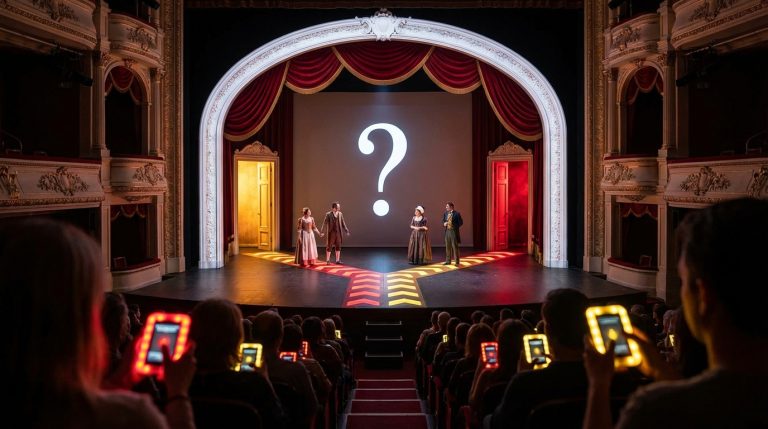
A single bare bulb swings above your head, humming faintly. You smell cold metal and dust. A stranger in a torn suit locks eyes with you, steps close enough that you can see the smear of stage blood on his collar, and whispers, “You should not have come here alone.” The door slams behind you. No velvet curtain. No safe distance. You are in the story now.
Immersive theater is what happens when theater stops asking you to watch from the dark and starts insisting that you exist inside the light. It trades rows of seats for corridors, scripts for secrets, and polite applause for racing pulses. The rise of immersive theater is not a trend; it is a correction. For years, audiences have been treated as observers. Immersive work breaks the fourth wall, burns it, and uses the ashes to draw a circle around you: present, implicated, necessary.
Immersive theater rises wherever audiences are tired of being furniture and want to be participants.
Why immersive theater is surging now
The fourth wall used to be a pact. Performers pretend the audience is not there. The audience pretends to accept that. Both sides keep their distance. Safe. Predictable. Quiet.
The recent surge of immersive theater is, at its core, a rebellion against that pact.
- Audiences are hungry for experiences that feel personal, not generic.
- Physical spaces are being reclaimed as story environments, not just venues.
- Technology has trained us to expect interaction, so passive watching feels thin.
The result: work that feels closer to installation art, escape rooms, and dream logic than to standard proscenium plays. You walk, touch, read, choose. You might be watched as closely as you are watching.
Once you put an audience on their feet, you cannot pretend they are invisible anymore.
From proscenium to proximity: the broken wall
Imagine the traditional theater as an aquarium. The actors are inside, swimming in character, framed by the stage. The audience sits outside the glass, looking in. Light, sound, narrative, all carefully pointed one way.
Immersive theater drains the tank.
Now the performers and the audience share the same air, the same floor, the same temperature. That invisible glass plane, the fourth wall, dissolves. You might stand three inches from an actor as they deliver a confession meant only for you. You might be invited to hold a prop that carries the secret weight of the whole narrative.
The shift is not just spatial. It is ethical. Once the wall breaks, the audience stops being an abstract crowd and becomes a room of individuals, each with a body and boundaries and expectations. Good immersive work treats that as material.
Breaking the fourth wall is less about performers acknowledging you, and more about admitting that you can change what happens.
What “immersive” actually means in practice
Immersive theater is often confused with things that are simply “all around you.” Big projection screens, 360-degree sound, or a stage in the middle of the room can still feel distant if you remain a static watcher.
Immersion, in this context, comes from three key shifts:
| Aspect | Traditional theater | Immersive theater |
|---|---|---|
| Audience position | Seated, fixed viewpoint | Standing or roaming, shifting viewpoints |
| Story relationship | Observer of events | Witness, participant, sometimes character |
| Space usage | Stage-focused, frontal | 360-degree, layered, explorable |
You are not just surrounded. You are implicated. If a character collapses at your feet, you are close enough to see their breath shake. Some productions ask you to respond. Others rely on your silence, but that silence has a different weight when it exists at arm’s length.
Why audiences want to step into the story
Stand in any foyer after a strong immersive piece and you hear the difference. People do not just say “The acting was strong.” They say “I ended up alone in a room with her and she told me something I am still thinking about.” It becomes confession, not just critique.
So why is immersive work rising? Because it answers specific cravings that passive entertainment cannot satisfy.
Craving 1: Presence in a distracted world
Screens are designed to splinter attention. Theatre, at its best, does the opposite: it insists on a single shared moment. Immersive theater intensifies that insistence.
When you are in a dark, unfamiliar hallway, guided only by a flickering practical sconce and a performer you barely trust, your phone is suddenly irrelevant. Your body hums. You are there. If you tune out, you might miss the door that only opens once.
This is presence achieved not by spectacle alone but by proximity and uncertainty. You are aware of your own breathing. You are aware of the stranger next to you. That awareness is part of the design.
Craving 2: Agency, even if it is curated
Narrative video games trained a generation to believe that choice is part of story. Even small, guided choices. Immersive theater translates that into physical space.
Your choices in a well-constructed immersive piece might be simple:
– Follow the woman in red or stay with the man in gray.
– Open the drawer or leave it closed.
– Accept the mask offered to you, or refuse.
Often, the macro-plot does not change. What changes is the path you travel and the intimacy of what you witness. That is not shallow. That is the difference between reading a case file and being in the room when the confession happens.
Craving 3: Texture and tactility
Humans are wired for texture. A smooth digital interface can only satisfy so much. Immersive theater feeds a hunger for surfaces, weights, and atmospheres.
You remember the perfume on a character’s scarf. The scuff of old paint on a stair rail. The chill of real night air spilling through an opened loading dock door. These sensations anchor the fiction in the nervous system.
Immersive theater uses set design as a second script, written in texture and light.
How set design shifted from backdrop to world-building
Once you invite audiences into the playing space, your set cannot be a distant picture. It has to hold up at close range. Every nail, every label on a file, every crack in the tile might be examined by someone whose eyes are less than a foot away.
This has driven a quiet revolution in scenography.
Designing for 360-degree scrutiny
Traditional sets often cheat. Flat walls with no ceiling. Furniture only painted where the audience can see. Doors that lead nowhere.
Immersive design has to function like architecture, not illustration. A door is not convincing unless it feels like it could actually open. A corridor is not convincing unless it seems to lead to somewhere beyond the immediate narrative, even if that “somewhere” is carefully controlled.
Every sightline matters. If someone turns around, kneels, or cranes their neck, the spell must hold. The corners of the room carry as much responsibility as the central focal point.
This requires close collaboration between:
| Role | Responsibility in immersive design |
|---|---|
| Scenic designer | World logic, materials, layout |
| Lighting designer | Guiding attention, carving paths with light |
| Sound designer | Spatial cues, emotional undercurrent, orientation |
| Director / creative lead | Choreographing audience flow and narrative beats |
The audience is not moved by mechanical seat wagons. They are moved by curiosity, guided by design choices: a pool of warm light at the end of a hallway, a murmur of conversation behind a cracked door, a sudden silence in a room that had constant ambient noise.
Props as clues, not decorations
In immersive theater, props are rarely just objects. They are information systems.
A ledger on a desk can reveal a character’s guilt. A series of newspaper clippings pinned on a wall can serve as both exposition and treasure hunt. A phone that actually rings and accepts input turns the audience’s hand into a bridge between real and fictional circuitry.
Because your audience can touch things, prop design must consider durability, safety, and legibility at once. Heavy enough to feel real. Light enough to be safe. Clear enough to read in moody light, but not so obvious that it feels like a theme park queue.
Every object that an audience can reach becomes a line of dialogue without words.
Breaking the fourth wall: techniques that changed the game
The fourth wall is not just a line between stage and seats. It is any convention that keeps the audience from being acknowledged as present. Immersive theater breaks that line in distinct ways, each with its own emotional impact.
Direct address in close quarters
Direct address in a proscenium house is a projected monologue: the actor looks out over a sea of faces and speaks to some abstract “you.” In an immersive environment, it can feel like a confession or a confrontation.
Picture a dim study. The door shuts with a quiet but definitive click. You are the only audience member in the room. A character pours a drink, hands it to you, and says: “You look like someone who understands regret.”
In that moment, there is no safe anonymity. Your posture, your eye contact, your silence all become part of the scene. You can feel the performance adjusting to your reactions. That is not illusion. It is craft.
One-on-one encounters
Many immersive productions structure special one-on-one scenes: brief, private moments where a single audience member is taken away from the group.
These encounters break the fourth wall with surgical precision. A performer might:
– Ask you a real question.
– Place an object in your hand and ask you to keep it secret.
– Share a piece of story that no one else receives.
There is risk here. Mishandled, such encounters can feel invasive or forced. But handled with care, they create the deepest memories. When someone says “The show changed me,” often they are thinking of a one-on-one.
Audience tasks and choices
Sometimes the wall breaks not with dialogue, but with responsibility. You are asked to make a choice that feels morally or emotionally loaded.
Will you read the letter that is clearly not meant for you? Will you warn a character that someone is coming? Will you sign your own name in a ledger of questionable acts?
The key is this: your choice must register, even if only symbolically. If the show treats your action as irrelevant, you learn that your presence is decorative. Design for consequence, even small ones: an altered line, a changed route, a new object unlocked for you later.
The role of sound, light, and architecture in immersion
Immersive theater is not just about where people stand. It is about how the entire environment breathes around them.
Sound as invisible architecture
Close your eyes in a strong immersive piece and you should still have a sense of map. Distant music in one direction, murmured voices in another, the creak of a door just behind you. Sound can sketch the perimeter of spaces you never actually see.
Layered sound also shapes emotion. A low, nearly inaudible drone can make a bright room feel uneasy. A sudden drop to silence can feel like a held breath before something important.
Sound designers in immersive contexts treat speakers like hidden actors. They place them in vents, under floorboards, behind radiators. The goal is not to show off sound technology, but to make the space feel inhabited by more life than is visibly present.
Light as a traffic signal and storyteller
Light controls where the eye goes. In an environment without fixed seating, it also controls where the feet go.
Pools of light invite exploration. Stark shadows warn of boundaries. A sudden shift from warm tungsten to sickly fluorescent can flip a scene from nostalgic to clinical without moving a single piece of furniture.
Well-crafted immersive lighting often stays just bright enough for safety and legibility, but dim enough to let the imagination fill in gaps. Small fixtures, practical lamps, and candlelight replace sweeping follow spots. Or, if there is a bold lighting cue, it hits the entire room, swallowing audience and performer alike in the same color and intensity.
Architecture as collaborator
Warehouses, abandoned schools, basements, townhouses, former factories, decommissioned churches: immersive theater has a habit of inhabiting spaces that have stories of their own.
Good design listens to the building. Low ceilings encourage intimacy, so they might house quieter scenes. Grand staircases become natural stages. Long corridors support chase sequences or processions.
You can feel when a design respects the bones of a place rather than fighting them. There is a calm alignment between fictional history and actual structure: the peeling wallpaper is not just scenic distress, but part of what the building remembers.
The building is not a container; it is a character with its own lines, spoken in brick and steel.
Ethics, consent, and care in immersive spaces
Breaking the fourth wall without care is reckless. Once you invite audiences into the story physically and emotionally, you have responsibilities that traditional formats can sometimes evade.
Consent as design, not paperwork
Some immersive pieces deal with dark themes: violence, grief, intimacy, fear. In close quarters, these subjects can feel much stronger than they do on a distant stage.
Consent in this context is layered:
– Clear communication about the nature of the show before entry.
– Visible signals audiences can use to opt out or set boundaries.
– Performer training that treats “no” as a cue, not a challenge.
Designers can bake consent into the spatial language. A room with open doors and bright light reads as optional. A narrow, guarded doorway reads as a commitment. Visual symbols on masks or wristbands can let performers know how far to go with each person.
Accessibility in a maze-like world
Immersive work often loves stairs, narrow passages, and hidden spaces. Accessibility can suffer if these inclinations are not challenged.
Good practice means thinking beyond wheelchair ramps. It includes:
| Need | Design response |
|---|---|
| Mobility | Step-free paths, rest points, alternative routes that do not feel second class |
| Hearing | Visual storytelling, written materials, vibration cues |
| Vision | Guided experiences, tactile markers, careful contrast in lighting |
| Sensory processing | Quiet zones, content warnings, clear exits |
Immersive theater that only works for the fully able-bodied narrows its own audience and repeats old exclusions. The rise of this art form should not come at the cost of who gets to enter the story.
The influence of games, escape rooms, and theme parks
Immersive theater does not exist in isolation. It has grown in parallel with other forms of experiential design, borrowing and refining techniques along the way.
From video games: branching paths and world logic
Open-world and narrative games taught artists that audiences enjoy piecing together story fragments and exploring non-linear environments. Immersive theater maps that learning onto physical rooms.
You might encounter:
– Environmental storytelling: objects arranged to imply past events.
– Optional side scenes that deepen character, not plot.
– Multiple entry points into the same narrative thread.
Unlike games, immersive theater cannot reload a scene or present a menu of choices. There is only one timeline. That constraint forces designers to think very carefully about pacing and redundancy. Key story beats often appear in multiple forms so different audience paths still converge on understanding.
From escape rooms: puzzles as social glue
Puzzles in immersive theater can be risky. If they are too hard or too obvious, they break engagement. But when well designed, they give strangers a reason to cooperate.
A locked drawer that opens when three audience members place their individual objects inside is more than a trick. It is social storytelling: “You needed each other for this to matter.”
The difference between immersive theater and pure escape rooms lies in emphasis. The goal is not only to “win” or exit, but to feel the emotional weight of what has been uncovered.
From theme parks: crowd flow and safety
Theme parks have decades of experience moving large numbers of people through themed environments safely and with relatively consistent timing. Immersive theater borrows many of those lessons: capacity management, emergency lighting, concealed staff routes, show control systems.
The danger is that theater copies the gloss without the rigor. If you are designing immersive experiences, you should study how parks handle evacuation, signage, and backup systems. The more intimate your show, the more any failure will be felt as betrayal, not just inconvenience.
Immersion is fragile. Good design protects it not only with art, but with planning.
Why some immersive theater fails (and what that teaches)
Not every attempt to break the fourth wall succeeds. When immersive theater fails, it usually fails in recognisable patterns.
Surface-level spectacle without depth
A warehouse filled with fog, vintage furniture, and people in masks will photograph well. It might even feel impressive for ten minutes. Then the hollowness surfaces. If there is no coherent story, no emotional engine, the experience becomes a wandering photo opportunity.
Immersive design should resist the trap of Instagram-friendly surfaces without narrative substance. Ask blunt questions during development: What is this space for, emotionally? What changes here?
Confusion mistaken for complexity
Non-linear stories can invite curiosity, but they can also create fog. If audience members exit saying “I have no idea what happened,” and not in a good way, the design has outsourced too much work to them.
Clarity does not require hand-holding. It requires anchors. Repeating motifs. Distinct emotional beats. If a scene is witnessed by different people from different angles, they should still agree on what core event took place.
Audience objectification
The riskiest failure is when audiences feel used rather than invited. If a show pressures people into unwanted touch, humiliates them, or ignores their discomfort, it has broken more than a wall. It has broken trust.
Consent, choice, and the ability to step back must be designed as carefully as any corridor. Without them, the rise of immersive theater will rightly meet resistance.
Where immersive theater might be heading next
We are still early in this form’s evolution. The first wave established that people are willing to stand, walk, and be part of the story. The next wave is asking harder questions about meaning, form, and reach.
Blurring with everyday life
Site-specific immersive work is already creeping into hotels, bars, and public spaces. The line between “performance” and “night out” is softening.
Imagine booking a dinner and discovering, gradually, that some of the “other guests” are actors, and that the conversation around you is threading a quiet narrative about the city you are in. No tickets scanned at a door. No curtain time. Just a story that arises and then dissolves back into regular life.
This approach demands restraint. Not every moment should scream for attention. The power lies in gentle haunting: the sense that your ordinary environment might be carrying extra layers.
Smaller, more intimate pieces
After ambitious, large-scale productions, many creators are turning to smaller rooms, tiny casts, and audiences in the single digits. The focus shifts from elaborate sets to conversation, shared tasks, and personal histories.
In such settings, the fourth wall is not just broken; it never existed. You know each other’s names. You share tea. You might end the night feeling like you have met someone rather than “seen a show.”
Hybrid digital-physical immersion
Technologies like AR and more subtle interactive systems are starting to seep into immersive work. Not to replace the physical, but to extend it.
Possibilities include:
– Location-aware audio that responds to where you stand.
– Personal devices that receive secret messages during the show.
– Environments that change based on collective audience choices tracked in real time.
The risk here is gadgetry overwhelming presence. The question should always be: Does this make the human interaction sharper, or does it distract from the shared air between bodies?
Immersive theater rises on one simple truth: people still want to gather in rooms and feel something real together.
The fourth wall had its purpose. It framed stories, protected actors, and gave audiences a stable vantage point. But it also kept theater at arm’s length, like a painting behind glass. The current rise of immersive work is not about novelty for its own sake. It is about removing that glass, accepting the mess that follows, and trusting that the shared risk of proximity can produce experiences no passive seat will ever match.