The first thing you notice is not the actor. It is the wall behind them. Cracked limestone, cool and heavy, swallowing the stage lights instead of throwing them back. You can almost feel the chill that stone gives off after sunset. Your eyes know it is old. Your body believes it. Your brain, if you let it speak, knows it is just foam and paint.
That is the trick: to make surfaces lie convincingly.
The short answer: if you want realistic stone and wood on a set, you rarely use real stone or solid wood. You build the illusion. For stone, that usually means carved EPS or XPS foam, sculptable plasters, scenic texture products, and careful paint work layered with glazes and dry brushing. For wood, that means plywood or MDF skins, vacuum-formed sheets, vinyl planks, or carved and grained foam, finished with stains, scumbles, and clear coats. The craft lives in the surface: texture first, color second, sheen last. If one of those three feels wrong, the spell breaks the moment the lights come up.
Choosing between “real” and “realistic”
Before talking about materials, you have to pick a side in a quiet war: real substance vs believable illusion.
Real stone and solid timber feel noble, but they behave badly on stage. Stone is heavy, brittle, and unforgiving to rigging. Solid wood moves with humidity, warps, splits, and eats time in carpentry and finishing. Your budget bleeds, your crew swears, and your stage manager loses sleep over load limits.
So most productions cheat. Intelligently.
Good scenic choices are not about purity of material, but about what reads as true from the audience’s point of view, under the actual lighting, at the actual distance.
You ask three things before you choose a build method:
| Question | Why it matters |
|---|---|
| How close will the audience get? | Film close-ups demand real grain and pore structure; distant theatre views do not. |
| How much will actors touch or abuse it? | Fight scenes, climbing, and leaning require impact resistance and safe edges. |
| How long must it last? | Touring sets, long runs, and rentals need different materials than a two-day shoot. |
Once those three are honest, you can choose the right imitation: foam that carves like butter but chips if kicked, or fibreglass that shrugs off boots but eats budget; thin veneers that glow like real wood, or printed vinyl that reads fine from ten meters away.
Materials that mimic stone
You do not build stone. You model how stone fails: chips, cracks, lamination lines, soft erosion. That is where the realism hides.
1. Foam as stone: EPS, XPS and high-density foams
Expanded polystyrene (EPS) and extruded polystyrene (XPS) are the workhorses for fake stone.
Foam gives you thickness without weight. You can have a one-meter-thick castle wall that two people can carry. You can sculpt dramatic overhangs that would terrify a structural engineer if they were real.
On stage, gravity is optional, but the texture of gravity is not. Foam lets you “cheat” mass while keeping the look of weight.
Key foam types for stone:
- EPS (Expanded polystyrene): Those white beads fused together. Cheap, light, easy to hot-wire into big blocks. The bead texture can show if you sand too aggressively, so it needs a coating.
- XPS (Extruded polystyrene): Usually pink or blue in the hardware store. Finer cells, smoother surface, carves cleaner detail. A favorite for carved brick or rock faces.
- High-density urethane foam: More expensive, takes sharp detail and resists crushing better. Often used for hero elements near camera.
Common carving and shaping methods:
| Tool | Use | Stone effect |
|---|---|---|
| Hot wire / hot knife | Rough cutting and profiling | Breaking rock faces, block shapes, strata |
| Surform / rasp | Softening edges, refining | Weathered corners, eroded steps |
| Wire brush / stiff brush | Texturing | Chiseled tool marks, sedimentary grain |
| Heat gun (carefully) | Controlled melting | Rounded, worn surfaces, softened chips |
If you are tempted to leave foam exposed with just paint, do not. Under bright light, naked foam reads like what it is: plastic beads or tight bubbles. Real stone scatters and drinks light; foam reflects in a plastic, uniform way. You need a coating layer.
2. Coatings and hard shells
The coat is what sells the lie. It adds tooth, weight to the eye, and durability to the foam.
Some common scenic coatings for stone:
- Acrylic texture products: Premixed scenic compounds (like Rosco Foamcoat or similar) create a sanded plaster feel. Brush, roll, or trowel them on, then knock back with a wet brush or sponge.
- Joint compound and PVA mixes: Cheap and workable, good for indoor theatre. Mix ready-mix joint compound with white glue and a bit of latex paint for crack-resistant plaster.
- Sand and paint slurry: Exterior latex acrylic mixed with masonry sand or play sand. Durable, slightly gritty, ideal for big blocks that need to survive some impact.
- Two-part polyurea and epoxy shells: For film or outdoor, where abuse and weather are real concerns. Sprayed-on shells that create a near-indestructible skin over foam.
Thickness matters. Too thin and the foam telegraphs through. Too thick and everything becomes blobby and loses the sharpness of cut stone.
The best faux stone surfaces almost never have a single texture recipe. They are layered: a harder coat for edges, a softer skim for faces, and subtle scratches laid in just before curing.
Edges are where the eye tests you. Real stone breaks irregularly, with small micro-chips that catch shadows. Take a knife or rasp to your coated edges before they fully cure, nicking and bruising them. That small violence sells centuries of weather in a heartbeat.
3. Sculptable plasters and cementitious products
When you want more weight and closer contact with light, clay-like plasters or cementitious coatings step in.
These are useful when:
– The camera will move very close.
– There will be water, flame effects, or outdoor exposure.
– You want the set to feel physically heavy under an actor’s hand.
Common choices:
| Material | Pros | Cons |
|---|---|---|
| Gypsum plaster | Fine detail, carves well, soft light absorption | More fragile, vulnerable to moisture |
| Cement board skim with thin-set | Very durable, outdoor friendly | Heavier, harder to sculpt once cured |
| Lightweight sculpting plasters | Between foam coat and real plaster | Cost, cure time |
You can trowel plaster over carved foam, stamp patterns with rock stamps or custom tools, then refine with carving tools as it sets. The key is timing: carve too early and it smears; too late and it chips in large flakes instead of fine dust.
4. Vacuum-formed stone sheets
For fast builds or modular flats, vacuum-formed thermoplastic sheets with stone textures can save days.
Picture thin plastic, pulled hot over a rock mold, frozen with all the detail. These sheets attach to flats or lightweight frames, then receive texture paint.
They excel in:
– Long walls with repeating stonework.
– Touring sets that must be light.
– Places where actors do not lean or kick aggressively.
Their weakness is repetition. Patterns repeat like wallpaper. You must break that up with:
– Cutting and flipping sections.
– Inserting custom carved foam blocks at eye level.
– Varying paint schemes so the pattern does not shout at the viewer.
Repetition is the enemy of natural surfaces. Stone never tiles itself neatly. Your fake stone should not either.
5. Paint for stone: color, value, and sheen
All the carving in the world fails under flat, careless paint. Stone painting is less about color choice and more about value shifts and translucency.
Principles that rarely fail:
– Start darker than you think you need. Real stone is rarely pure white, even limestone. Use a tinted base coat that feels like the “shadow” color of your stone.
– Work translucent. Glazes, scumbles, and washes let previous layers breathe through, mimicking mineral variation.
– Avoid single-color stones. Real rock carries veining, lichen stains, dirty water trails, and sun bleaching.
A simple process for believable stone:
1. Roll a dark, warm or cool base (depending on stone type).
2. Sponge a mid-tone in broken patches, leaving some dark visible.
3. Dry brush lighter tones on edges and raised areas.
4. Add targeted washes: vertical stains from “water”, moldy greens in damp corners, rust browns under imagined metal fixtures.
5. Control the sheen at the end. Most stone reads as matte to satin, never glossy. Use matte clear coats, then selectively hit “polished” areas with a soft satin gloss if needed.
Under stage light, contrast needs to be pushed. From the audience, detail collapses. Deepen your shadows and highlight edges more than you would in a gallery painting. The camera will flatten things even further, so test under the actual lens whenever possible.
Materials that mimic wood
Wood is more intimate than stone. Actors lean, slide hands along banisters, slam doors. Viewers know wood from childhood: floors, tables, door frames. Their bodies understand it, even if they cannot name the grain species.
To fake wood convincingly, you respect its three main qualities: grain, joint logic, and finish sheen.
1. Substrates: what sits under your “wood”
Choosing the base material for faux wood is as important as the surface treatment.
Common substrates:
- Plywood: A classic scenic material. True wood face veneer, good screw-holding. Looks like wood because it is a thin slice of it. Edges betray the layers, so they need capping or filling.
- MDF (Medium-density fiberboard): Smooth, uniform, takes paint and routing well. No grain, so you create it with paint. Edges are thirsty and need sealing.
- Hardboard / Masonite: Thin, strong skins, ideal for floor overlays and panel faces. Needs sealing and careful support.
- Foam (EPS/XPS/urethane): Useful for carved beams, ornate trim, or soft impact-safe “wood” for close stunts.
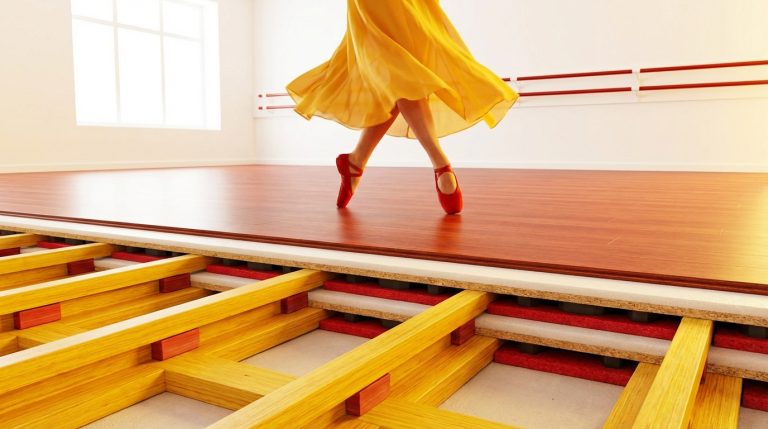
For floors, thin plywood or engineered underlayment panels are practical. For beams that hang overhead, foam or hollow box constructions keep weight manageable.
If a viewer will see the “end grain,” build a logic for it. Real boards and beams reveal their internal story at every cut.
That means: avoid painting end grain onto a hollow box without thinking about how that beam would be milled. If it is not believable structurally, it will quietly irritate anyone who has built a shelf.
2. Veneers, laminates, and vinyl
Sometimes the best fake wood is real wood, reduced to a thin skin.
– Real wood veneer: Thin slices of real species, pressed onto plywood or MDF. Beautiful grain, stains like real wood, but fragile against impact and chipping on edges.
– Plastic laminate: Printed or textured surfaces, very durable, easy to clean. Many reads like commercial office furniture, which might be perfect in some sets and wrong in others.
– Vinyl planks and sheet goods: Modern printed vinyl flooring has convincing grain and color, often with embossed texture. Quick to lay, forgiving, and great for large floors.
On stage, vinyl planks have become a favorite for floors that read as wood. They handle repeated traffic, take scrapes better than stained plywood, and can be replaced in sections if damaged.
For film close-ups, real veneer has more depth and random variation, but it is less forgiving in quick builds and must be handled with care.
3. Carved and shaped fake wood
For beams, ornate paneling, carved details, and heavy timber, foam or softwoods shaped with routers and carving tools are your allies.
– Foam beams: Large architectural beams and rafters that look massive but weigh almost nothing. Carved XPS or urethane, coated with hard coat and painted with wood grain techniques.
– Box beams: Plywood or MDF frames built as hollow “U” shapes. They read as solid timber when seen from below, with less material and weight.
– CNC-routed MDF panels: For period interiors with complex raised panels or filigree. The router does the carving, paint sells the wood.
Choose carefully where you use each. Foam beams in a tavern fight scene are a good safety choice; solid hardwood posts on a touring show are a transport nightmare.
4. Scenic wood graining techniques
Realistic wood often comes from paintbrushes rather than forests. Scenic painters have a full toolkit to turn flat sheet goods into believable timber.
Core concepts:
– Wood grain has direction. It must follow structural logic: along the length of planks, around knots, across end grain.
– Grain has scale. Overly large, cartoon grain reads fake from far away. Micro-grain disappears entirely under theatrical distance.
– Wood is translucent in depth. Layers of stain and glaze help mimic that glow.
A typical scenic graining sequence:
1. Seal the substrate. Use a primer that gives an even, non-porous surface. For MDF, pay extra attention to edges.
2. Lay in a base color. This is your “lightest” wood tone. For oak, a warm straw; for walnut, a milk-chocolate brown.
3. Apply a darker glaze. A thin mix of transparent color dragged with brushes and graining tools to simulate growth rings and cathedrals.
4. Create knots and figure. With smaller brushes, break the regularity: knots, swirls, little deviations.
5. Soften and unify. Feathered brushes, soft rags, or cheesecloth can knock back harsh lines.
6. Seal with clear coat. Satin or semi-gloss for floors and trim; matte for aged, dry wood.
Graining tools, such as rubber “rockers,” can quickly stamp in arches of grain, but they can look mechanical if used alone. Hand brushing, feathering, and selective interruptions bring the pattern back into something that feels natural.
Bad faux wood repeats like a print; good faux wood misbehaves just enough to feel alive.
5. Distressing: aging wood with intention
Freshly painted grain looks like new furniture. Most sets need history.
Distressing is a choreography of tiny damages:
– Physical wear: Sand edges where hands would slide. Soften stair nosings. Add small dents and bruises in kick zones.
– Color wear: Rub through darker top coats at contact points to reveal lighter “older” wood beneath, or the reverse for stained overpaint.
– Stains and contamination: Darkened patches around imagined old spills, water marks under windows, soot near imagined candles or lamps.
Use reference. Look at real handrails, workbenches, bar counters. Notice that wear is rarely uniform. It concentrates where bodies interact with the thing.
Finish sheen is crucial again. A bar counter might have a deep, almost wet gloss where hands and cloth have polished it for years. Barn wood that has sat dry and sun-bleached reads as chalky matte.
Balancing realism, practicality, and budget
Technical choices are artistic choices. Every material carries visual and behavioral consequences, even if they start as financial ones.
1. Audience distance and camera truth
The closer you are, the more you must lean on real texture instead of painted suggestion.
Theatres with deep stages and long throws forgive flatter textures and bolder paint gestures. Intimate black box venues and cinema close-ups expose every shortcut.
If you are building for both live and camera capture, err on the side of more texture and more subtle paint. The camera picks up micro-contrast that the human eye may not register from ten meters away, and modern lenses are merciless.
2. Weight, rigging, and safety
Real stone and real heavy timber belong in architecture, not flying pieces.
Ask blunt questions:
– Will anyone stand under this?
– Will it move in or out quickly?
– Will performers climb on it, lean, or strike it?
Foam and shells for overhead elements; heavier, more solid materials at the floor where the mass looks plausible and is better supported. A stone fireplace might be foam over a timber frame; its hearth could be actual concrete board with scenic finish, so stomping boots feel grounded.
The illusion should never be so committed to “real” that it endangers the very people meant to inhabit it.
3. Durability and maintenance
Materials that look perfect on day one but crumble by show ten are not good design.
– Touring productions need surfaces that can shrug off constant loading, rubbing against cases, and indifferent local crews.
– Long-running shows face cleaning, repainting, and seasonal humidity swings.
For stone, that might tip you from plaster into polyurea shells. For wood, from delicate veneer to tougher vinyl or thick polyurethane top coats.
Also consider: repair language. Can a local scenic touch up a chipped edge without access to your entire mix of paints and compounds? Simpler recipes with clear layering logic help future you.
4. Intention: when to lean into artifice
Not every story needs invisible fakery. Sometimes the best choice is slightly heightened, stylized material.
Think about:
– Fantasy worlds where stone glows faintly, or wood carries exaggerated grain.
– Installations where touch is invited and the fact that something is “not quite real” is part of the dialogue with the visitor.
– Sets that honor theatricality, where painted drops and obvious flats are part of the visual language.
For those, you still rely on the same materials, but you let them show their own character a bit more. Foam can keep some of its softness; grain can be amplified. The trick is consistency. Mixed signals confuse the eye: one hyper-real column against a playfully painted wall makes both feel off.
Building a stone-and-wood environment: a practical example
Imagine a small tavern interior, built for an immersive theatre experience. Audience members will sit at the tables, brush past the walls, lean against the bar. The room must feel honest at arm’s length, yet load in through a standard doorway.
How might you handle the big elements?
1. Stone walls
Structure: standard flats or lightweight stud frames.
Surface:
– Face them with carved XPS foam, attached with compatible adhesive.
– Carve irregular stone blocks: varied sizes, slightly bowed faces, undercut mortar joints.
– Coat with an acrylic texture product mixed with fine sand, focusing on extra protection at corners and door edges.
Painting:
– Deep cool grey-brown base.
– Mottled mid-tones: mossy greens low to the ground, warmer browns near imagined candle sconces.
– Lighter dry brush along upper edges of stones to catch the “lamplight.”
Durability:
– Matte clear coat for the expanse.
– Extra hard coat at lower sections where chairs might scrape.
2. Timber beams and bar
Ceiling beams:
– Construct box beams from lightweight plywood, skinned with thin MDF.
– Rout shallow grooves along their length, then hand-carve subtle checks and cracks.
– Grain and stain them in deep, warm browns, with matte finish to keep overhead light from glaring.
Bar counter:
– Plywood core with a high-quality wood veneer, or heavy vinyl plank oriented along the bar length.
– Rich, layered stains, then several coats of satin or semi-gloss clear to suggest years of polish.
– Deliberately soften front edge where bodies lean.
Tables and chairs:
– If budget allows, real wood furniture. If not, MDF tables with convincing wood grain paint, then sealed strongly. The closer to the audience’s hands, the more you should lean on real material, or very high-quality finishes.
This blend respects weight where it belongs (under elbows and feet), and illusion where it is seen but not heavily touched (overhead, distant walls).
Common mistakes with faux stone and wood, and how to avoid them
Some errors repeat across sets, regardless of scale or budget. Avoiding them does more for realism than any expensive product.
1. Flat color on complex texture
Foam stone carved beautifully, then sprayed in a single mid-grey, looks plastic. Complex texture begs for complex color.
Break it up with glazes, multiple passes, and dirty water runs. Never stop at “base coat plus one highlight.”
2. Ignoring scale
Oversized brick joints, or wood grain thicker than a hand, throw viewers off.
Always step back to audience distance and squint. If the grain looks like a comic book from there, it is too large. Use reference photos, and match visual weight, not literal measurement.
3. Inconsistent wear
A heavily distressed door with a pristine, glossy frame rings false. Stone steps that look untouched while the railing beside them is “worn” by countless hands tell conflicting stories.
Trace imaginary paths: where feet go, where hands rest, where water might drip. Age those zones more deeply. Leave hidden corners closer to their original color.
4. Shiny stone and dead wood
High-gloss “stone” reads like plastic or ceramic tile, unless it is meant to be polished marble. Ultra-matte wood floors can feel like cardboard.
Match sheen to material:
– Rough stone: matte.
– Interior painted stone: matte to low satin.
– Old timber: matte with a few polished high-contact edges.
– Bar tops and banisters: satin or semi-gloss.
If you only adjust one thing at the last minute, adjust sheen. It can rescue mediocre color and texture far more than people expect.
5. Forgetting sound and touch
Realism is not just visual. When a door slams and echoes like hollow plastic, or a “stone” step thuds like foam, the illusion cracks.
Build contact points with a bit more mass: wood blocks under key areas, denser substrates where feet land, double skins on doors. Sometimes a small hidden sandbag or extra plywood under a key spot can add a satisfying weight to the sound.
Surfaces that people touch should not feel sticky, chalky, or fragile. Test with bare hands. If you hesitate to lean your own weight against a wall, the audience will sense that reluctance in performers too.
Testing and refining your stone and wood
Good scenic work grows in the gaps between the workshop and the stage.
1. Light tests
Paint that looks subtle and rich in the shop can flatten completely under stage LEDs, or go lurid under saturated gels.
– Bring sample panels to the actual venue or a similar lighting setup.
– Test under different cues: warm, cool, saturated, low intensity.
– Adjust mid-tones and glazes first, not just highlights. Sometimes lowering saturation is more truthful than adding more detail.
2. Camera tests
For film or any recorded work:
– Shoot close-ups and medium shots at the intended focal lengths.
– Watch for moiré or artificial patterns from vinyl or printed textures.
– Observe how much grain and texture survives compression and grading.
You may find you need slightly bolder grain on a background wall, or calmer patterns to avoid visual buzz.
3. Abuse tests
Take an offcut of your faux stone or wood build, and be unkind to it.
– Kick it.
– Drag a chair leg across it.
– Press a key ring into it.
See what breaks, dents, or chips. If the failure is too obvious to patch, adjust your coating or clear coat. It is better to crack a test piece in the shop than a hero element in the first week of performances.
Realism is not a single product. It is the sum of material choice, structural logic, surface treatment, and honest testing under the same pressures that the set will face in performance.
When stone feels cold even in your memory and wood carries the ghost of every hand that will touch it, you have done the quiet, careful work that makes a fabricated world feel lived in.