The stage is bare. Chalky dust hangs in the air, caught in a shaft of side light. One voice steps into the circle and speaks, and suddenly the empty space is not empty. It is a palace. A battlefield. A city waiting for a king who will never return. The audience leans forward, not because of scenery, not because of spectacle, but because they recognize something of themselves in the echo of that voice.
That is the power we have inherited from Greek theater, whether we admit it or not.
The short answer: modern storytelling still stands on Greek foundations. The way we structure plots, reveal character, use chorus-like groups, frame moral questions, and stage conflict comes straight out of the ancient amphitheater. Three-act arcs, flawed heroes, catharsis, dramatic irony, deus ex machina, even the way a Netflix series teases the next episode: all of these trace back to Greek dramatists. Our screens, stages, and immersive worlds are haunted by Greek ghosts in very clear, practical ways.
Greek theater as a blueprint for story structure
Stand in any control booth today and look at a script. You will likely see a shape that would feel familiar to Aeschylus: a beginning that sets the stakes, a middle that twists the knife, an end that releases pressure.
We often pretend this shape fell out of the sky, neat and universal. It did not. It was hammered together, outdoors, in stone amphitheaters facing the sun.
Greek theater did not just tell stories; it engineered emotional architecture, scene by scene, beat by beat.
At its simplest, Greek tragedy leaned on a clear flow: setup, complication, recognition, reversal, outcome. That rhythm still governs many stories today.
- Setup: Establish the world, the rule, the promise.
- Complication: Disturb that rule through a choice.
- Recognition: Let the hero see what they have really done.
- Reversal: Flip their fortune, often suddenly.
- Outcome: Deliver consequence and a final state.
In a modern script meeting we give those stages new labels. “Act I,” “midpoint turn,” “dark night of the soul.” The energy is the same: tension stretched, then snapped.
Consider how this appears across forms:
| Greek stage | Modern echo |
|---|---|
| Prologue and parodos (opening and chorus entry) | Cold open and title sequence |
| Episodes (scenes) split by stasima (choral odes) | Acts divided by musical stings, ad breaks, or transitions |
| Exodos (final scene and chorus exit) | Third act resolution or season finale |
The point is not to worship this model. Some of the most interesting work today breaks it on purpose. Still, most stories you see in cinemas, on streaming platforms, or even in immersive installations carry traces of this layered, staged progression. Even when creators think they are rebelling, they are wrestling with a structure Greek theater made visible.
The tragic hero and the modern protagonist
Walk into a rehearsal studio and listen to how performers speak about their roles. They rarely ask, “Is my character good or bad?” They ask, “What is my flaw? What do I want, and what does it cost?” That way of thinking is straight from the Greeks.
The tragic hero is not a villain. The tragic hero is not a saint. The tragic hero is a collision between strength and limitation. A figure large enough that when they fall, we feel the ground shift.
The Greeks gave us the flawed central figure whose deepest quality becomes their downfall; modern storytelling has not stopped copying that pattern.
This is more than a literary idea. It is a practical design tool.
When you shape a protagonist today, you often reach for:
– A strength that can be overused.
– A blind spot that feels human.
– A choice that reveals character rather than simply moving plot.
All of this mirrors “hamartia,” the tragic flaw. The term is debated among scholars, but in practice, in a rehearsal room, it means this: the thing inside your character that will trip them at the worst possible moment.
Look at contemporary examples:
| Greek hero | Flaw | Modern counterpart | Similar flaw |
|---|---|---|---|
| Oedipus | Relentless pursuit of truth and control | A detective in a noir or crime series | Obsession with the case, at the cost of loved ones |
| Antigone | Unbending loyalty to principle | A whistleblower or activist character | Refusal to compromise, even when others pay the price |
| Agamemnon | Hubris and strategic pride | A tech founder or political leader | Belief that they are above the rules they set |
Modern heroes do not need to be royal to be tragic. They just need to stand at a crossroads where their own nature steers them wrong. That is Greek to the core.
For set and experience designers, this matters. The spaces we build should press on the character’s flaw. A narrow hallway for someone who fears confinement. An overlit office for someone hiding a secret. Greek theater started this by tying character to action and action to fate. We carry it forward by tying character to environment.
Catharsis and why audiences keep coming back
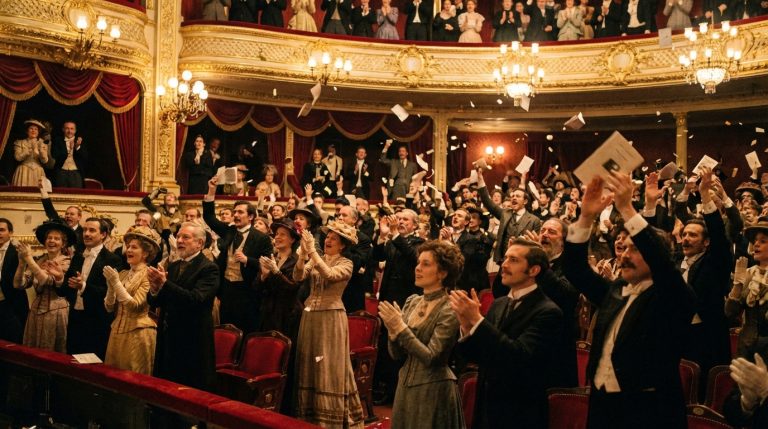
Imagine the end of a strong performance. The audience is very quiet. Then the breath comes back into the room all at once. A cough. A shoe squeak. Soft chatter. That soft collapse of tension is not an accident. It is engineered.
Aristotle used the word “catharsis” for the emotional release produced by tragedy. The English debate over that word is constant, but inside a theater, the sensation is familiar: a shared exhale after shared intensity.
Modern storytelling still lives or dies on its ability to pull an audience into tension and then let that tension go without feeling cheap.
Look at how this appears in various formats:
| Form | Greek-rooted build and release |
|---|---|
| Feature film | Emotional arc rises toward a central crisis, then clears with a decisive act or revelation. |
| Television season | Episodes stack smaller tensions that crest in a season finale echoing a tragic climax. |
| Immersive show | Audience passes through escalating rooms or encounters that culminate in a shared final scene. |
| Game narrative | Quests and choices increase stakes until a boss, trial, or irreversible choice resolves the arc. |
The Greeks realized something many modern creators forget: catharsis is not about happy endings. It is about clean endings. The story has asked a question. By the time lights go out, that question should be answered, even if the answer hurts.
This is where a lot of contemporary work feels weak. Endless sequels, stretched universes, and forced twists can muddle that sense of completion. Greek tragedies, even the bleak ones, usually land in a clear new state.
When you design a narrative environment, ask: what is the emotional residue I want people to carry into the lobby, into the street, into the train ride home? That residue is your modern form of catharsis.
The chorus and its modern descendants
One of the strangest Greek inventions for a modern eye is the chorus: a collective body that moves, sings, comments, reacts. Many first-time readers are impatient with it. They want to “skip to the story.” That is a mistake.
The chorus is the town. The conscience. The gossip. The memory.
The chorus is where public emotion gathers and becomes visible; modern storytelling has turned that idea into many new shapes.
You can see the chorus’s legacy almost everywhere:
| Greek chorus function | Modern version |
|---|---|
| Comment on the action | Voice-over narration, talking-head interviews in documentaries |
| Reflect social norms | Office coworkers, neighbors, schoolmates reacting to the lead |
| Embody fear, outrage, grief | Online comment threads, news montages, crowd scenes |
| Provide rhythm and breath between scenes | Musical interludes, visual montages, comedic beats in drama |
Not all modern work respects what the chorus can do. Groups are often treated as background, as “extras.” Greek theater gives us a sharper possibility: the group as an active emotional organ of the story.
On stage, a chorus can reshape space. A line of bodies can narrow the playing area. A circle can trap a character. This physical vocabulary feeds directly into modern ensemble staging, flash mobs, movement-based pieces, and immersive theater where performers ebb and flow around the audience.
Imagine an immersive environment where guests pass through rooms of “chorus” characters: gossiping servers in a banquet, commuters on a platform, devotees in a temple. Each group repeats, distorts, and recycles fragments of the central story, like a living echo chamber. That is Greek in spirit, updated in form.
Dramatic irony and the art of letting the audience know more
Few Greek devices feel as sharp, even now, as dramatic irony: the gap between what the audience knows and what the character believes. The spectators know the prophecy; Oedipus does not. They know the king is guilty; the king does not. That gap is where dread lives.
Dramatic irony turns spectators into accomplices, trapped in knowledge they cannot share with the people on stage.
Modern storytelling relies on this constantly:
– Horror films show the lurking threat before the character walks into the room.
– Thrillers reveal a betrayal to the viewer while the protagonist stays in the dark.
– Comedies let us see the misunderstanding that leads to farce.
Greek dramatists had a specific context. Their audiences often knew the myths already. Surprise did not come from “what happens” but from “how we reach the known ending.” That is still a powerful approach, especially in adaptations.
For designers and directors, dramatic irony is also spatial. A seated audience looking down on an open stage will notice objects and relationships that characters pretend not to see. In immersive work, where guests move among performers, this becomes very pointed: a guest can stand next to a conspirator and then watch an innocent character enter, unaware.
The key is restraint. Many modern scripts over-explain their ironies. The Greeks placed trust in silence, pause, and the audience’s preexisting knowledge. You can reclaim that by resisting the urge to spell out every secret in dialogue. Let props, placement, and costume carry some of the burden. Let viewers complete the pattern.
Deus ex machina and the temptation of easy endings
The phrase “deus ex machina” has become a warning in writers’ rooms. It comes from a literal stage device: a crane (the “machine”) that lowered an actor playing a god into view, solving the unfixable.
Sometimes it worked. Sometimes it felt like a surrender.
Modern audiences hate feeling that a story has escaped its own logic; Greek theater is both the origin of that problem and a lesson in how visible it can be.
Today, we rarely lower a god on a crane, but we often do the same thing conceptually:
| Ancient method | Modern parallel |
|---|---|
| Literal god appears to untangle plot | Last-minute reveal of a new rule or power that solves everything |
| Oracle’s sudden new message | Convenient text, clue, or call that had no setup |
| Mythic intervention | Coincidental accident that removes the villain |
This device can feel honest if the story has announced its gods from the start. In a mythic setting, intervention is part of the contract. The problem comes when a narrative has trained the audience to expect causal logic, then abandons that discipline for the sake of a clean wrap-up.
Here, Greek theater is not something to copy. It is a caution sign pinned to the fly rail.
If a modern piece truly wants to evoke divine intervention, it should be baked into the world: visible in design, sound, and gesture long before it is used as a key. For instance, a space where voices from hidden speakers respond to audience choices can feel “fated” rather than arbitrary if the pattern of those voices is foreshadowed early.
Bad deus ex machina feels like the world bending around the writer’s wish. Good Greek-inspired intervention feels like a world that has always been larger than its characters realize.
Space, architecture, and the “total theater” idea
Greek theaters were not black boxes. They were carved into hillsides, open to sky and weather. The shape of those amphitheaters still speaks to us: semi-circular seating, central playing area, architectural backdrop.
Greek theater treated the environment as part of the storytelling apparatus, not as a neutral container.
Look at the basic elements:
| Element | Description | Modern echo |
|---|---|---|
| Theatron | Tiered seating cut into the slope, embracing the stage | Raked seating in stadiums, thrust stages, in-the-round configurations |
| Orchestra | Circular performance space for chorus and actors | Central pits, circles of action in immersive shows, arena staging |
| Skene | Stage building used as backdrop and entry point | Modular flats, projection walls, architectural facades in set design |
| Parodoi | Side passageways for entry and exit | Vomitoria in contemporary theaters, side aisles, audience entry routes |
The geometry of seeing and being seen is part of the Greek legacy. Performers faced a crowd that wrapped around them, not a rectangle of darkness. The form demanded broad gestures, graphic imagery, and clear blocking.
Modern immersive and site-specific work is, in many cases, re-discovering this. When performers are surrounded, they must think in 360 degrees. When an audience moves, privacy of action is fragile; the story must work from multiple vantage points.
There is also acoustics. Greek theaters used stone, slope, and shape to project unamplified voices. They created natural reverb, clarity, and focus. Today, microphones and speakers can dull our sensitivity to how space itself can carry or muffle sound. Intelligent design pays attention: a whispering gallery for conspiracies, a deadened chamber for confession, a reverberant hall for announcements. Greek amphitheaters prove that raw geometry can serve narrative without gadgets.
Mask, archetype, and the layering of identity
Picture a Greek mask up close: fixed expression, exaggerated features, hollowed eyes. For some, it feels alien, too rigid. Yet this device feeds directly into how we handle archetype and persona now.
The mask separates the performer from the role and distills the character into clear, repeatable signals.
Modern storytelling uses “masks” in many ways:
| Greek practice | Modern equivalent |
|---|---|
| One performer playing multiple masked roles | Actors in anthology series, or minimal-cast productions with quick costume shifts |
| Mask as amplified face | Graphic makeup, stylized prosthetics, branded superhero suits |
| Mask as signal of type | Stock characters in sitcoms, visual shorthand in animation and comics |
For designers, this is about clarity. A mask flattens nuance but increases legibility. That trade is powerful when an audience is far away or when many stories are running in parallel.
In immersive environments, mask gives something extra: anonymity with presence. A masked audience member becomes both observer and figure within the world. This loops back to Greek tradition, where the line between citizen and performer was thinner than we might assume.
Narratively, archetypes that Greek theater loved still hold:
– The ruler wrestling with justice.
– The outsider speaking against the city.
– The messenger carrying terrible news.
– The trickster testing power.
When these archetypes appear today, they often wear new clothes, but their spine is recognizable. The risk is cliché. The value is immediate comprehension. The art lies in bending the archetype without snapping it, allowing us to recognize the form but be surprised by the detail.
Ritual roots and communal experience
Greek theater was not just entertainment. It was ritual, built into festivals, tied to civic identity and religious observance. Citizens gathered in daylight. They watched stories tied to their myths, their politics, their gods.
We tend to separate our art from ritual, at least publicly. That separation is thinner than it looks.
Every time a crowd gathers, quiets, and accepts a set of rules inside a fictional frame, it steps into a kind of secular ritual.
Consider:
| Greek festival element | Modern parallel |
|---|---|
| Seasonal scheduling | Film festivals, annual award ceremonies, recurring theater seasons |
| Shared myths retold | Franchises, origin stories, reboots, reinterpretations of classics |
| Collective attendance as civic act | Premiere nights, communal watch parties, fan conventions |
The strongest modern storytelling experiences lean into this ritual aspect. They build pre-show journeys, shared responses, post-show conversations. They respect the full arc of attending: travel, arrival, waiting, watching, leaving, remembering.
Greek theater is a reminder that the story does not start with the curtain and does not end with the bow. The story extends into how people gather, how they talk on the way home, how they retell scenes to friends.
For immersive creators, the ritual dimension is especially rich territory: invitations, codes, secret entrances, recurring motifs that carry across multiple visits. Those patterns give the work weight. They say: you were here, you will be changed, you will return.
Ethical questions and moral tension
Greek tragedies rarely focused on small personal preferences. They went straight for ethical fractures: duty versus love, law versus conscience, loyalty versus justice. Their characters stood at fault lines that threatened the entire city.
Modern storytelling, at its strongest, still draws power from such tension.
The influence of Greek theater is clear every time a story asks not “who wins?” but “what kind of person do we become if we choose this path?”
Look at some recurring Greek tensions and their modern forms:
| Greek conflict | Contemporary reflection |
|---|---|
| Obey the state’s law or honor family duty (Antigone) | Follow corporate policy or protect a colleague from harm. |
| Pursue vengeance or accept limits (Orestes) | Seek personal justice or trust imperfect legal systems. |
| Tell hard truth or guard stability (Oedipus) | Expose a scandal or preserve an institution’s fragile order. |
Many modern works shy away from clear moral stakes, choosing mood over conflict. There is nothing wrong with quiet stories, but the Greek heritage reminds us that audiences are willing to face serious questions if guided with care.
For designers, moral tension can be etched into space and interactivity. A branching path, a room visitors must choose to enter or avoid, a character begging for help while another warns against interference: these are structural ways to echo Greek dilemmas without preaching.
The key is honesty. Greek tragedies do not offer easy virtue. Antigone is brave and stubborn in ways that cause real damage. That complexity is a standard we should still hold.
From amphitheater to screen: continuity and fracture
If we look at modern film and television storycraft, the Greek shadow is clear, but there are also sharp differences.
Some continuities:
| Greek trait | Modern continuation |
|---|---|
| Clear structural arcs | Three-act films, pilots with inciting incidents and climaxes |
| Focus on a central figure’s choice | Character-driven dramas, prestige series built around an antihero |
| Use of ritual or festival framing | Holiday episodes, season premieres tied to cultural events |
Key fractures:
| Greek condition | Modern difference |
|---|---|
| Shared daylight audience, single performance space | Fragmented viewership across devices, times, and contexts |
| Known myths with expected endings | Emphasis on surprise, twist, and spoiler avoidance |
| Limited visual effects, reliance on language and presence | High reliance on visual spectacle, editing, and sound design |
The influence of Greek theater survives not because we mimic their costume or language, but because we still rely on many of their core strategies to hold attention and shape emotion. Where we diverge, sometimes we lose something.
For example: an obsession with shock endings can erode the measured recognition and reversal that give tragedy its weight. Infinite serialization can weaken catharsis by refusing to close any door entirely. These are choices, not inevitabilities. Greek theater offers an alternative model: depth instead of endless extension.
Greek threads in immersive and experiential storytelling
Immersive and site-based work might feel very far from a stone amphitheater. Different tech. Different pacing. Yet much of the best immersive storytelling feels closer to Greek practice than proscenium theater does.
Both share:
– A sense of shared event, not just private viewing.
– Awareness of physical environment as a participant.
– Fluid boundaries between performer and observer.
In immersive storytelling, guests do not just watch a tragedy; they walk through its spaces, overhear its chorus, and stand close enough to see the trembling of a hand.
Some Greek-influenced moves in immersive design:
| Greek origin | Immersive adaptation |
|---|---|
| Processional entry of chorus | Guided audience processions through corridors or streets |
| Use of levels and distance in seating | Balconies, mezzanines, and hidden vantage points for guests |
| Repetition of motifs in choral odes | Recurring visual or aural motifs across different rooms |
The presence of fate can be translated into systems. For instance, a show where no matter which room the audience chooses, certain key scenes always intersect with them at fixed points. It feels free, but an invisible skeleton holds everything together. That is an architectural version of Greek inevitability.
Immersive work also has a chance to reclaim the chorus more directly: hiring ensembles whose job is not to deliver plot beats but to create atmosphere, comment, and connect. Too often, immersive experiences become scavenger hunts or puzzle rooms. Greek theater reminds us that shared emotional waves, guided by a “chorus,” are just as powerful a design goal as clever mechanics.
Where Greek influence should be resisted
It is possible to lean on Greek shapes so heavily that work becomes stiff. Not every story needs a tragic arc. Not every character must stand for an ethical abstract. Not every theater needs to echo an amphitheater.
Greek theater offers tools, not commandments, and some of those tools clash with contemporary values and possibilities.
Places where direct imitation can be harmful or dull:
| Greek habit | Modern risk |
|---|---|
| Rigid adherence to fate-driven plots | Characters with no apparent agency, leaving audiences disengaged |
| Limited roles for women and marginalized figures | Unquestioned replication of old power dynamics |
| Chorus as passive commentator | Groups on stage who merely repeat obvious points |
As creators, we need to argue with our ancestors, not bow to them. Greek tragedy gives us a language for conflict and consequence, but we can point that language at new subjects: climate, technology, identity, migration, surveillance.
If a story feels like a museum piece, sealed under glass, it has missed the living pulse that made those old plays matter. The Greek influence is healthiest when it sharpens our sense of structure, chorus, catharsis, and ethical weight, while we discard their blind spots and add voices that were absent on those stone steps.
That is the real inheritance: not marble and myth, but a set of tools for turning human conflict into shared experience across a crowd. The dust in the light. The voice in the circle. The sense that, for a moment, we are all inside the same question.