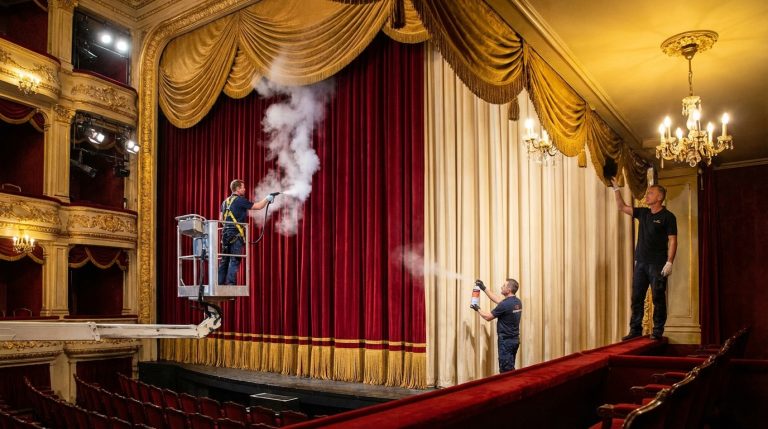
The painted velvet curtain hangs heavy in the dark. Fresnel light cuts across it, catching every brushstroke, every stitch, every hidden staple. The audience sees color and texture. You see something else layered behind it: risk. Dry fabric. Wood flats. Wiring that has been “temporarily” taped two seasons ago. A stage is a beautiful lie built out of very real, very burnable things.
Fireproofing props and backdrops is the quiet art that keeps that lie from turning into a headline.
The short answer: if it can burn, you must either treat it, replace it, or design around it. That means choosing inherently flame-retardant materials where possible, applying tested flame-retardant chemicals where you cannot, documenting every treatment, and rehearsing your team in what happens if something still goes wrong. Fireproofing is not a one-time spray and forget. It is a system of choices, tests, labels, and training that protects performers, crew, and audience while still letting you build the world you want on stage.
Understanding what “fireproof” really means on stage
Nothing on your set is truly fireproof. It is either:
- Noncombustible: will not burn in normal fire conditions (metal, glass, many ceramics).
- Inherently flame retardant (IFR): the fiber itself resists ignition and self-extinguishes (treated polyester, some specialty fabrics).
- Flame retardant (FR) by treatment: has been chemically treated so it resists ignition, slows spread, and self-extinguishes when you remove the flame.
On stage, “fireproof” almost always means “buys us time to get everyone out and the fire put out”.
The goal is not immortality for your props. The goal is time, predictability, and containment. Time for a stage manager to call “house lights, fire curtain, evacuate”. Time for sprinklers. Time for the lighter that a reckless audience member should never have lit to be snuffed out when it brushes a drape.
Your design choices either gift that time, or steal it.
Common materials: which ones keep you up at night
Your set is a collage of risk. Some surfaces are harmless under flame. Others behave like they have been waiting years for a spark.
Here is how they tend to behave.
| Material | Fire behavior | Typical response |
|---|---|---|
| Cotton muslin, canvas, gauze | Ignites fast, burns hot, drips ash | Treat with FR solution or use IFR fabric |
| Velvet, velour | Holds heat, can smolder, then flash | Choose IFR velour where possible |
| Untreated plywood, MDF, softwood | Burns steadily, structural loss as it chars | Use fire-retardant panels or coat surfaces |
| Polystyrene / foam | Melts, drips, toxic smoke | Avoid near heat; use fire-rated foams & coatings |
| Paper, cardboard, book props | Flashes quickly, embers travel | Limit quantity, treat, or fake with safer materials |
| Real greenery, dried florals | Dry = tinder; oils make flare-ups | Replace with FR faux or seal and treat carefully |
| Plastics (mixed) | Unpredictable: melt, drip, heavy smoke | Choose rated plastics; keep away from hot fixtures |
The worst combination is familiar: soft goods overhead, wood structure underneath, and hot fixtures tucked in close. That pretty halo of light around a drop can also be a gentle, constant baking of fabric fibers, making them drier, stiffer, more ready to catch.
Every time you put something flammable near a source of heat, you are making a promise that you will treat it, test it, and check on it.
Codes, standards, and why they exist
Fire regulations are not there to crush creativity. They exist because someone, somewhere, lit a match and an audience did not go home.
The two standards you will hear most in stage work:
NFPA 701 and fabric on stage
NFPA 701 is the most referenced test for flame propagation of textiles used in scenery, curtains, and drapes. In simple language: a sample is exposed to a small flame for a set time. To pass, it must not:
– Ignite easily
– Continue to burn once the flame is removed
– Drip flaming particles
When a vendor tells you their soft goods are “NFPA 701 compliant”, they are saying the fabric, as supplied, passed this test. That does not give you a permanent shield. Dust, paint, aging, and cleaning can change behavior.
Every major curtain or scenic drop in a performance space should either arrive with an NFPA 701 certificate or be tested on site after treatment.
Local fire codes and inspectors
Cities and regions fold standards like NFPA into their own codes. They may:
– Require visible labels on drapes and drops stating flame-retardant status.
– Ask for documentation on what chemicals you used, and when.
– Require regular re-treatment of certain fabrics.
If you treat your own goods, you move from client to fabricator in the eyes of the inspector. That means a higher responsibility. No guessing. No “it should be fine”. Either you have proof, or you do not.
Choosing materials with fire in mind
Good set safety begins long before anyone picks up a spray bottle. It starts when you are in front of a samples folder asking yourself, “What do I build this with?”
Lean on noncombustible where the risk is highest
There are places where flammable materials simply do not belong:
– Set pieces hugging lighting booms or hung right below projectors.
– Surrounds for practical fixtures using real bulbs.
– Elements integrated with pyrotechnics or open flame (candles, torches, stoves).
Metal framing. Steel mesh. Mineral fiber boards. Glass and certain ceramics. These are not glamorous, but they are invisible in the final look. They carry weight, hold shape, and do not feed a fire.
Spend your flammability “budget” where the audience can actually see the material, not inside walls and near lamps.
IFR vs treated fabrics
For backdrops, masking legs, and travelers, IFR fabrics are the calm choice. They cost more, but they keep their properties for life if you treat them with care. No need to reapply chemicals every time they are cleaned.
Use chemically treated FR fabrics when:
– You need a very specific texture or weave that does not exist in IFR.
– You are building a one-off, short-run production where long-term storage is unlikely.
– You are re-working existing stock that you cannot afford to replace.
Every time you pick a non-IFR textile, ask yourself if the visual gain truly justifies the ongoing treatment burden. Often it does not.
How flame-retardant treatments actually work
There is a persistent myth that “fireproofing spray” is like a magic armor. Spray it once, and the fabric becomes immortal. That is not how chemistry works.
Flame-retardant treatments usually function in one or more of these ways:
1. They help form a protective char
Many FR chemicals encourage materials to form a stable char layer when heated. Instead of bursting into open flame, the surface blackens and insulates the underlying material. The fire starves.
This is common in cellulose-based products such as wood and paper. The treatment changes how they thermally decompose, steering them away from flaming combustion.
2. They release nonflammable gases
Some treatments release gases such as water vapor or nitrogen when heated. These gases dilute the oxygen and fuel gases around the flame, slowing or stopping combustion.
Think of it as a small, localized “breath” that smothers the tiny flame before it can grow.
3. They interrupt the flame chemistry
Certain compounds interfere with the chain reactions in a flame. Fire is not just heat; it is a set of repeating chemical steps. Break the cycle, and the flame collapses.
Different materials respond best to different chemistries. That is why one product works beautifully on cotton and badly on synthetic fibers, or vice versa.
Treatments are tailored to material and use. There is no single universal spray that works perfectly on everything.
Applying flame-retardant treatments to props and backdrops
Process matters as much as product. A good chemical, poorly applied, gives you a false sense of security.
Choose the right product for the substrate
Before you buy anything:
1. Identify the material clearly. Is it 100% cotton? A blend? A foam with a skin? Wood species? MDF?
2. Read the product’s technical sheet. It should state:
– Approved substrates
– Application methods
– Coverage rates
– Cure time
– Whether it is interior only, or suitable for humidity
3. Check whether you need a certified product for your authority having jurisdiction. Some inspectors only accept listed brands.
If a product’s documentation is vague or full of marketing language but thin on actual test data, walk away.
Surface preparation
Dust, oil, and previous coatings all interfere with absorption.
For fabrics:
– Pre-wash new cotton and linen to remove sizing.
– Allow them to dry fully before treatment.
– Avoid fabric softeners; they can repel water-based FR solutions.
For wood and paper:
– Sand rough surfaces lightly so the solution can soak in.
– Remove dust with vacuum or tack cloth.
– Deal with existing paint or varnish. Many treatments need raw or at least porous surfaces to work.
Sealed, glossy surfaces are almost impossible to treat correctly on the outside only. You treat those by choosing fire-retardant base materials before you seal them, or by applying an intumescent coating designed for painted assemblies.
Application methods
You have three main approaches.
Spray
Good for large drapes, backdrops, soft props, and textured surfaces.
– Use a low-pressure sprayer with a fan tip.
– Apply in multiple light passes, cross-hatching to avoid gaps.
– Work on clean plastic drop cloths so solution does not get contaminated.
– Keep a log of total volume used vs area covered. Coverage much lower than specified is a warning sign.
Spraying feels easy, which is dangerous. The risk of “pretty wet” that in reality is not enough is high. Measure.
Soak / dip
Best when you must know the entire fabric thickness is treated.
– Fill a clean bin with solution at the recommended concentration.
– Submerge the item completely, agitating to release air bubbles.
– Allow excess to drip off; do not wring aggressively, which can create uneven spots.
– Dry flat or hung with support so weight does not distort seams.
This approach uses more product and takes more time, but for critical goods such as main curtains or scenic drops that sit near heat, it is hard to beat.
Brush / roll
Used mostly on rigid scenic pieces and props.
– Work methodically in sections.
– Maintain a wet edge so there are no dry streaks.
– Watch for absorption. Some areas will drink solution faster and need extra passes.
For 3D props, pay close attention to undersides and back faces. Fire crowds around hidden air pockets very quickly.
If a surface can catch an ember, it must be treated. Back, sides, inside faces. Not just what the audience sees.
Drying and curing
Many treatments require a cure period before they perform as intended.
– Follow stated drying times for your humidity and temperature.
– Provide ventilation, but avoid blasting hot air directly on fresh treatments; it can cause uneven deposition of active ingredients.
– Keep treated items away from dust and unapproved paints while curing.
Do not stack damp treated fabrics. They can mildew, and that microbial growth will also alter fire behavior.
Painting, aging, and how they affect fire behavior
You pour months into scenic art. Glazes, aging, specialty metallics, powdered charcoal. All those choices affect flammability.
Order of operations
If your FR product is water-based and designed to penetrate fibers, you generally:
1. Treat raw fabric or wood first.
2. Allow full cure.
3. Prime and paint with compatible coatings.
4. Apply clear topcoats as needed, checking compatibility with your treatment.
If you paint first, many FR solutions will simply sit on top of the paint, unable to reach the underlying fuel. That turns them into decorative water.
Some manufacturers offer top-coat-compatible fire retardants that sit in the paint layer itself. Those are different products with different test data.
Types of coatings to worry about
– Solvent-heavy metallics and leafing paints can act like fuel layers on top of otherwise safer substrates.
– Oil-based enamels dry very hard but can still support flame, especially if applied thickly.
– Certain scenic varnishes can undo the exposed behavior of a treated surface.
If your design calls for rich metallic gilding on a drop, consider:
– Using metallic foils or fabrics that are IFR, instead of paint.
– Limiting those finishes to smaller, more remote sections.
– Testing the finished, decorated sample in a flame test, not just the base fabric.
The only honest fire test is on the finished, fully painted, aged, and sealed surface, not the clean offcut from the shop floor.
Testing: proving that your treatment worked
You cannot see fire resistance. You must prove it.
Simple field flame test
Many fire marshals accept a basic field test, when done with care:
1. Cut a representative sample: same fabric, same paint, same number of layers.
2. Hold it with tongs at a 45-degree angle in a fireproof container.
3. Apply a small flame (such as from a butane lighter) to the lower edge for 12 seconds.
4. Remove the flame and observe.
You want:
– Minimal ignition.
– Self-extinguishing quickly once the flame is removed.
– No dripping flaming particles.
Record the result. Video helps, as long as you conduct it safely with extinguishing equipment present and away from the main building.
This does not replace a laboratory NFPA 701 test, but it is a practical check that your process is doing something real.
Documentation and labeling
Treat treated items as if you are building an archive for your future self.
– Tag backdrops, drapes, and large soft goods with:
– Date treated
– Product used
– Method (spray, dip)
– Who performed it
– Keep a binder (physical or digital) of product datasheets and receipts.
– Log any washing, dry cleaning, repainting, or re-sealing.
When an inspector asks, you do not want to rely on memory or “We always do it that way.” You want named evidence.
Fireproofing specific categories: props vs backdrops
The phrase “fireproofing props and backdrops” hides a truth: they live in very different risk zones.
Backdrops, drapes, and large soft goods
These are your potential fire highways. They are:
– Large.
– Vertical.
– Often overhead or surrounding performers.
Priorities for them:
– Use IFR fabric whenever humanly possible for main curtains, masking, and large scenic drops.
– Treat all sewn-on elements, appliques, and patching fabrics.
– Control gaps and air paths behind them where fire could race unseen.
– Maintain clearance from fixtures. That 10 cm you “borrow” from a safety distance to make something look tighter can be the difference between a warm glow and a hot spot.
If you must hang a treated, non-IFR drop near hot fixtures, consider adding a secondary noncombustible screen behind it, such as thin metal mesh, to block direct radiant heat to the fabric.
Hand props and furniture
Props are intimate. They touch actors, live in their hands, and end up in unpredictable places on stage.
Areas of concern:
– Props that are supposed to be near open flame, cigarettes, candles, stoves.
– Soft furniture: upholstered chairs, sofas, bedding, draped textiles.
– Paper props such as letters, books, newspapers.
For hand props:
– Swap real paper for FR-treated paper or thin FR fabrics printed to look like paper, wherever that does not damage the story.
– Use fire-retardant foams and batting in upholstered pieces.
– Treat decorative trims, tassels, and throws just as seriously as the main upholstery.
For items exposed directly to heat in the blocking, reconsider materials entirely. A wooden candelabrum can often be remade in metal and painted. A fake torch can use LED technology with clever diffusion rather than actual flame.
If you are designing a prop to “almost” touch real flame, design it as though the flame will contact it fully every single performance.
When pyrotechnics and open flame enter the story
Sometimes the story demands fire on stage. Torches. Fireplaces. Spark showers. That is where fireproofing shifts from background task to primary collaborator.
Work with certified technicians
If your production involves pyrotechnics or real flame, you need:
– A licensed pyro technician familiar with theatre, not just outdoor events.
– A fire safety officer or equivalent who understands both the code and stagecraft.
They will help specify:
– Minimum clearances from soft goods and props.
– Shielding and flame arrestors.
– Firewatch positions during performance.
Your job as designer is not to out-guess them. It is to engage early, show them your materials list, and allow their constraints to shape your choices, not bolt on later as a problem.
Zone your set by risk
Map the stage into zones:
– High-risk: areas with open flame, pyro, or hot metal effects.
– Medium-risk: close to high-wattage fixtures or practical lamps.
– Lower-risk: no direct heat sources, more distant sightlines.
Then, be ruthless:
– In the high-risk zone, remove flammable materials wherever possible. Use metal, mineral, glass.
– In the medium-risk zone, use IFR and FR with strict spacing and monitoring.
– Reserve untreated, delicate, or special finishes for low-risk zones only, if at all.
This zoning approach gives you clarity when production wants to “just move that candle table a little stage left”. The answer is guided by the map, not by convenience.
Maintenance: fire safety is not a “one and done”
Sets age. That charming patina on an old drop is also fiber breakdown. Treatments leach, wash out, and degrade.
Re-treatment cycles
Many FR products specify a service life. For example:
– After one washing or dry cleaning.
– After a set number of years in use.
– After exposure to outdoor conditions.
Build re-treatment into your production calendar. Before a remount or a tour:
– Inspect all major soft goods for discoloration, stiffness, or unusual stiffness that can signal aging.
– Flame test samples from high-risk locations.
– Re-treat entire items where needed. Spot fixes are rarely adequate across a large drop.
Storage conditions
How you store treated pieces matters.
– Keep them dry and away from water leaks, which can both stain and leach.
– Protect from rodents and pests; their damage changes fire behavior.
– Avoid high-heat storage lofts that bake materials for years.
Roll large drops on cores instead of folding whenever possible. Fold creases can crack painted layers and expose untreated fibers.
Training the people who live inside your world
You can design a careful system and ruin it with an untrained hand.
House rules around flame and heat
Create clear, non-negotiable rules such as:
– No real candles unless approved and supervised.
– No e-cigarettes or lighters used as stage business without sign-off.
– No ad-hoc rewiring of practicals backstage.
These rules must cover not only performers, but visiting artists, guest designers, and external groups using the space.
Every production brings its own habits. Your safety rules must outlast any particular show.
Onboarding for designers and prop makers
When someone joins your creative team, orient them to your fire philosophy:
– Provide a simple materials guide: what is allowed, what is discouraged, what is banned.
– Share your approved FR products list.
– Show them where documentation lives.
Encourage them to bring you “tricky” ideas early: that flocked wallpaper, the dry wheat installation, the mountains of antique books. The worst fire safety condition is the one that appears at tech and “just has to go in because we are out of time.”
Emergency behavior rehearsal
We rehearse cues. We rarely rehearse failure.
At least once per production run, walk the cast and crew through:
– What the alarm will sound like.
– Who calls the show and triggers the fire curtain, if you have one.
– Where extinguishers are, and who is trained to use them.
– Evacuation paths from backstage, not just from the front of house.
The more calmly people can respond, the more your carefully fireproofed materials have a chance to do their work.
Designing for safety without sacrificing beauty
It is easy to slip into two unhelpful extremes: panic-driven minimalism that strips the stage of warmth, or denial-driven abundance that ignores risk.
The art is in finding that middle ground.
Let the constraint shape the style
Sometimes, learning that your lush fabric-heavy concept would be a nightmare near the rig of practical gas lamps is a gift. It nudges you toward:
– Lighter scenic vocabulary, more negative space.
– Architectural solutions in hard, noncombustible materials.
– Creative light and shadow instead of yards of drapery.
Fire safety can push you toward more disciplined visuals. That is not a loss. It is an editor.
Be honest with producers about cost and time
Treating, testing, documenting, and sometimes re-building for safety has a price. When budgets are tight, there is a temptation to skip steps.
Resist that. Tell them plainly:
– What it would cost to do it correctly.
– What risk they invite by cutting corners.
– What design compromises could reduce that cost without hiding risk.
You are not there to simply say “yes”. You are there to protect people while building worlds. Sometimes that means saying: “No, that many untreated paper lanterns over a standing audience is not acceptable.”
Good stage design is not only about how it looks when the lights come up. It is about how it behaves when something goes wrong.
Fireproofing props and backdrops is quiet work. It leaves no applause line. When it succeeds, nobody notices. The curtain falls, the audience goes home, and the set is struck in tired, ordinary light.
That uneventful ending is not an accident. It is built, treated, tested, recorded, and defended by you.