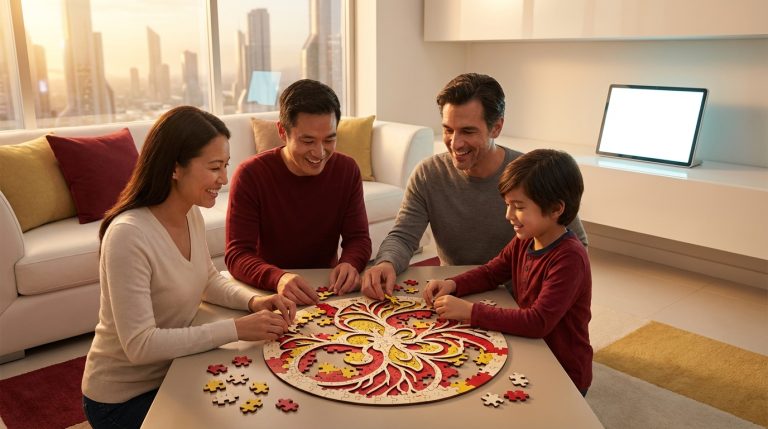
The lock clicks, but nothing opens. The timer on the wall bleeds red numbers into the dark. Someone is talking over someone else. Someone has gone quiet. The puzzle pieces are all there, scattered on the table like a half-remembered dream, but the room feels heavier than it did ten minutes ago. This is the moment you can feel it: the group is not just stuck on the puzzle. The group is stuck on itself.
Some escape room teams fail because the puzzle is too hard. Most fail because the people in the room stop working as a team. They split into loud and quiet, leaders and spectators, heroes and ghosts. They repeat the same ideas, miss obvious clues, cling to wrong assumptions, and, under pressure, turn an elegant design into chaos. The lock does not beat them. Their dynamics do.
Escape rooms do not just reveal who solves puzzles. They reveal how a group handles confusion, ego, listening, and pressure in a shared space.
The beauty, and the cruelty, of a well-designed escape room is that it acts like a mirror. Not a polite mirror that flatters, but one with harsh overhead lighting. It shows you who freezes, who grabs control, who hoards information, who translates complexity into something shared. When a group fails, the reason is rarely invisible. It is right there in the way people stand, talk, and choose what to ignore.
Now let us pull apart those behaviors, like resetting a room after a chaotic team has left. We will look at how different roles, habits, and group patterns quietly sabotage the chance to get out in time.
What Actually Breaks Inside a Failing Team
Before thinking about puzzles, keys, or locks, it helps to think in terms of three strands that hold a team together in an escape room:
- How information moves between people
- How decisions are made
- How emotions spread in the room
When a group fails, usually one of those three has snapped. Sometimes all three.
Escape rooms are social design in its rawest form. They compress time, overload the senses, and then wait to see if people choose to connect or fragment. The same clues sit on the same shelves, but two different teams can make them feel like entirely different rooms. The difference is not in the props. It lives in the dynamic.
An escape room is a communication test disguised as a puzzle game.
Let us move through the most common ways teams quietly sabotage themselves, and how set design and game design amplify or expose those patterns.
1. The Illusion of Progress: When Activity Replaces Strategy
Failure often begins with noise. People rush to touch things, flip books, yank drawers, and scatter props across the floor. From a distance, it looks lively. Up close, it is pure static.
A group can spend 30 minutes moving and talking and still not move forward at all. This usually happens when:
– No one is keeping track of what has been tried.
– No one is connecting puzzles into a sequence.
– Everyone is solving, but no one is synthesizing.
In design terms, the room becomes a stage full of solo acts, all performing at once, none listening to the others.
Energy without shared direction feels powerful, but in an escape room it quietly drains the clock.
You see this in the way objects drift. A code found on the wall is taken to a lock, tried, then abandoned. Someone else discovers the same code fifteen minutes later, tries it again, and has no idea it has already failed. The group is not failing the puzzle. The group is failing memory.
A simple whiteboard can save a team like this. A central table. A clear “this has been used” zone. When the environment is designed to make the state of the game visible, it nudges players out of private progress and into shared progress. Where this is missing, any group prone to distraction will slide toward failure.
2. The Loud Voice Problem: Dominance Without Clarity
Every escape room host knows this character: the loud strategist. The person who takes the center of the room without anyone giving it to them. Sometimes they are brilliant. Sometimes they are not. In both cases, the pattern is the same.
They:
– Decide what matters.
– Dismiss ideas quickly.
– Direct people to tasks, often vaguely.
When they are wrong, the room narrows around their mistakes.
A single loud voice can turn an open, exploratory game into a tunnel with one dim exit.
In failing groups, the loud strategist often:
– Rejects information that does not fit their current theory.
– Talks instead of asking.
– Frames disagreement as a challenge to their authority, not as a shared attempt to solve.
From a design perspective, the room starts to “tilt” in response. Half-finished puzzles are abandoned because the dominant voice is not interested in them. Visual cues that should attract attention sit untouched because the de facto leader has already decided they are “probably nothing.”
Good set design can either feed or soften this. Rooms that have:
| Design Choice | Effect on Loud Strategist |
|---|---|
| Highly linear puzzle chains | Reinforces single-leader control; everyone waits for the “main” solver |
| Parallel puzzle paths | Encourages different micro-leads to form around different puzzles |
| Clear feedback on progress (lights, sounds, reveals) | Makes it harder for one person to claim ownership of all progress |
Team failure appears when the loud voice is wrong for too long and no one is able to challenge the pattern. Timers do not create pressure by themselves. Unquestioned authority under a timer does.
3. The Vanishing Players: Spectators Inside the Game
At the opposite end of the spectrum are the players who slowly vanish. They stand near the walls, follow others, hold props without using them, and eventually just watch. Physically present. Mentally outside the game.
This is not always shyness. Often it is design.
In many rooms, there is a cramped focal point: one lock, one mechanism, one piece of paper everyone crowds around. The more attention funnels into a single focal point, the more likely some players are to step back and give space. After ten such moments, they are no longer part of the problem solving.
When a room invites only two hands at a time, every extra person becomes an observer, not a collaborator.
Groups fail when their human “bandwidth” reduces from, say, five active minds to two or three. Puzzles that were designed for a full team now sit on the floor, unexamined, because the quiet players have moved into silent orbit.
Design can gently resist this in several ways:
– Split clues physically across the room, forcing movement and distribution.
– Use multi-person mechanisms that literally require many hands.
– Create puzzles that need information held by different players.
Teams that still fail in these spaces tend to do something very specific: they let some people self-assign to “not a puzzle person.” Once someone has decided they are not useful, they stop noticing, stop touching, stop suggesting. The room loses their eyes and their perspective. The error is subtle, but the cost is large.
4. Hoarding Clues: When Information Gets Stuck
Information in an escape room should behave like light in a mirrored space: bouncing, reflecting, landing where it is needed. That almost never happens by accident.
In many failing groups, you see players clutching objects, codes, or notes as if they are private achievements. The thrill of “I found this” quietly turns into “this is mine.” They wander around with a key they never try in a lock. They keep a folded note in their pocket. They mention something once and, when no one reacts, they assume it has no value.
A clue discovered but not shared might as well still be hidden behind a wall panel.
Common versions of information hoarding:
– Physical hoarding: one player keeps many items in their hands or near their body.
– Verbal hoarding: someone reads text silently and summarizes it poorly or not at all.
– Emotional hoarding: a player feels something “seems important” but, due to fear of being wrong, does not speak up again.
Designers sometimes unintentionally support hoarding by:
– Not providing shared surfaces like central tables.
– Creating small, easy-to-pocket objects.
– Overloading the room visually, so players feel the need to “protect” what they find.
Groups that avoid failure often have one simple habit: they read things out loud. They lay everything where others can see it. They trust the group with raw information instead of pre-filtering it.
Groups that fail often act as if understanding must be complete before sharing. In a timed, collaborative puzzle experience, that instinct is the enemy.
5. Puzzle Blindness: When Assumptions Become Walls
Many escape rooms include puzzles that are not technically hard, but psychologically awkward. The clue is clear if you are willing to step outside your first assumption. Failing teams often lock themselves into an early interpretation and never climb out.
Common mental traps:
– Believing all numbers must go to locks.
– Assuming every visible prop must be used.
– Treating decorative set pieces as purely aesthetic when some hide clues.
– Expecting puzzles to match puzzles they have seen before.
In the heat of the game, a group becomes a single animal with shared bias. One person says “these letters must be initials,” and suddenly everyone only looks for names. A designer might have given three hints pointing another way, but bias filters them out.
The room does not have to be tricky for players to trick themselves.
Good game masters see this pattern from the control room. They watch a team cling to the wrong story and resist giving hints too early, because some rooms are designed to teach flexibility through frustration. Yet there is a line where stubbornness stops being constructive.
In failing teams, two things combine:
– Confidence that is not questioned.
– A culture where saying “what if we are wrong about this” feels like slowing things down instead of saving time.
When a group cannot release its first story about what a clue means, all new information is bent to fit that story. Eventually the puzzle becomes unsolvable, not because it is flawed, but because the group has built a mental cage around it.
6. Emotional Contagion: Panic, Blame, and Silence
Time pressure is not neutral. It colors every interaction. As the timer falls below 20 minutes, the air in the room thickens. Little mistakes start to feel like personal failings. Voices crack. Sarcasm appears.
Most failed teams share at least one of these emotional patterns:
– One person panics loudly and spreads that panic.
– Someone uses blame as relief: “You should have tried that earlier.”
– The group stops celebrating small wins, so progress feels invisible.
From a design perspective, sound and light choices affect this deeply. Harsh countdown alarms, flashing red lights, or abrasive voiceovers tend to spike anxiety. Calm, theatrical audio and gentle cues tend to keep people playful. The same team might perform very differently under each aesthetic.
People rarely solve gracefully while feeling watched and judged, even by their own friends.
Emotional contagion becomes fatal when it silences curiosity. In those last ten minutes, what the room needs most is new thinking. What it gets instead is re-trying old codes, repeating actions, and snapping at each other.
Curiously, some failure feels peaceful. Certain groups accept, early on, that they will probably not get out. Once the pressure lifts, they relax, explore, and sometimes make more progress than before. Finish times do not always reflect how close the group came to understanding the design. Emotional patterns do.
7. Over-specialization: When Roles Turn into Cages
Human beings like roles. “She is the math person.” “He is good with patterns.” “They will handle the locks.” Roles can help in the first ten minutes, but over time they can freeze possibilities.
You see it play out like this:
– The math person stares at numbers that are not really math puzzles.
– The pattern lover tries to create patterns where there are none.
– The “leader” feels required to decide, even when tired and less clear.
The longer a role is held, the harder it becomes for that person to step away from it, even when the puzzle does not fit them anymore.
In failing groups, people apologize for touching puzzles “outside” their assigned strengths. Someone reaches for a logic puzzle, laughs nervously, and says “I am not a puzzle person, you take this.” Then stands aside, even though their perspective might be exactly what would help.
From the design side, rooms that mix puzzle types thoughtfully can disrupt rigid roles. A numeric code that is actually about wordplay. A visual puzzle that turns into a mechanical task. When a player fails at something that looked like “their” puzzle, it can either break their confidence or free them from expectation.
Teams that cling to labels tend to repeat the same approaches. Teams that treat roles as fluid costumes rather than fixed identities adapt. Rigid ones fail, not because they lack skills, but because they refuse to move those skills around.
8. Ignoring the Room as a Character
Escape rooms are not just sets that hold puzzles. They are characters with moods, habits, and logic. Many failing groups try to solve puzzles as if they sit in empty space, unrelated to story or environment.
They:
– Ignore narrative clues in letters or decor.
– Treat thematic details as background, not instruction.
– Miss clear hints embedded in artwork, props, or soundscapes.
For example, a “mad inventor” room might reward messy experimentation, trying strange combinations, and poking at odd corners. A “museum archive” room might reward careful observation, filing systems, and gentle handling. When a team does not pay attention to these cues, they often apply the wrong style of thinking.
Good escape rooms tell you how to solve them, not just what to solve.
Designers place these cues carefully:
– The palette suggests where attention should rest.
– The wear and tear on objects suggests what is interactive.
– The tone of written text hints at puzzle style.
Groups that rush in and treat everything as equal lose these subtle guideposts. They end up pushing and pulling on things that are not intended to move and ignoring drawers painted in a slightly different shade that screams “I am special” to any eye that is actually looking.
When a team fails, the post-game walk-through often contains a quiet shock. Players say, “How did we not see that?” They did not miss it because it was hidden. They missed it because they treated the room as a storage unit, not as a speaking partner.
9. Failure of Reset: Repeating Instead of Reframing
There is a moment in almost every escape room experience where the first plan clearly does not work. The group is stuck. This is the hinge. Successful teams use that moment to reset. Failing teams try the same thing harder.
They:
– Enter the same code, convinced they mis-typed it.
– Re-interpret the same clue in nearly the same way.
– Reorganize the same props without adding new thinking.
From a bird’s-eye view, nothing new is happening.
The hardest move in a timed game is not to try again, but to stop and rethink the entire shape of the problem.
Many groups resist the reset because it feels like wasted time. Standing in the center of the room, talking about what they know, seems less productive than touching things. Yet that pause is often the only thing that allows a room to “reappear” in a new form.
Designers can encourage good resets by:
– Creating natural breakpoints where a big reveal invites regrouping.
– Using audio or light changes to mark progress phases.
– Giving subtle in-world cues that signal, “You are missing one key idea.”
Groups that do not reset drift into a loop where the same few actions and theories orbit endlessly. The timer hits zero with everyone mid-gesture, trying the same code for the third or fourth time. The room has beaten them, not with complexity, but with their reluctance to step back.
10. The Hint Standoff: Pride vs Collaboration
Hints are one of the clearest windows into team psychology. A hint is not just a clue. It is an admission. Taking a hint means saying, “We did not get there on our own.” How a team relates to that moment often shapes their outcome.
Common destructive patterns:
– Waiting too long to ask for a hint, out of pride.
– Letting one person refuse hints while others stay silent.
– Taking hints and then arguing with them.
From the game master perspective, this feels almost tragic. They see a team one step away from the right insight, resisting a gentle nudge that would let them enjoy the next phase of the experience.
Treating hints as failure misses the point: they are part of the designed conversation between players and the room.
Hints are not cheating. They are a mechanic. When designers and hosts craft them well, they are calibrated to preserve agency: enough to unlock the next layer, not enough to remove all challenge. A team that embraces hints at thoughtful moments often sees more of the room, experiences more of the narrative, and engages more deeply with the design.
Teams that fail frequently treat the hint button like a glass case with an alarm. No one wants to be the one who says, “Press it.” Time drains away while people debate whether they “should need” help.
In that silence, pride outweighs play.
How Designers Shape, Reveal, and Expose These Dynamics
The fascinating thing about all of this is that escape room failure is not just human. It is also architectural. As a designer or set artist, you decide how fragile or resilient a group dynamic will be within your space.
Design Choices that Strain Weak Teams
Some design choices are beautiful but unforgiving. They make for strong narrative, sharp puzzles, and very high failure rates among groups with poor communication.
These include:
- Tightly linear puzzle paths where one unsolved puzzle blocks all others
- Very subtle clueing that assumes players will share and interpret every scrap of information
- Single-focus mechanisms that only one or two people can interact with at a time
In a room like this, any flaw in team dynamics amplifies. A hoarder can stall all progress. A loud strategist can steer everyone into a dead end. Quiet players have fewer chances to step in because the structure never widens enough to invite them.
From an artistic point of view, such rooms can feel pure, almost like a chamber piece in theater. But they are fragile. One strong personality can dominate the experience, for better or worse.
Design Choices that Support Shared Intelligence
Other rooms are built like ensembles. They deliberately widen the path so different players can carry different parts of the story and converge at key moments.
Here, design can help counter the failure patterns we have explored:
– Parallel puzzles reduce the cost of one wrong assumption.
– Multi-step puzzles that require items from different corners encourage information sharing.
– Physical layout encourages movement and cross-pollination of ideas.
Every prop placement is a vote: either for private discovery or for shared discovery.
Set pieces that demand many bodies in motion, not just many eyes, tend to pull quieter players back into the story. For example:
– A lever that must be pulled while another person reads a changing display.
– A floor puzzle that only makes sense when viewed from a raised platform.
– A sound puzzle that requires everyone to stand in different parts of the room and call out what they hear.
In these spaces, team failure is still possible, but the room keeps asking for connection. It tugs people away from isolation.
Reading Teams from the Control Room
Game masters are the hidden audience to team dynamics. They see dozens, sometimes hundreds, of groups move through the same set. Patterns of failure become visible in a way that no single player ever experiences.
Common signs from that vantage point:
| Observed Behavior | Likely Team Dynamic |
|---|---|
| Players crowding one puzzle while others stand idle | Role collapse, over-focus on a “hero” solver |
| Repeatedly trying the same codes or objects | Assumption lock, fear of resetting strategy |
| Visible arguments near the end of time | Blame dynamics, poor emotional regulation |
| One player constantly holding multiple items | Information hoarding, leadership confusion |
Designers can, and often do, adjust rooms based on these observations. A room with too many silent failures might gain extra feedback (lights, sounds) to reward partial progress. A puzzle that repeatedly confuses teams might get an extra in-world nudge so teams do not spiral.
Yet some failure is left in place deliberately. Not out of cruelty, but because escape rooms are not only entertainment. They are laboratories of collaboration. A slightly harsh mirror can be instructive.
When Failure is the Point
There is a quiet truth many players do not realize: a well-designed failure can be as meaningful as a clean escape. From a creative perspective, showing players the gap between how they believe they work together and how they actually behave is powerful.
Escape rooms can be rehearsals for how groups handle stress, confusion, and ego outside the game.
Teams that talk afterward about:
– Who spoke and who did not.
– Which ideas were ignored and later turned out to be right.
– When they held onto being “right” instead of being curious.
are getting more from the room than just adrenaline. They are using failure as material, not as an endpoint.
For designers who care about experience, this is fertile ground. Every misplaced clue, every cramped corner, every theatrical sound cue shapes not just whether a team escapes, but what that failure will feel like in their bodies. Shameful. Hilarious. Tender. Energizing. Quietly accurate.
When some groups fail in escape rooms, the locks are not mocking them. The room is doing what it was designed to do: revealing how fragile or resilient their connections are under bright light and a ticking clock.