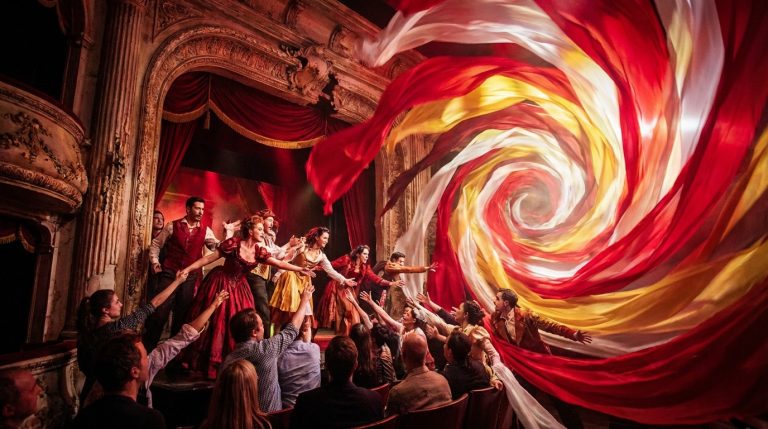
The curtain rises on a cracked phone screen. Blue light. Half-read notifications. A girl in a vintage blazer opens a door, and the sound hits her first: a wall of strings, a human voice that feels like it comes from the center of the earth. Gold leaf, red velvet, a ceiling painted like a sky pretending to be heaven. For a second, she forgets to breathe.
This is not dead culture. It is not homework. It is not just for people who already know when to clap.
It is opera. And it is very much alive.
The short version: opera is not a museum piece for rich strangers in tuxedos. It is live, high-intensity storytelling with bodies, breath, and sound, and it can speak very directly to millennial life: student debt, burnout, climate dread, messy relationships, digital anxiety. The stigma of “high art” hangs around it because of old rituals, ticket prices, and cultural snobbery, not because the art form itself is inaccessible. When directors rethink staging, when designers reimagine space, and when opera houses stop treating the audience like uninvited guests, opera becomes a visceral, physical experience that millennials can own, question, and reshape.
Opera is not done. It is waiting for better lighting, fairer pricing, and a younger voice in the room.
Why opera carries the “high art” allergy
Opera did not ask to be a status symbol. People did that to it.
The art form is simple at its heart: a story told through music and bodies in space. Yet for centuries it sat inside buildings that looked like jewelry boxes for monarchs. Gilded balconies. Heavy curtains. Marble staircases that echo under patent leather shoes.
That shell clung to it. Even when the politics moved on.
The stigma works on three main fronts:
- The building: intimidating, polished, coded with old-money etiquette.
- The audience: mostly older, often white, often dressed in a particular way, signaling that you “belong”.
- The assumptions: that you need prior knowledge, a certain education, or fluency in Italian, German, or French.
For a millennial walking in after a day of gig work, or teaching, or coding, this can feel like entering someone else’s grandfather’s club.
The barrier is not the music. The barrier is the room and the rules wrapped around it.
The so-called “high art” label grew out of class, not content. Opera once functioned as mass entertainment: rowdy, social, sometimes chaotic. People ate, shouted, flirted, bargained, and only occasionally watched the stage. The idea that you sit in reverent silence all night came later, when opera wanted to separate itself from popular theater and prove its “seriousness.”
Millennials inherited that seriousness like a stiff heirloom coat. A size too big. Smells faintly of mothballs.
What opera really is when you strip away the etiquette
If you mute the social codes and look at the raw material, opera is made of three elements:
| Element | What it actually is | Why it matters for millennials |
|---|---|---|
| Voice | Unamplified human sound pushed to its physical limit | In a screen-heavy life, it feels shockingly “offline” and present |
| Story | Compressed emotion, high stakes, clear conflict | Like a prestige series, but you feel it in your chest, not just your eyes |
| Space | Architecture, light, costume, bodies arranged in three dimensions | It is immersive by default. The room is part of the script. |
At its best, opera works like an MRI for feelings. It scans love, greed, fear, jealousy, grief. Then it turns those into sound and movement inside a shared room.
No buffering. No scrolling. No pause button.
Why millennials flinch at “high art”
Millennials grew up caught between two stories.
On one side: the ghost of cultural hierarchy, where “high art” sits at the top like a marble statue, and everything else scrambles beneath it.
On the other side: an algorithmic feed that tells you every art form is content, strip-mined into clips and ranked by clicks.
Opera has been misfiled by both stories. Too “serious” for your For You page, too old-fashioned for a culture that loves mashups and meme logic.
There is also a financial bruise. For many millennials, money and time are compressed. Student loans, unstable work, rising rent. So when an art form has a reputation for high ticket prices and strict ritual, it feels like an extra hoop to jump through.
The problem is not that opera is “too deep.” The problem is that it often acts like a gated community when it should behave like a street festival with exquisite sound design.
There is another layer: representation. Walk into many opera houses and you still see a narrow version of who gets to be on stage and who sits in the best seats. That is not an artistic truth. That is a hiring and outreach choice.
Opera for millennials cannot just be the same old work in modern costumes. It has to question who tells the stories, whose bodies are central, whose language is heard in the room.
Opera as an immersive experience, not a distant object
From a set design and immersive theater perspective, opera is a dream material. You have:
– Live music surrounding you like weather.
– People singing at physical volume levels that make your ribs buzz.
– A huge room that can be reshaped, sliced, or fragmented like a film frame.
When directors still treat the stage like a flat postcard, it feels like a waste.
Think of the opera house not as a box for display, but as a living installation. The lobby, corridors, hidden staircases, backstage corridors: all of these can become parts of a story. The line between audience and performer can blur without destroying the music.
Opera does not need to copy immersive theater to feel immediate. It already has ritual, collectivity, and repetition. What it needs is a shift in how the space listens to the audience.
Breaking the stigma through design and staging
A lot of the “high art” barrier is visual. The room tells you how to behave before a single note is sung.
If the environment feels like a temple to money, many younger people will freeze. Good design can loosen that grip.
Lighting as a signal of welcome
Light is the first language that most visitors understand. Harsh chandeliers over polished marble say: do not touch, do not run, do not spill.
Imagine this instead:
– The lobby lit like a warm installation: pockets of soft light, projections of the score on the walls, subtle gradients that echo the mood of the night’s piece.
– House lights that do not snap to black but slowly fade, giving the audience time to sink into the dark like entering a pool.
– Curtain calls with house lights half up, so clapping feels less like worship and more like conversation.
Light can either declare “you are entering a museum” or “you are entering a shared experiment.”
Millennials read those cues very clearly. Many spend hours in cafes, co-working spaces, small venues, and pop-up galleries that think carefully about the color and intensity of light. If opera wants them present, it should care at least as much.
Costume and set: from tradition to translation
Traditional opera costuming leans on period shapes, elaborate fabrics, and historical reference. That can be beautiful. It can also create distance, like looking at a painting behind glass.
Modern design choices can create active translation instead of nostalgic reproduction:
| Traditional choice | Effect | Alternative |
|---|---|---|
| Fully period costumes | Historical accuracy, visual richness, emotional distance | Hybrid styling using contemporary silhouettes with historical textures |
| Heavy painted flats | Picture-book visuals, low flexibility | Modular structures, projection, and found materials that echo city life |
| Fixed proscenium focus | All attention front-facing, audience as watchers only | Stage elements that extend into side aisles, balconies, or lobby |
Design does not need to “dumb down” opera to reach millennials. It just needs to speak a visual language that belongs to now: neon edges, brutalist textures, streetwear, digital glitch, recycled materials. This does not ruin Verdi or Mozart. It unlocks them.
The set is a translator between centuries. It can either whisper in code or speak in the colors of the present.
Language, surtitles, and the myth of needing to be an expert
Many people still think you need to know Italian or German to follow an opera. That assumption hangs over the form like fog.
Surtitles already exist. Yet they are often treated as a technical necessity, not a creative surface.
Imagine surtitles treated as part of the visual design:
– Text projected not only above the proscenium, but also on side walls, around arches, or subtly near the floor line, so you do not need to crane your neck.
– Typography that changes weight or size with emotional intensity.
– Occasional moments where text fragments float in the room before a big aria, like the character’s thoughts leaking out.
Language can be playful. For a millennial audience, a straightforward translation mixed with sharp, clear phrasing works better than a clumsy attempt at old-fashioned speech.
Opera does not lose depth if the text is plain. Many libretti are direct, almost blunt. “I love you. You betrayed me. I will die.” The music adds complexity. The staging sets the context.
You do not need expertise to feel opera. You need only a body, a seat, and a willingness to stay in the room.
The job of the creative team is to make sure the room does not punish you for walking in unprepared.
Pricing, access, and the architecture of welcome
The stigma of “high art” is tangled with money. Millennials who grew up during recessions and social instability recognize quickly when something is not meant for them.
Opera houses often do offer cheaper seats, rush tickets, and student deals. The problem lies in how those options are communicated and where those seats actually are.
Four design and policy choices make a difference:
| Choice | Old pattern | Better pattern |
|---|---|---|
| Ticket structure | Complicated tiers, hidden discounts | Clear entry-level pricing, simple categories, digital-first sales |
| Seat location | Cheaper tickets far away with poor sightlines | Rotating blocks of strong seats at accessible prices |
| Entrance rituals | Guarded entrances, strict dress assumptions | Casual check-in, mixed dress, relaxed foyer behavior |
| Food & drink | Formal bars, high prices, stiff atmosphere | Informal counters, affordable options, spaces to linger |
If the lobby looks like a luxury boutique, the message is clear. If it looks like a strange, beautiful commons, the message shifts: you belong whether you wear sneakers or silk.
From a design view, small shifts in texture and layout change how expensive a space feels. Less polished marble, more warm wood. Less velvet rope, more flexible seating. Corners where people can sit on steps or lean on a wall without feeling in the way.
Programming that speaks to millennial realities
The subjects of classic operas are often perfectly in tune with millennial life: economic collapse, family pressure, social rules strangling personal freedom, cycles of war and exploitation.
The disconnect comes from framing.
The way you introduce a story shapes how the audience receives it. A short, honest description can bridge the gap:
– “This is an opera about a woman gaslit by her entire community.”
– “This is a story about two people who do not fit the roles their world built for them, and they pay for that.”
– “This piece follows a group of workers trying to stay human in a system that treats them as replaceable.”
These are not marketing slogans. They are plain speech, and they let someone who has never been to an opera locate themselves inside the narrative.
Commissioning new works also matters. Subjects like:
– Climate crisis framed as a slow-burning tragedy set in a flooded city.
– Tech burnout told through a character who hears constant notification sounds as a chorus in their head.
– Migration stories staged in multiple languages, mixing opera techniques with spoken word or electronic music.
There is a risk: if opera only chases trends, it will date quickly and lose its weight. The better path is to take long-term issues that define millennial life and treat them with the same seriousness as a royal love triangle.
To speak to millennials, opera does not need to be younger. It needs to be honest about the present.
Opera outside the opera house
One of the easiest ways to break the “high art” stigma is to remove the marble box entirely.
Opera in warehouses. Under railway arches. In empty swimming pools. On rooftops. In abandoned malls with broken escalators turned into terraces.
These spaces match the places millennials already gather: concerts, markets, underground film screenings. The first visual message is different. No chandeliers. No stacked balconies. Just bodies, light, and sound.
From a set design standpoint, these non-traditional venues are gifts:
– Rough textures that swallow and scatter light.
– Unpredictable acoustics that force creative sound planning.
– Existing architectural “found objects”: loading bays, graffiti, steel beams.
Pop-up opera does not have to compromise quality. It can offer a different scale. Smaller ensembles. Tighter casts. Closer proximity. The trade is intimacy for spectacle.
This approach also opens the door to more experimental formats:
– Walking operas, where the audience follows the performers from room to room.
– Fragmented narratives where scenes repeat in different corners, and you choose your path.
– Short-form operas, 30 to 60 minutes long, paired with conversation or installation work.
For millennials trained on episodes, seasons, and limited series, this banded structure feels natural.
Digital presence without flattening the experience
Opera has a complicated relationship with screens. Filmed performances can reach wide audiences, but something crucial changes when the sound shrinks into laptop speakers.
The danger lies in treating digital as a storage shelf: full recordings dropped online and forgotten.
A more creative route sees digital work as sketchbook and doorway:
– Behind-the-scenes clips that show the making of a set, the fitting of a costume, the warm-up rituals before a show.
– Short, well-mixed excerpts of arias shot in rehearsal spaces, fire escapes, or empty auditoriums.
– Guided tours of the building focusing on hidden corners, mechanical systems, and old markings backstage.
For a millennial viewer, this material builds a relationship before any ticket is bought. The building becomes less mysterious. The performers become human rather than distant icons.
The goal of digital opera content is not to replace the live moment. It is to make the first live moment feel like a reunion instead of an entrance exam.
Care is needed: endless promotional content with forced cheer will not help. Honest, quiet material that respects the intelligence and time of the viewer will.
Audience behavior: giving permission to feel
One of the strangest rituals around opera is behavioral: when to clap, how to sit, what to do with strong emotion.
Many millennials worry about “doing it wrong.”
The house can interrupt this anxiety with simple signals:
– Printed cards or pre-show slides that say, plainly: “You can respond. You can laugh. You can clap when something moves you.”
– Hosts or ushers who speak in a relaxed, clear way, not in coded etiquette.
– Post-show spaces where audience members can stay, talk, and even ask the creative team questions without feeling like intruders.
This might sound minor. It is not. It changes the psychological contract between stage and seat.
During the performance, directorial choices can invite or reject audience energy. Stagings that break the fourth wall, that let performers move through the aisles or acknowledge the crowd, gently remind everyone that we are all in the same air.
From a design view, seating layouts tell people how much freedom they have. Rigid rows anchored to the floor insist on passivity. Mixed configurations, side benches, small standing zones at the back: these open up micro-movements.
Opera as communal ritual in an anxious age
Millennials know communal rituals mostly through concerts, protests, festivals, and sports. These are not refined. They are messy, loud, participatory.
Opera at its core is also a ritual. Lights dim. People assemble. A group of humans stand up and offer sound and story. The audience listens, reacts, breathes.
The “high art” layer is like an extra coat of varnish over that shared act. If you scrape it away, you get something millennial life often lacks: focused, collective attention on one story at a time.
No second screen. No multitasking. Just the shared act of sitting in the dark, facing something bigger than a single feed.
Opera is not about being cultured. It is about agreeing, for a few hours, to feel something together at full volume.
This is exactly what many millennials are hungry for: a chance to exit constant partial attention and surrender to a structured emotional journey.
The challenge is to invite them in without condescension, fear, or snobbery.
What needs to change inside opera culture
It is easy to build an Instagrammable foyer and call it youth outreach. That is not enough.
To break the stigma of “high art,” opera institutions must change from the inside:
Leadership and programming voices
Boards and artistic directors cannot all come from one generation, one class, or one educational path. When the people choosing repertoire, directors, and designers share millennial experiences, the work will naturally shift.
This is not about age quotas. It is about lived reality. People who have navigated precarity, online life, and cultural crosscurrents will choose different stories and collaborators.
Collaborations across art forms
Opera can invite graphic novelists to design sets, electronic musicians to work alongside the pit, street artists to reshape lobbies, podcasters to create narrative prologues.
These are not gimmicks if they come with real creative power, not just branding.
The goal is mutual respect: opera brings its scale and vocal tradition; contemporary artists bring form, language, and visual codes that resonate with younger audiences.
Education as invitation, not gatekeeping
Workshops, open rehearsals, and pre-show talks should avoid jargon and insider tone. They can:
– Explore how a single motif in the orchestra mirrors a character’s mental state.
– Show how a costume sketch becomes fabric, fitting, and movement.
– Talk about money openly: who gets paid what, how budgets work, where compromises land.
When you let people see the scaffolding, the “high art” aura dissolves. All that remains is hard work, craft, and choice.
What millennials can bring to opera
This is not a one-way street where opera reaches down and “invites in” a younger crowd. Millennials can actively reshape the art form.
They bring:
– A natural sense for remix and collage.
– Deep comfort with cross-genre work.
– Experience with online communities organizing around niche passions.
A millennial-led opera collective might stage small works in found spaces, crowdfund productions, share process openly on social media, and reach audiences that never step into main houses.
They might commission libretti written by poets from marginalized communities, question long-standing character tropes, or reframe classic works from minor characters’ views.
This is not vandalism of tradition. It is the continuation of it. Opera has always been edited, rearranged, updated. The idea that the canon must remain frozen is recent, and it serves gatekeeping more than artistry.
The future of opera for millennials will not be built by flattering a younger audience. It will be built by giving them keys to the building and space on the stage.
When that happens, the phrase “high art” may finally feel irrelevant. Not because opera has lowered itself, but because the false ladder that placed it above other forms has been quietly dismantled.
What will be left is something simple and hard to replace: human breath pushed through a body at the edge of its capacity, carrying stories that still hurt, in spaces that finally feel like they belong to everyone who walks in.