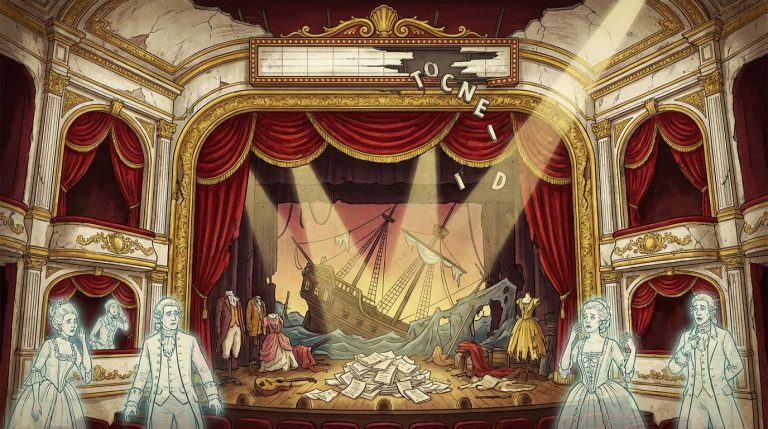
A swish of fabric cuts through the dim rehearsal light. A skirt does not just move; it carves the air into a shape. An actor turns, and you do not really see the person first. You see the outline. The volume. The way the body appears taller, smaller, wider, sharper. Before story, before text, there is silhouette.
Costume history is really the history of these outlines. The TL;DR: silhouettes shifted every few decades because of a tug-of-war between technology, social rules, and fantasy. When corsets tightened, skirts widened, shoulders sharpened, or waists vanished, it was never random. It was a visual script for how a body “should” exist in a given era. If you design for stage, film, or immersive work, you are not just picking a style. You are choosing which century’s rules of the body to invite into your space.
Why Silhouette Matters More Than Detail
Stand at the back of a theater during a run-through. Squint a little. Details blur: embroidery, buttons, trim. What remains is the outline. That outline tells the audience almost everything they need to know, long before the actor speaks.
- A narrow, elongated silhouette reads as controlled, formal, sometimes repressed.
- A wide, structured silhouette feels powerful, ceremonial, or restricted.
- A loose, low-contrast silhouette feels relaxed, modern, or resistant to traditional rules.
If you get the silhouette right, the era feels right. You can cheat every other detail and the illusion will still hold.
Costume history is full of tiny shifts, but for set and costume design, what really shapes the visual world of a production is the great swing of volume and line: where fabric gathers, where it releases, where the body is allowed to exist.
To understand how silhouettes changed through the decades, it helps to think of clothing not as fashion trivia, but as architecture for the human form.
The Late 19th Century: Engineered Curves and Controlled Volume
Picture a figure in gaslight. The waist is pinched, the torso molded, the skirt heavy but arranged, as if someone planned every inch of air under it.
Victorian Hourglass: The Engineered Body
By the late 1800s, the iconic silhouette is the corseted hourglass: rounded bust, narrow waist, substantial skirts. Underneath the surface, hidden structures do almost all the work. Corsets compress the torso. Bustles thrust the skirt outward at the back. Petticoats and horsehair padding sculpt the dress into something closer to a mobile sculpture than simple garment.
From a design perspective, this era is a lesson in external architecture. The body is a frame to be re-shaped, not accepted. The silhouette is about control: the waist must appear small, the posture upright, the gesture refined because the clothing does not permit otherwise.
For stage and immersive work, Victorian silhouettes telegraph:
Restriction, hierarchy, and a world where surfaces are carefully managed and nothing relaxed is shown in public.
Even the menswear of the period reflects this: structured frock coats, narrow shoulders, and long lines that taper from chest to hem. Everything points downward and inward, as if the body is being pulled into a diagram.
Early 1900s: From S-Curve to Release
The new century opens with a shift in how the body is imagined. The silhouette does not change overnight, but the tension starts to move.
The Edwardian S-Curve: A Posture of Soft Control
Around 1900 to 1910, women’s fashion stretches the hourglass into a different kind of distortion: the S-curve. Corsets now push the hips back and the bust forward, creating a sinuous line when viewed from the side. Skirts are still generous, but the emphasis moves upward to the torso and neckline.
In movement, this silhouette can feel oddly birdlike: chest leading, back arched, steps short. The body appears delicate, yet still rigid. It is another form of control, just arranged differently.
For designers, the S-curve offers an expressive tool. A chorus line in S-curve gowns instantly signals pre-war elegance and a fragile social order. The silhouette suggests a world in which beauty is ornamental and heavily supervised.
1910s: Narrowing Lines and the First Cracks
As the decade moves toward World War I, the silhouette begins to narrow. Skirts slim down. Waists relax ever so slightly. The long, column-like shapes of the 1910s skim the body rather than ballooning around it.
Technology and life are changing: more women work, people move faster, cities grow. The clothing has to permit a different kind of movement. The silhouette starts to echo a more active body: straighter, less stacked atop layers of structure.
The 1910s are a visual hinge: you can still see the old world in the lines, but the volume has left the room.
The 1920s: The Dropped Waist and the Rewritten Body
Then, almost suddenly, a revolution in outline. The 1920s flatten the torso and drop the waist toward the hips. The hourglass is not just softened; it is rejected.
The Boyish Column
The iconic 1920s silhouette is long, straight, and low-waisted, with very little emphasis on bust or hips. The dress hangs from the shoulders, moving straight down in a gentle column before breaking at the knee. Hemlines rise, revealing the legs. The body becomes less sculpted and more suggested.
For costume and set design, this is one of the most distinctive shapes you can place on stage. From the back row, the short, swinging skirt and low-floating waist are unmistakable. The silhouette carries associations of jazz, nightlife, and new freedoms, but also of a deliberate move away from older ideals of femininity.
The 1920s silhouette does not flatter curves; it erases them in favor of motion and youth.
On an actor, this changes movement profoundly. The center of visual interest shifts from the torso to the knees and calves. Steps feel lighter, turns quicker. The dress is not a cage; it is a moving fringe of fabric around an active body.
Menswear also loosens: jackets a bit boxier, trousers wider. The overall feeling is less armored, more casual, even when fully suited.
The 1930s: Bias, Gravity, and the Returned Curve
The 1930s bring the curve back, but in a new language. Instead of rigid corsetry, designers cut fabric on the bias, allowing gravity to do the sculpting.
The Liquid Silhouette
A 1930s gown, cut on the bias, hugs the body at the hips and waist, then falls with a soft, controlled flare. The result looks like poured metal in old Hollywood lighting: fluid, close, but still formal. Shoulders become a quiet feature, gently defined and sometimes padded near decade’s end.
If the 1920s dress hangs from the shoulders like a simple tube, the 1930s dress grows out of the body like skin made of silk. The silhouette shows curves while keeping volume minimal. It is sleek, but not sharp.
For immersive and stage design, this is invaluable when you want elegance that feels grounded in the body’s natural form. The clothes do not re-engineer the figure; they trace it.
The 1930s are about cooperation with the body, not warfare against it.
At the same time, menswear sharpens quietly: broader shoulders, narrower waists, but still relaxed tailoring compared to earlier rigid coats. You begin to see the seeds of the strong-shouldered 1940s suit.
The 1940s: Utility, Structure, and the Power of the Shoulder
War reshapes not just politics and industry, but also silhouette. Fabric rationing cuts volume. Practicality narrows skirts. Yet the line above the waist gains intensity.
The Strong-Shouldered Shape
In the 1940s, both men and women share a visual language: structured shoulders, nipped waists, lean hips. The female silhouette becomes almost martial: square or slightly extended shoulders, narrow skirts, functional jackets with defined waistlines. The male suit exaggerates the “V” shape: powerful chest, tight waist, straight trouser.
From a distance, the body looks like an upright wedge: strong across the top, contained below. This is one of the easiest silhouettes to read in group scenes. The eye follows the line from shoulder seam down to waist, then almost drops vertically to the hem.
For immersive environments that reference wartime or postwar years, this silhouette communicates resilience and discipline. Skirts are short enough for movement but far from playful. Clothing is serious, not decorative.
The 1940s silhouette puts responsibility on the shoulders and keeps every inch of excess fabric out of the way.
Even with evening dresses, the influence of the suit remains visible: defined shoulders, controlled volume, and an unmistakable awareness of rationed material.
The 1950s: New Look, New Volume
After years of restraint, the 1950s explode outward again, especially for women. Two competing, but related silhouettes dominate: the full skirt and the narrow pencil line.
The Hourglass Reimagined
The full-skirted 1950s dress features a tiny waist, structured bodice, and skirts that bloom wide over stiff petticoats. The visual effect is almost floral: the torso is the stem, the skirt the open bloom.
At the same time, wiggle dresses and pencil skirts create a different hourglass: close to the body, narrow at the hem, still with a pointed focus on the waist.
From a design angle, both silhouettes share the same message: the waist is the anchor. The body is again sculpted into a clearly gendered shape.
If the 1940s gave women uniforms, the 1950s give them packaging.
Menswear streamlines: slimmer suits, natural shoulders, tapered trousers. The overall look is tidy and controlled, yet less aggressive than the 1940s. The visual story is one of domestic order and prosperity, with clothing that favors neatness over experimentation.
For immersive theater, a room full of 1950s silhouettes has a distinct rhythm: skirts swish in wide arcs, or straight hems pencil the legs together, influencing stride and posture.
The 1960s: Mini, Mod, and the Undoing of the Waist
The 1960s split visually into two clear chapters: early-decade refinement and late-decade revolt.
Early 1960s: Slim and Controlled
Early 60s style stays close to the 50s but smooths it out. Hemlines rise slightly, waists still exist but are less sharply cinched, and the silhouette is clean, almost architectural. Think sheath dresses, tailored suits, and narrow coats. It is an edited, polished version of mid-century propriety.
Mid to Late 1960s: Mods and Minis
Then the waist drops out of focus again. The mod silhouette is straight and short: A-line mini dresses, boxy jackets, narrow trousers. The dress no longer clings at the middle; it stands slightly away from the body, like a simple shape cut from paper.
From a distance, the 1960s mod figure looks like a letter “A”: narrow at the shoulders, wider at the hem, hem hovering high above the knee. Movement shifts to legs and boots. The torso becomes a graphic field for color-blocking, prints, and bold contrast.
For stage or immersive worlds, this is priceless when you want an instantly readable sense of youth, rebellion, and visual punch. You can pack a room with rectangles and triangles of color, and the silhouette alone carries the period.
Menswear embraces slimmer cuts, shorter jackets, and eventually more daring pieces like flared trousers near decade’s end. The overall trend is away from weight and toward clarity.
The 1970s: Flow, Flare, and Earthbound Ease
If earlier decades obsessed over controlling the torso, the 1970s shift that attention downward. The silhouette grows softer, longer, and more relaxed.
The Vertical Line and the Flared Hem
1970s fashion stretches the figure. High-waisted flared trousers make legs appear endlessly long. Maxi dresses graze the floor. Tunics drift over hips. The waist is present but not rigid; the body appears elongated rather than cinched.
One of the most defining shapes is the flare: fitted through the thigh, breaking outward below the knee. On stage, a group of actors in flared trousers creates a moving line of triangles at floor level. The silhouette is all about flow: hems, sleeves, and hair moving in time with music and environment.
The 1970s silhouette feels like gravity has loosened its grip just enough for fabric to sway freely.
Compared to the straight, short volumes of the 1960s mod look, the 70s silhouette is vertical and soft, with less hard edge. Even structured tailoring becomes relaxed, with wider lapels and looser fits.
For immersive projects, this era reads as grounded, tactile, and slightly wild: a period where the body is claimed as natural, not sculpted by strict undergarments.
The 1980s: Exaggeration, Power, and the Battle of Proportions
If the 1970s blurred forms, the 1980s redraws them with a thick marker. Silhouettes become about exaggeration and presence.
The Power Shoulder and Volume Play
The most iconic detail of the 1980s silhouette is the shoulder pad. Jackets, dresses, even knitwear carry built-in structure that broadens the upper body. Hips sometimes gain volume too, through pleated trousers or gathered skirts. The waist may be belted, but the real focus is on a strong, assertive upper line.
From a distance, the figure can appear triangular: wide at the shoulders, narrowing down. In other outfits, especially in streetwear, volume is everywhere: oversized tops with slim legs, or full skirts with cropped jackets.
For performance design, 1980s shapes are highly graphic. Silhouette is not afraid of contradiction: balloon sleeves with pencil skirts, huge jackets with tiny miniskirts, high-waisted jeans with tucked-in tops that emphasize the V shape.
The 1980s silhouette is not subtle; it is a visual claim on space.
Menswear shares this exaggeration: broad lapels, padded shoulders, roomy trousers. Even casual wear inflates with bomber jackets, large jumpers, and sportswear that amplifies bulk.
In a group scene, the effect is loud: a mass of angles, ridges, and strong horizontals at the shoulder line.
The 1990s: Minimal Lines, Relaxed Outlines
After the clash of proportions in the 1980s, the 1990s strip things back. There are two parallel currents: sleek minimalism and loose, casual volume.
Slip, Straight, and Oversized
On one side, the 1990s give us the slip dress: a narrow, body-skimming tube of fabric, often cut on the bias, that falls from delicate straps to mid-calf or ankle. The silhouette is nearly columnar, with barely any visible structure.
On the other side, casual fashion leans into looseness: baggy jeans, oversized T-shirts, unstructured flannels. The body is either traced simply or hidden inside relaxed, almost androgynous volumes.
From the back of the audience, you might read 1990s silhouettes as:
| Style Current | Core Silhouette | Visual Impression |
|---|---|---|
| Minimalist | Narrow, straight, body-skimming | Quiet, restrained, almost blank |
| Casual/Street | Loose tops and/or loose bottoms | Relaxed, unbothered, anti-formal |
The 1990s silhouette often pushes personality away from the outline and into texture, color, or attitude.
Menswear, especially in street and youth culture, favors oversizing. Suits, when worn, become simpler and less padded, mirroring the minimalist current.
For immersive design, this decade helps when you want everyday realism, low ornament, and characters who do not seem to be trying to impress through clothing architecture.
The 2000s: Fragmented Proportions and Low-Rise Experiments
The early 21st century fracturing of style shows up as mixed silhouettes, but one line dominates the memory: the low-rise.
The Low-Slung Divide
Low-rise jeans and trousers change the body’s apparent proportion. The visual “center” drops from the natural waist to the hips. Tops get shorter or tighter, revealing abdomen or cutting across the torso at unusual points. The result can make the legs look shorter, the torso longer, and the body segmented.
Silhouette in this period often feels pieced together: fitted at one point, loose at another, short here, long there. Layering of camisoles, shrugs, and jackets builds complexity at the upper body, while the lower body stays narrow.
From a design standpoint, this can be challenging for stage because the outline is less clean. It is less a single shape and more a combination of stacked rectangles and diagonals.
The 2000s silhouette is about fragmentation: no single clear line rules the body.
Menswear plays with both slim and baggy cuts: low-slung jeans, long T-shirts, relaxed hoodies. The sense of proportion is more about casual disarray than deliberate structure.
The 2010s: High Waists, Athleisure, and the Return of Shape
The 2010s swing the visual center back upward. High-waisted trousers, skirts, and leggings redraw the body’s long vertical line.
The High-Waisted Curve and Athletic Outline
High-waisted bottoms lengthen the leg visually and re-emphasize the waist. Paired with cropped or tucked tops, the silhouette becomes an updated hourglass: focus on waist and hips, but with materials that stretch and move easily.
Athleisure also creates a new kind of outline: close-fitting, body-conscious, but made from soft, flexible fabrics. The look is less about external structure and more about the body itself, plainly revealed.
From far away, the 2010s silhouette for all genders often reads as:
A clean, narrow torso atop defined hips and long legs, with little excess fabric and a strong vertical axis.
Oversized elements do appear, particularly in outerwear and streetwear, but they tend to sit over a lean base: big coat, slim jeans; large sweatshirt, fitted leggings.
For immersive and set design, this decade gives you a modern, streamlined figure that reveals the body’s natural shape while still drawing a graphic line at the waist.
Reading Silhouette as Social Story
Across these decades, silhouettes do more than mark time; they reveal shifting attitudes about the body and its place in society. A quick comparison through that lens:
| Era | Silhouette Focus | Social Story |
|---|---|---|
| Victorian / Edwardian | Engineered torso, heavy skirts | Control, propriety, visible hierarchy |
| 1920s | Dropped waist, straight line | Youth, rejection of old gender rules |
| 1930s | Bias-cut curve, minimal volume | Elegance within constraint, natural form |
| 1940s | Strong shoulders, lean skirts | Duty, discipline, shared hardship |
| 1950s | Exaggerated hourglass | Domestic ideal, postwar order |
| 1960s-70s | Mini A-lines, then flowing flares | Social change, liberation, youth culture |
| 1980s | Power shoulders, big volume shifts | Ambition, consumer power, spectacle |
| 1990s-2010s | From minimal and baggy to body-aware | Individualism, comfort, blurred formality |
For costume designers, this is more than visual reference. When you select a silhouette for a character, you are giving them a philosophy about their own body, whether they know it or not.
Using Historical Silhouettes in Contemporary Design
In immersive theater, theme parks, and experiential installations, silhouettes can be your strongest tool for time travel. But they can also be misused.
If you only copy details without honoring the core silhouette, the era will feel wrong. A dress with a Victorian print and a 1920s shape is confusing. On the other hand, if you understand silhouette deeply, you can bend history on purpose.
Think of each decade’s silhouette as a vocabulary. Once you are fluent, you can write new sentences without losing meaning.
Some practical creative uses:
Compressing Time
You can compress a century of costume history into one space by exaggerating each era’s silhouette. One corner holds towering Victorian bustles. Another, sharply vertical 1930s gowns. Another, neon 1980s power suits. Visitors experience time not as dates, but as changing outlines that frame their own bodies differently in each zone.
Character Contrast
In a single time period, use conflicting silhouettes to show who is resisting or embracing change. A 1920s scene could hold both older characters in soft Edwardian shapes and younger ones in stark flapper columns. Without a single line of dialogue, the room already speaks: some bodies cling to structure; others slip free of it.
Abstracted Silhouettes
You can translate historical silhouettes into abstract forms for contemporary or fantastical worlds. Imagine a sci-fi piece where rank is indicated by silhouette alone: low ranks in 1920s-style slim lines, higher ranks in 1950s-style broad skirts or coats that consume space, commanders in 1980s-inspired power shapes that almost widen the doorframes.
The viewer does not need to recognize the historic origin to feel the hierarchy.
When Silhouette Choices Go Wrong
There is a temptation to mix “favorite” elements from many decades without respect for structure: a corseted top, a flapper skirt, platform 70s boots. If your goal is deliberate anachronism or fantasy, this can work. If you are trying to evoke a specific period, it will fail.
The problem rarely lies in pattern or color. It lies in ignoring where the volume sits and how the body is divided.
Bad period design is usually not about wrong buttons; it is about a wrong proportion of body to fabric.
If you want a believable 1950s reference, the waist must control the look. If you want a credible 1920s echo, the waist must almost disappear. If you want the 1980s, the shoulders have to take command.
When you compromise on silhouette for convenience, you sacrifice clarity.
Silhouette as Your First Design Decision
When you start a new project, resist the urge to think about trims and colors first. Start in shadow.
Imagine your character, or your ensemble, backlit behind a thin curtain. Ask:
What shape do I want to cut out of the light?
Is it a bell? A column? A triangle? A long vertical slash? A top-heavy wedge?
Only once that answer is clear should you choose which decade, or which blend of decades, offers that shape.
Costume history becomes far more useful when you stop seeing it as a museum of looks, and start seeing it as a library of silhouettes. Each decade offers a different way of negotiating with the body: to hide it, exaggerate it, simplify it, or let it stand alone.
On stage, in an installation, or among an audience wandering through your immersive world, those outlines meet and converse. They tell the viewer who bends, who resists, who remembers another age, and who steps into the next one.
Silhouette is not background. It is the first line of dialogue.