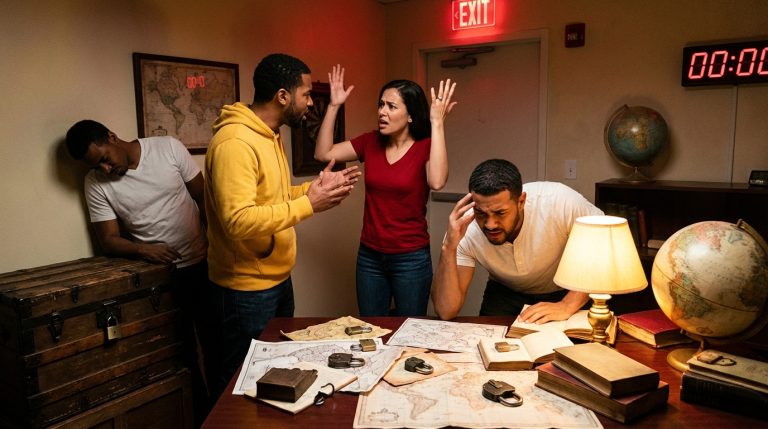
The room is dark enough that colors fall away, but the sound does not. A slow drip echoes from somewhere in the rafters, too regular to be random. A low hum trembles under the floor, almost felt more than heard. In the corner, an old radio crackles, cycling between static and a faint melody that never quite finishes its phrase. Nothing moves. Yet the whole space feels alive, as if the walls are listening and waiting for someone to hear the pattern.
That is the power of a soundscape used as a puzzle: sound is not just background, it is the puzzle’s nervous system.
The short version: if you want audio to cue puzzle solutions, you need three things. A clear pattern that a human ear can recognize. A deliberate relationship between the sound and an action in the room. And a soundscape that feels like part of the world, not like a blunt hint stuffed into a speaker. When you treat sound as material, like light or wood or fabric, you can guide players to codes, timings, and sequences while wrapping them in an atmosphere that feels inevitable, not forced.
Good audio puzzles do not shout the answer. They create a feeling that “something is off,” then reward careful listening with a clear, repeatable pattern.
Sound is not just another clue channel. It is timing, rhythm, pressure, and emotion. Used well, it becomes the quiet director behind every choice in the room.
Why sound works so well for puzzles
Light points; sound surrounds. You can ignore a prop in the corner, but you cannot quite escape a drip or a hum that fills the space. That constant presence is what makes audio so powerful for puzzle design, and also so risky if it is lazy or irritating.
There are a few reasons sound is uniquely suited for puzzles:
- Human ears are wired for rhythm and pattern. We hear “1-2-3 pause 1-2” and our brain starts counting without permission.
- Sound carries emotion. A single low note can make a room tense. A gentle repeating chime can calm people enough that they notice detail.
- Audio can be layered. Background ambience can hide subtle puzzle cues that slowly rise when needed.
- Unlike text or props, sound can change over time without anyone touching it, so it is ideal for sequence, timing, or progress feedback.
Think of your soundscape as another performer on stage: it reacts, it prompts, it holds tension, but it never breaks character.
Before you design clever audio locks or rhythm codes, you need to make one decision: is the sound organically part of the world, or is it a meta hint from “the game”? Both can work, but they create very different experiences.
Diegetic vs non-diegetic sound
In film, “diegetic” sound exists inside the story world: a radio, a creaking floorboard, a character whistling. “Non-diegetic” sound is external: the orchestral score that heroes cannot hear.
In immersive puzzles, that distinction matters.
| Type | Example in a puzzle space | Player feeling |
|---|---|---|
| Diegetic | A broken intercom that beeps in a pattern; a music box that repeats a melody; a ventilation fan with a stuttering rhythm | “The world itself is giving me clues.” |
| Non-diegetic | A mysterious chime that plays when a code is input; a voice-over hint from “the archivist”; music that shifts key when a state changes | “The system is talking to me from outside the story.” |
Neither is wrong. They just have different strengths:
– Diegetic sound is perfect when you want players to feel like investigators inside a believable environment. The risk is that they may dismiss the sound as atmosphere.
– Non-diegetic sound is clear and functional. The risk is that it can break immersion if used bluntly.
Strong experiences mix the two with intention. For example, a room might have a constant diegetic ambience (old pipes, hallway noise) and then layer in non-diegetic stingers for feedback when a step is completed. The key is that both feel stylistically part of the same universe: same tonal palette, same restraint.
If a sound cue feels like it could never exist in your space, you have weakened the illusion, no matter how clever the puzzle is.
Types of audio cues that make elegant puzzles
When you say “using audio to cue puzzle solutions”, it is easy to think just of Morse code through a speaker. That is one tool, but it is narrow. Sound can signal so many different relationships:
1. Rhythmic codes and sequences
This is the most direct: a series of tones or knocks that map to a code.
Examples:
– A sequence of beeps that matches a 4-digit lock: short-short-long-short = 2-2-4-2.
– Lights that flash in rhythm with drum hits, teaching the timing for buttons.
– A machine that sputters regularly, with one “off” cycle hinting at where to press.
What makes these puzzles feel artistic rather than mechanical is the way the pattern is introduced. A raw “beep-beep-beep pause” on exposed speakers is dull. But a cracked toy piano that plays those notes, or a recorded heartbeat that slips out of sync, can carry the same logic with a richer emotional texture.
Pitfalls:
– Patterns that are too long. Human working memory is fragile; if your pattern is more than 7 units without clear groupings, many players will lose it.
– Ambiguous lengths. If a “long” and “short” are barely different, you are not challenging players, you are just testing their hearing or your speaker quality.
You can refine these puzzles by having the pattern repeat on a steady loop and by giving players a way to replay on demand, triggered by a physical action that makes sense (winding a box, pressing a replay button, turning on a device).
2. Melodic or pitch-based clues
Sound carries pitch as well as rhythm. A rising scale, a three-note motif, or a repeating melody can all encode information.
For instance:
– A melody outlines the numbers of a safe code: the first note appears 3 times, the second 1 time, the third 4, and so on.
– A set of chimes in the room match pitches of tones that play from a hidden source. Players must hit them back in the same order.
– A door lock has colored buttons, and a tune maps each note to a color through props (for example, a painting of a piano with colored keys).
Melodic puzzles can feel very graceful, but they carry a hazard: not every player has musical training, and some may struggle to identify pitch differences. To avoid creating a test of musical skill, you can:
– Make pitch gaps large and obvious (low vs very high, for instance).
– Pair pitch with another channel: different lights, different symbols, or different physical objects.
When a puzzle relies on melody, design it for people who cannot sing, not for the one pianist in the group.
3. Environmental sounds that hold information
Sometimes the most subtle audio puzzles come from sounds that feel like natural byproducts of the space: water, machinery, voices bleeding through a wall.
Examples:
– A “dripping pipe” where the drips fall in groups that match the length of book spines on a shelf.
– Air vents that rattle in a specific corner each time a hidden timer hits a beat, pointing toward a secret compartment.
– A divided stereo field where a clue phrase repeats only in the left speaker, hinting left-right choices or code positions.
Here, the trick is to keep the sound plausible. A dripping pipe that “says” Morse code is charming only if the physical pipe looks like a source of controlled leakage, not a leftover from a random decor decision.
Players must have a reason to suspect that this sound is not just background. That reason can be narrative (“the last log said the pipes talk to you”) or structural (the room becomes quiet when this one noise starts).
4. Voices, whispers, and spoken riddles
Voice is the most direct form of audio. It can become heavy-handed if it just reads out answers, but it is strong for layered clues, narrative hints, and pacing.
You might use:
– A recorded confession that describes actions in the space: “I turned the handle three times before the music stopped.”
– Overlapping voices, where only one angle in the room lets you hear the relevant one clearly.
– A character who responds differently when players say certain words aloud.
Voice can encode puzzle solutions temporarily, but it is better when it supports player thinking instead of doing it for them. If a voice can be transcribed easily with pen and paper, players will do that and bypass the atmosphere you crafted.
5. Reactive and responsive audio
Static loops are one thing. Reactive sound that responds to player input feels alive.
For example:
– Each tile on a floor triggers a distinct tone; stepping in the correct order plays a familiar melody that players heard earlier.
– A console grows louder or more dissonant as players get closer to a solution, giving them hot/cold feedback without words.
– Solving one puzzle shifts the key or tempo of the background music, signifying that the space has progressed.
Reactive sound is extremely useful for feedback. Instead of a clunky “success” beep, you can let the soundscape bloom, reduce tension, or move from minor to major. This tells players that they are on the right path while also enriching the emotional arc.
Every major state change in your room should be audible in some way, even if players are looking in the wrong direction.
Designing audio as a sculptor, not as a technician
Good sound puzzle design is not only about what audio plays. It is about silences, repetition, texture, and restraint. Think of it as sculpting time and air.
Signal vs noise: what deserves attention?
Your players walk into a room with a finite attention budget. If every machine is humming, every speaker is playing, every prop creaks, the ear cannot tell what matters.
You must decide what is “signal” and what is “noise”.
Signal is any sound that carries direct or indirect information about how to progress. Noise is everything else that supports mood but has no puzzle content.
A lean, generous sound design has:
– Very clear foreground sounds that carry puzzle content.
– Background sound that is stable and predictable, so anything new stands out.
– A controlled number of overlapping sources, so nothing muddies the rest.
An error many designers make is to stack ambient tracks carelessly: a looped “spooky music” bed plus an unrelated factory noise plus random thunder. The result is a soup. Players cannot tell if the small ticking in the corner matters or is just a side effect of your playlist.
If a sound might be read by a logical person as meaningful, either commit and make it meaningful, or remove it. Half-meanings erode trust.
Rhythm, repetition, and patience
Patterns are comforting. Even when you design a horror space, the brain likes predictability. Repeating loops are how players notice and test hypotheses.
When using audio as a cue:
– Repeat enough that those who missed the first cycle get a second and third.
– Leave clear gaps between patterns. Silence is part of the phrasing.
– Keep loops from desynchronizing. If two patterns overlap at odd intervals, players will mix them mentally.
Sometimes you will be tempted to “spice up” a loop by adding variation to keep it interesting. That can be kind to your staff, who hear it all night, but it can destroy puzzle clarity. If a beeping pattern changes slightly every run, your code is no longer reliable.
If staff fatigue is a concern, aim for variation that does not touch the key logic. For instance, you can have three alternate ambience tracks that all share the same crucial beeping pattern at the same tempo.
Volume, distance, and direction
Placement matters. Sound has a location in space, and players use that information subconsciously.
A few practical points:
– Important cues should feel close. If the audio comes from the ceiling but the related puzzle is on the floor, players will look up, then get frustrated.
– Use stereo width if possible. A left-right spread can guide bodies to move through space in the way you want.
– Volume is not the only way to signal importance. A quiet but distinct noise in an otherwise still moment can draw attention more than a loud one.
Avoid constant high volume. What feels atmospheric during a one-minute test may become exhausting over an hour. Once ears are tired, even well-designed audio puzzles feel like chores.
Mapping sound to actions and codes
To use audio to cue puzzle solutions elegantly, the relationship between sound and required action needs to be intelligible, not obscure. This is where many ambitious designs collapse: clever mapping that looks brilliant on a whiteboard but feels arbitrary in the room.
Direct mappings: tone equals button
The clearest approach is a one-to-one mapping: some distinct sonic unit corresponds to a distinct interactive element.
Examples:
– Four tones. Four colored buttons. Each tone is paired with a color light, so later when the tones play without lights, players remember the mapping.
– Three mechanical clanks. Three levers. The pitch of the clank matches the depth or shape of each lever.
When you use direct mapping:
– Teach the relationship early in a low-stakes context.
– Repeat it in a later puzzle under new conditions, reinforcing a sense of coherence.
This creates a design vocabulary, like the grammar of a language, and players feel proud when they “speak” it fluently.
Indirect mappings: structure equals pattern
More subtle designs connect the abstract structure of a sound to another pattern in the space.
For example:
– A ticking clock slows down into a pattern of 2 short ticks and 1 long tick, which mirrors the arrangement of holes on a panel.
– Bird calls in a recording match images of birds on the wall. The order of calls hints at which portraits to press.
– A storm ambience contains three thunderclaps that align with flickers in three windows, teaching an order without stating it.
These puzzles succeed when the connection feels discoverable and narratively justified. Birds call because birds exist in the story, not because the designer needed a three-tone pattern.
If the only explanation for a sound’s behavior is “so the puzzle works,” many players will feel cheated when they finally see the logic.
Time-based audio puzzles
Sound owns time. It can measure, divide, and reshape it. Timing puzzles can be thrilling, but they must put player expression before system precision.
Common forms:
– Pressing buttons in sync with a beat.
– Waiting a certain number of “ticks” before acting.
– Holding a switch until a tone reaches a peak.
Risks:
– Latency. Cheap speakers, Bluetooth, or networked systems can introduce small but deadly delays.
– Player groups stepping on each other. A timing puzzle that demands a single precise interaction is fragile in a room of excited people.
To make timing puzzles feel fair:
– Allow generous timing windows.
– Give clear auditory feedback on attempts, not just success.
– Avoid chaining more than a handful of timed inputs in a row.
You can also design timing puzzles that use rhythm recognition rather than strict synchronization. For instance, a system that listens for three knocks in a “short-short-long” pattern but does not care about tempo is less frustrating than one that demands perfect tempo.
Layering narrative with audio cues
If your work sits in immersive theater or story-driven escape rooms, you probably care as much about narrative coherence as you do about clever mechanics. Sound is where these two concerns can meet.
Making the clue belong to the character
Instead of playing a sequence of beeps, you can ask: who or what in this world would reasonably make this sound?
– In a laboratory, a malfunctioning security AI could emit structured alert signals that double as codes.
– In a haunted manor, a phantom pianist might repeat a phrase that holds the key.
– In a submarine, sonar pings could reveal positions and distances tied to a map puzzle.
When the sound is clearly owned by an object or character, players accept it as a clue more readily. They are less likely to dismiss it as “just atmosphere” or to resent it as a meta intrusion.
Story as instruction manual
You do not have to put all your instructions in text or speech. Story moments can quietly teach players how to interpret sound later.
For example:
– An early scene shows an NPC tapping a specific rhythm as a sign of trust. In a later, darker scene, players hear that same rhythm through a wall, guiding them toward an ally.
– A journal mentions that “the generator has a strange three-beat cough before it stalls.” Later, that cough pattern mirrors the opening sequence of a door mechanism.
– A museum plaque explains that a composer hid messages in the number of times a motif repeats. That idea primes players to listen for repetition counts in music.
This approach respects the intelligence of your audience. Rather than handing them the key on a silver platter, you plant seeds that bloom when the right sound appears.
Emotional pacing through sound
Sound is not only about encoding numbers and orders. It also controls tension, relief, and flow.
If every puzzle layer has the same sonic temperature, the experience will feel flat. Consider:
– Letting successful actions “brighten” the sound palette: more harmonic content, less dissonance.
– Using sparse, tense sound in exploration segments, then richer textures in puzzle-solving safe zones.
– Quieting ambience just before a crucial audio clue, so players instinctively hold their breath and listen.
This is closer to composing than to engineering. You are shaping how it feels to move through your story, not just handing out locks and keys.
Testing audio puzzles with real ears
You are not designing for idealized players in a vacuum. You are designing for groups in a noisy, emotional, often rushed state. That reality must guide your testing.
Test with people who are not you
Your own ear is corrupted by knowledge. You know what the sound is “supposed” to mean, so you hear it clearly. Strangers do not.
When you test:
– Bring in people who did not read your design notes.
– Let them explore without over-explaining.
– Observe when they notice the sound and when they ignore it.
Warning signs:
– Players constantly ask, “Is this sound important?” about things that are not clues.
– Or, worse, they never ask that about the crucial sound.
If a group misses an audio cue entirely three times in a row, your design is likely unclear. Do not blame the players. Change the design.
Environment and interference
Rooms are noisy. Players talk, move, drop props. Air conditioners hum. Staff radios crackle. All of these interfere with delicate sound design.
Before you commit to an audio puzzle:
– Walk through the space with all machines running.
– Add a layer of simulated player noise: talking, laughter, footsteps.
– Then see if your cue still cuts through.
If it does not, you have options:
– Raise the volume, but only within comfort.
– Change the frequency range so it sits in a clearer band: a sharp midrange click instead of a low rumble.
– Reduce other competing sounds during the moment of the cue, perhaps by tying them to lights that naturally dim.
Also remember: human hearing varies with age and health. High frequencies are especially fragile. Do not hide critical logic in a narrow frequency band that older players might not hear at all.
Accessibility and fairness
Sound-based puzzles raise a clear question: what about players with hearing impairments? You should not ignore them.
There are a few approaches:
– Provide parallel channels: a visual vibration, a light pulsing, or a physical movement that carries the same pattern as the sound.
– Use audio not as the only source of information, but as a reinforcing or clarifying hint.
– Offer an alternate path or modified experience if a group includes deaf players, explained upfront without stigma.
You might feel that a pure audio puzzle is more “pure” from a design standpoint. That purity is less valuable than welcoming more bodies and minds into your work. Strong design can carry the same idea across senses.
Technical choices that shape artistic outcomes
You do not need an elaborate rig to create convincing audio puzzles, but your technical choices have direct impact on how your artistic intentions survive contact with reality.
Speaker placement and type
Cheap, badly placed speakers will sabotage you.
Consider:
– Directionality: A small, directional speaker can localize a sound to a specific prop, making it feel “inside” that object.
– Diffuse ambience: Larger, more diffuse speakers or hidden transducers can spread background sound through walls or furniture.
– Isolation: If two separate puzzles use sound, keep their speakers physically distant or well shielded, so patterns do not bleed and confuse.
Avoid tinny, phone-quality playback for anything that is supposed to feel rich or emotional. The texture of the sound carries as much narrative as the content.
Triggering and control
You can use simple manual triggers or more advanced control systems. The level of complexity should match the reliability you need.
– Looped ambience can run on simple players with no interaction.
– Timed or reactive cues may need microcontrollers or show control software to synchronize with lights and mechanics.
– Staff-triggered sounds are fragile. A game master who must remember to press a button exactly when a team reaches a moment will sometimes fail.
Whenever a sound cue is central to a puzzle solution, automate it if you can. Use manual triggers only for hints or optional embellishments.
Fail states and repetition
Ask yourself: what happens if the team misses the sound?
If the answer is “they are stuck forever,” your design is brittle.
Better answers:
– The sound repeats every X seconds automatically.
– Players can trigger a replay by acting on a nearby object.
– Staff can trigger a gentle in-world hint that points them back.
Repetition does not ruin the magic if it is built into the fiction. An old machine might cycle. A haunted phonograph might restart its record. This way, the functional need to repeat does not feel like a mercy from the gods of game control.
Common mistakes with audio-based puzzles
Every discipline has its recurring traps. In sound puzzles, these are the ones that show up constantly:
Mistaking obscurity for depth
Hiding a code in a heavily distorted whisper buried in reverb does not make you clever. It makes the puzzle inaccessible.
Depth comes from layers of meaning, not from making the basic information hard to perceive. You can have a simple, clear sound that supports a sophisticated chain of reasoning.
If playtesters say “We never could have heard that,” believe them.
Overloading the room
Multiple concurrent loops, each with their own logic, turn into mush. You might enjoy them in your sound design session, but in the room they cancel each other.
Unless a puzzle deliberately involves separating layers (for instance, two speakers with different messages that players must isolate), keep concurrent pattern-heavy sounds to a minimum.
You can stagger puzzles so that one audio-heavy section resolves before another begins, guiding the journey through intentional phases.
Relying on trivia or music theory
Building a code around “players will recognize this as Beethoven’s Fifth and count the motif” is charming in your head and fragile in practice. Not everyone has the same musical references.
Music theory based puzzles (intervals, chord names, minor thirds) quickly become exclusionary. If you insist on them, make sure the room itself teaches every concept needed, rather than assuming outside knowledge.
Abandoning sound design after the puzzle is “solved”
There is a habit of turning off an audio cue once the related puzzle step is done, which is logical. But it can leave pockets of dead air that feel accidental.
Instead, think about transitions:
– A pattern could “resolve” into a new ambience once its puzzle is solved.
– A troubling mechanical clank could smooth into a steady purr when the machine is fixed.
– A distant voice could fade into a closer, clearer presence.
This way, solving does not remove sound, it transforms it. The environment responds, and the story moves forward.
Case sketches: ways to let sound cue solutions gracefully
It is useful to imagine concrete scenarios.
The clockmaker’s workshop
The space: a room thick with wooden clocks, gears, and dust motes caught in thin beams of light. Dozens of clocks tick at once, creating a sea of micro-rhythms.
The sound puzzle:
– At first, everything ticks at random.
– Once players power a main clock, all but three clocks fall silent.
– The remaining three have distinct rhythms: 2 beats, 5 beats, 3 beats.
– Those numbers correspond to hands on a central, handless clock that players can place manually at 2, 5, and 3.
The soundscape supports this by muting the general tick chaos just before the key moment. The three rhythms are panned left, center, right, inviting bodies to move, heads to tilt. No voice tells anyone “listen now.” The room itself leans into quiet, and people follow.
The underwater research station
The space: subtle blue-green light, metal corridors, low mechanical drones, the distant rush of water pressing at the hull.
The sound puzzle:
– Players need a coordinate to navigate a mini-sub.
– Three sonar arrays in different rooms emit pings at different intervals.
– On a wall map, three zones are marked with symbols that match the tones of each array (low, medium, high).
– The interval between pings represents distance: closer pings equal closer to the station center.
Players must listen, identify which zone has the longest interval, and match that to a number printed near that area. No one explains the system fully; clues in logs mention “we chart distances by how restless the sea sounds.”
The soundscape here is fragile. If you add too much extra “sea noise,” the sonar clarity goes away. So you keep the ambience minimal and let the pings become the heartbeat of the room.
The memory theater
The space: a crumbling proscenium, old velvet seats, a stage with dusty props. Above, an array of hidden speakers.
The sound puzzle:
– Fragments of past performances play faintly when players sit in different seats.
– Each seat triggers a different voice line: “I waited,” “You never came,” “Three nights,” etc.
– On stage stands an old metronome that starts to tick if players repeat these sentences into a standing microphone.
– The order in which they speak the lines adjusts the ticking tempo and light on the metronome.
In this setup, audio is both clue and input. Players must assemble a coherent narrative from fragments and then “perform” it back to the room. The solution is not purely mechanical, but emotional coherence still locks to a technical response: when they speak the lines in the “correct” tragic order, the metronome light points to a time code that opens a drawer.
This is riskier, but it illustrates how sound can be used to ask for a kind of participation beyond button presses.
When not to use audio as a core clue
It is tempting, especially in immersive theater or escape games, to force sound into every corner. That is a mistake.
You might be taking a bad approach if:
– Your space already has heavy visual complexity and you add equally heavy audio complexity, leaving no quiet surface to focus on.
– Your venue has unpredictable ambient noise (street traffic, venue neighbors) that you cannot control.
– Your system has unreliable playback gear, causing glitches and dropouts.
In those situations, sound might be better reserved for mood and feedback instead of core puzzle logic. There is no shame in leaving some information in text, objects, or light if that serves clarity and experience better.
Sound is powerful, but it is not mandatory. Use it where it raises the experience, not where it merely checks a box.
When you do choose to let sound carry the solution, treat it as a material in your hands, not as a gadget. Shape it. Carve out silence around it. Give it a believable source. And always, always listen to your own room from the perspective of someone who has never stepped into your world before.