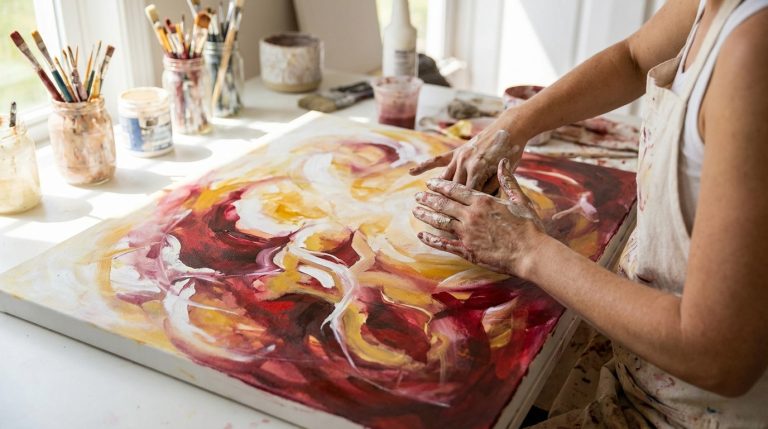
The painting leans against a chipped white wall, still smelling faintly of acrylic and coffee. There is blue sky where there should be ceiling, a crooked horizon, and a figure that looks almost like you, almost like a stranger. For a second, the room falls away and it is just you and this slice of someone else’s mind pinned to canvas.
You want it. Your bank account does not.
Here is the short answer: you can buy real, original art on a small budget if you stop looking for prestige and start looking for proximity. Trade prints for sketches, big galleries for school shows and open studios, polished frames for raw edges. Pay artists in money, yes, but also in time, curiosity, and consistency. The art you live with does not need to be large, famous, or expensive. It needs to be honest. And chosen.
Why supporting local artists matters more than buying decor
Art bought from a chain store behaves like wallpaper. It fills silence. It covers a blank patch. It says very little about you.
Art from a local artist behaves like a conversation. It shifts with the light, collects your memories, and quietly reveals what you care about. One is generic atmosphere. The other is relationship.
When you buy from a local artist, you are not just decorating a wall; you are extending the life of a practice that might otherwise stop at the sketchbook.
There is a practical side to this as well. Local artists are closer to your budget range than you think, because they are closer to your reality: rent, side jobs, cramped studios, the cost of paint. The distance between you and them is a bus ride, not an auction catalog.
Here are a few grounded reasons this choice matters:
- Your money goes directly to the person who made the work instead of being diluted by layers of middlemen.
- You influence what gets made next. Artists notice what sells. When thoughtful work pays the bills, more thoughtful work appears.
- You get context. A local artist can tell you where that photo was taken, whose hands they were thinking of while sculpting that clay.
- You build a living collection that grows with you, not a set of matching accessories.
Cheap decor asks, “Does this go with the sofa?” Local art asks, “Does this go with me?”
The tension, of course, is money. Original work carries the weight of materials, time, years of exploration. You might feel embarrassed, standing in front of a painting with a three-digit tag that feels like a month’s groceries.
You are not wrong to feel that tension. But the answer is not to walk away from the entire idea of original art. The answer is to change where and how you look.
Step one: stop shopping like a tourist
In a tourist shop, the work exists to be easy. Easy to like. Easy to sell. Easy to replicate. That is why everything starts to blur together.
When you hunt for local art on a budget, you want the opposite of that experience. You want the side room. The studio at the back of a warehouse. The messy table at a student exhibition.
Real art is often found in spaces that look temporary: pop-ups, shared studios, school corridors after hours.
Start shifting your habits:
Follow the noise of making, not the shine of selling
Where do people in your city actually make art? Look for:
| Place | What you might find | Why it is budget-friendly |
|---|---|---|
| Art school shows | Bold experiments, ambitious large pieces, strange materials | Students price lower, eager for first collectors |
| Open studio events | Works in progress, older series, sketchbooks | Artists often give better prices in-person |
| Small theater lobbies | Photography, illustration, set sketches | Work displayed to support artists, not as a main revenue stream |
| Cafes & community centers | Local painters, photographers, graphic artists | Prices are usually modest, with flexible payment |
| Artist markets & zine fairs | Prints, small originals, art books, textiles | Wide price range, often starting under the cost of a meal |
When you enter these spaces, do not rush to ask, “How much is this one?” right away. Walk slowly. Notice scale, textures, recurring colors. See what pulls you back for a second look. Your budget is a limit, yes, but your taste should not be defined by price tags alone.
Look for small work, not small ambition
Budget art buying is not about settling. It is about scale. A small original drawing can hold as much intensity as a mural. A ceramic cup can hold a whole philosophy about the human hand and comfort.
If you focus on intimacy instead of size, the world of affordable art opens up very quickly.
Artists often create studies, test pieces, or side experiments that do not fit into big exhibitions. These are fertile ground for someone with limited funds. Ask if there are “studies” or “older works” available. This is not insulting. It is curiosity.
Understanding what you are actually paying for
When you look at a painting priced at what feels like a small fortune, you might think you are paying for paint and canvas. You are not.
You are paying for:
– Hours of practice that came before this piece.
– Materials, yes, but also rent, tools, transport.
– The mental risk of putting something out in public to be judged.
– The time the artist spends at that market or opening, away from other income.
Without this context, art prices seem arbitrary. With it, you start to understand why original work cannot and should not compete with mass-produced wall decor.
Price is not a measure of “talent”; it is a measure of time, resources, and risk condensed into an object.
If your budget is tight, honor that reality. But do not ask artists to cut their worth in half. Instead, adjust what you buy and how.
The honest conversation: “I love your work, my budget is limited”
Many people stay silent because they fear sounding cheap or rude. Silence helps nobody. You walk away empty-handed; the artist loses a chance to connect with a supporter.
A straightforward approach can be surprisingly graceful:
– “I really connect with this series, but my budget is around [amount]. Do you have any smaller pieces or studies in that range?”
– “Is there a way to pay in installments for this piece?”
– “Do you offer prints or reproductions of this work?”
You are not bargaining at a flea market. You are looking for an honest fit between two realities: the artist’s need to be paid fairly and your need to keep your lights on.
Sometimes the answer is no. Respect that. Sometimes the answer is an invitation to look deeper into the box under the table, or a quiet, “I can hold this piece for you if you want to think about it.”
Creative ways to buy art when money is tight
When budgets shrink, creativity has to expand. Here is where you can start thinking like a set designer: work with constraints, use layers, play with scale.
1. Fall in love with works on paper
Canvas gets all the glory, but paper holds incredible value, visually and financially. Ink drawings, charcoal studies, watercolor sketches, monoprints, collage.
Paper is less expensive to produce and easier to store, so artists often price these pieces lower. For you, this means more access.
A few practical notes:
– Ask about archival quality. Is the paper acid-free? Are the inks or paints lightfast?
– Invest a little in a good frame later, even if you start with a cheap one.
– Do not fear visible tape edges, pencil notes, or rough borders. These quirks can feel intimate, like stage directions left on the script.
A single A4 drawing in a clean frame can hold an entire wall, if the work is honest and the hanging is confident.
2. Buy prints thoughtfully, not as an afterthought
Prints are often seen as the “budget” option, and they are. But they are not lesser versions if they are treated with care.
Ask the artist:
– Is this a limited edition or open edition?
– Is it hand-signed and numbered?
– Who made the print, and on what paper?
Limited editions carry more long-term value and a closer link to the original. Open editions are more casual, but still a way to get the image you love on your wall and money into the artist’s hands.
You can build a whole collection from prints if you pay attention to quality and variety. Mix screenprints, risographs, high-quality giclees, and handmade block prints. Let color and subject guide your choices, not format.
3. Hunt for “non-wall” art
You are not limited to rectangles on plaster. Many of the most affordable works live in other forms:
– Handmade ceramics: cups, plates, small sculptures that live on shelves and tables.
– Artist books and zines: affordable, intimate, often signed, sometimes one of a kind.
– Textile pieces: small weavings, embroidered patches, painted tote bags.
– Theater and set design ephemera: model pieces, painted props, costume sketches.
These objects often fall through the cracks of traditional “collecting”, but they carry the same creative weight. Placing a small ceramic figure on a shelf can change a room as much as a framed piece.
4. Commission small, focused work
Commissioning sounds expensive, but it does not have to be if you think small and clear.
Instead of: “Can you paint my entire living room wall?”
Try: “I love how you draw hands. Would you be open to doing a small ink drawing of my hands holding [object] at around [size] for [budget]?”
Commissioning gives you:
– A piece tailored to your life or space.
– A deeper relationship with the artist.
– The chance to ask for a specific scale that fits your budget.
Be honest about your ceiling. Give the artist freedom inside some boundaries, avoid micro-managing the result, and pay on time.
5. Trade carefully, when it is fair
Sometimes money is not the only resource you have. Skills, services, or materials can occasionally stand in for cash.
For example:
– A photographer might offer updated studio photos in exchange for a small piece.
– A web designer might refresh an artist’s site in exchange for art, if both agree on value.
– A carpenter might build shelves for the studio, with a predetermined art credit.
Trade is only respectful when both sides feel it is a real exchange, not charity in disguise.
Never pressure an artist into a trade. Offer it gently, with a clear acknowledgement that their work is valuable and that “no” is a completely acceptable answer.
Building a collection slowly, with intention
A good art collection on a budget is not about getting everything at once. It is about choosing one piece, then another, guided by a thread that you only see clearly in hindsight.
Let your eye, not the trend, lead
Instead of chasing what is “in”, pay attention to what your body does when you look at a piece.
– Do you lean closer or step back?
– Do you feel calm, unsettled, curious?
– Do you want to know the story behind this, or do you just want it to match your cushions?
Trendy art ages quickly. Personal art ages with you. A small drawing that catches your breath now may still hold you ten years from today, even if your furniture changes completely.
You are not buying a style; you are buying a recurring feeling.
Over time, you may notice patterns:
– A pull toward certain colors, like deep blues or sharp reds.
– A fascination with specific subjects: hands, windows, staircases, city streets.
– A preference for certain textures: thick paint, delicate graphite, coarse linen.
Let these patterns guide future choices. You will end up with a collection that looks like a map of your inner life, not a catalog page.
One piece at a time: a realistic rhythm
If your budget is tight, set a gentle rhythm that feels sustainable:
– One original or limited print per year.
– A small zine or object when you attend a show or performance.
– A “art savings jar” where you regularly set aside small amounts.
Treat art not as an impulse purchase but as a recurring line in your personal budget. No drama, no guilt. Just a quiet habit of saying, “I will make room for this.”
Ethical buying: respect, credit, and context
Supporting local artists on a budget is not just about money saved. It is about the ethics of how you enter their world.
Do not copy, do not commission copies
If you cannot afford an artist’s work, do not try to find a cheaper artist to imitate their style at a discount. This is not flattery. It is disrespect.
If you want something in that visual family, talk to the original artist. They might have a smaller, simpler piece in your range. Or they might point you to someone they respect who works in a related manner.
Always credit when you share
When you post your new piece online, name the artist clearly. Tag them, link to them, tell your friends where you found the work.
Your praise is a currency too, but it only works if it leads back to the person who earned it.
In a local scene, word of mouth is powerful. You become part of the invisible support structure that helps that artist keep going.
Pay on time, honor agreements
If you agree to installments, treat it seriously. You are not borrowing a book from a friend. You are entering a professional agreement.
– Get the terms clear in writing, even if it is just an email.
– Do not disappear or delay payment because “they are an artist, they will understand.”
– If something changes in your finances, communicate early and honestly.
Respect here is part of the support you claim you want to offer.
The role of digital spaces in budget art collecting
Not every city is rich in physical galleries and markets. Sometimes your access point to local artists is your screen.
Finding local artists online without getting lost
Start by searching with location in your tags or keywords:
– “#yourcityartist”
– “#yourcityart”
– “your city + painter / ceramicist / printmaker / illustrator”
Then filter:
– Does the artist post work in progress, studio shots, or just polished product images?
– Do they talk about where they are based?
– Do they mention markets, fairs, or local shows?
An artist who is rooted in your area is more likely to offer studio visits, local pickup, or chances to see the work in person later.
Buying through DMs and small shops
Many emerging artists sell directly through social media or small online stores.
Be clear and concise:
– “I am interested in [piece]. Is it still available? Could you share the size, price, and shipping or pickup details?”
– If something is over your budget: “Thank you, that is beyond my current range. Do you have any smaller works or prints under [amount]?”
Protect both sides:
– Ask for clear photos, including close-up and back if needed.
– Use secure payment methods that both sides are comfortable with.
– Accept that shipping and packaging have real costs.
A local artist online is still a neighbor; the internet is just the hallway between you.
Making space at home: hanging, grouping, and living with your art
Buying art on a budget is one thing. Making it feel at home in your space is another.
Treat small works like jewels, not leftovers
A common mistake: buying a beautiful small piece, then letting it drown on a huge empty wall or in a cluttered corner.
Think like a set designer guiding the audience’s gaze:
– Hang small works at eye level, not too high.
– Give them breathing room, perhaps on a narrow strip of wall between doors.
– Group several small works in a tight cluster, with similar spacing, to form a single visual unit.
Cheap frames can look refined if they are simple and consistent. White, black, or natural wood, with clean lines. If a frame is temporary, that is acceptable. The point is protection and clarity.
Rotate and rearrange
Your collection does not need to be static. Rotate works seasonally. Move pieces from the hallway to the bedroom. Take everything down once a year and rehang with fresh eyes.
This costs nothing and keeps you in active relationship with the work. You notice new details. You see how different pieces talk to each other.
Treat your walls as a stage, not a storage unit.
Even on a strict budget, this sense of care turns a rented room into a curated space.
When not to buy art
There is an uncomfortable truth here: supporting artists does not always mean purchasing.
If buying a piece would cause you to miss rent, or push you into unhealthy debt, walk away. The artist does not need your financial crisis. They need a long-term collector who can keep showing up.
Support can also look like:
– Attending shows and bringing friends.
– Sharing artists’ work with people who do have the means to buy.
– Buying a smaller item now and planning for a larger purchase later.
– Writing thoughtful messages about how the work affects you.
Real support respects both the artist’s survival and your own.
When your situation changes, you will return to these relationships. You will know exactly whose work you want to live with, because you have been paying attention all along.
Putting it all together: a realistic path for a small-budget collector
Imagine this as a quiet, steady sequence, not a shopping spree.
Year one: you visit an art school show, buy a small ink drawing. You follow the artist online, share their work when you can. You start a tiny monthly “art fund.”
Year two: you discover a local printmaker at a weekend market. Your saved fund covers a limited edition print. You talk for ten minutes at the stall. A connection forms.
Year three: you commission a small, specific piece from the printmaker, now a friend. You pay in installments that fit your budget. You visit their studio once, see the work in progress. Your home begins to feel like a gallery of memories.
Year four: your finances improve a little. You buy a ceramic piece from a theater set designer at an open studio event. It sits on your table. Guests ask about it. You tell the story of how it came into your life.
You are still on a budget through all of this. You have not bought a single famous name. You have built something richer: a living, breathing collection of local art that reflects who you are, where you live, and who you have chosen to support.
And each time you walk past that first ink drawing, framed a bit awkwardly, you feel the same small pull in your chest that you felt in that school hallway. That is the measure of success here. Not price. Not status. That wordless tug.
The feeling that your walls are not just surfaces, but witnesses.