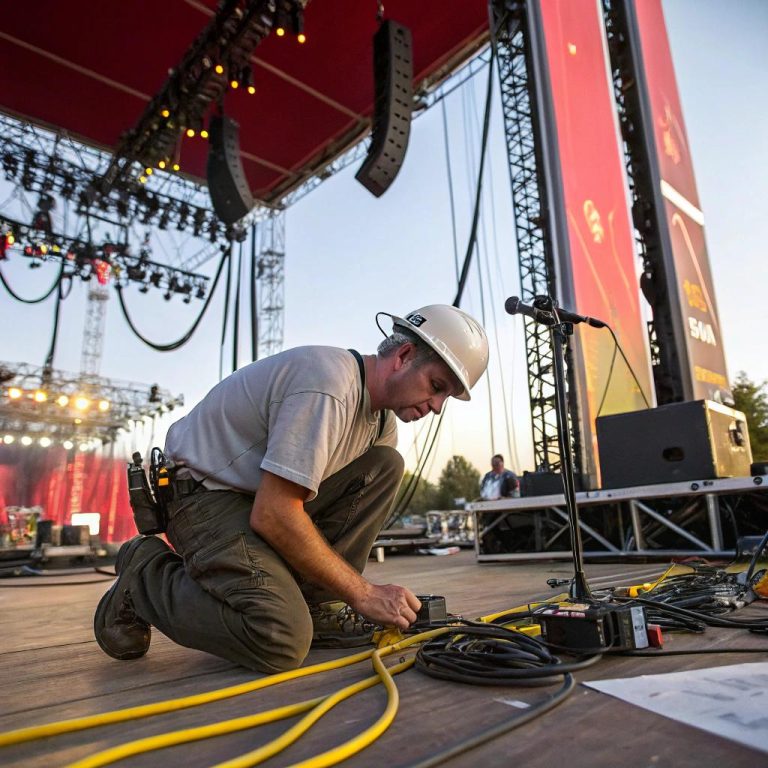
The bass line rises first, a low vibration in the floorboards. A wash of color swells across the set, catching on sequins, bare wood, chipped paint. Someone speaks the first line of the night, a phrase you borrowed from a script that has lived in a hundred other mouths. The music is perfect. The words land perfectly. The audience leans in.
And in the back of your mind, a small cold thought:
“Do I actually have the right to use any of this?”
That question is where this story starts.
You do not really license music and scripts “because the law says so.” You license them because every show is a collaboration with people who are not in the room. The songwriter who never meets your lighting designer. The playwright who does not see your set. The composer who wrote that three-note sting that holds your blackout together. Copyright law is the set of rules that protects that invisible collaboration. If you want to use someone else’s work in your production, you have two honest choices: pick material that is genuinely free to use, or get a license that clearly covers what you are doing. Anything in between is gambling with your budget, your venue’s reputation, and eventually your own freedom to keep making work.
How copyright actually touches your stage
Picture your show as a physical object laid out on a table.
There is the script. The songs. The underscoring. The recorded sound effects. The poster design. The program. The photos you post. The reel you cut for Instagram. Every one of those pieces is its own separate “work” under copyright. The law does not care that they feel like one coherent experience to you. It treats each one as its own little island.
So when you say, “I want to license this show,” you are not buying one magic permission slip. You are arranging several very specific rights that behave like different kinds of light on your stage.
- The right to perform a script in front of a live audience is one thing.
- The right to use a song as recorded background music is another.
- The right to stream or film the performance is different again.
Mixing them up is where many small companies, immersive creators, and student productions get in trouble. They assume that because they paid for something, they can bend it however they like.
They cannot.
Paying money does not guarantee you are covered. Only a clear written license that matches what you are actually doing gives you real safety.
Let us pull the work apart and look at the two main creatures you deal with on stage: music and scripts.
Licensing music: what you are really buying
Your ears hear one piece of music. Copyright law hears several.
A song is usually at least two separate copyrights:
| Part | What it is | Who controls it |
|---|---|---|
| Composition | The melody, lyrics, underlying musical work | Songwriter and/or music publisher |
| Sound recording | A particular recorded performance of that composition | Record label or whoever funded the recording |
If you use recorded music in a show, you usually need permission for both the composition and the recording. If a band is playing live on stage, you need permission for the composition but not the recording, because you are creating a new performance in that moment.
That split shapes every license you sign.
Public performance rights: music in the air
If an audience can hear the music, there is a high chance that you are engaging a “public performance.” That phrase covers background music in your lobby, songs sung live by actors, or a track that plays while people move through an immersive corridor.
Performance rights for compositions (not recordings) are usually managed by Performance Rights Organizations, or PROs, such as:
| Region (example) | Common PROs |
|---|---|
| United States | ASCAP, BMI, SESAC, GMR |
| United Kingdom | PRS for Music |
| European Union (various) | SACEM, GEMA, SIAE, etc. |
| Canada | SOCAN |
The usual pattern is this:
You, or your venue, or your production company, holds a blanket license with a PRO. That license allows you to perform or play music from that PRO’s catalog in public spaces. Hang on to that phrase: “blanket license.” It is broad. It is useful. It is also often misunderstood.
A PRO license usually covers live performance and playback of songs, not recording those songs into a video and pushing that video online.
So if you are:
* Having live musicians play recognizable songs in your production
* Playing commercial tracks over speakers for your audience
you need to know whether your venue or company already has PRO coverage. Many theaters do. Many pop-up immersive spaces do not.
Crucially, PRO licenses deal with the composition side. If you are using a specific commercial recording, another layer appears.
Master use rights: the recording itself
When you buy a track on a platform, or pay for a streaming subscription, you have not purchased the right to drop that track into an installation, projection-mapped hallway, or promo video. You have paid for personal listening.
To embed a specific recording in your production (“we want this exact version of this song”), you need a master use license from the owner of that recording, often a record label.
This usually matters in two places:
1. You are playing a particular track inside the show as part of the sound design.
2. You are using that track in a recorded video of the show, or in a trailer.
For live stage use only, some rights can be folded into a broader agreement, especially if you work with music libraries that sell “theatrical” or “production” licenses. For recording and online distribution, you usually negotiate more carefully.
If a license looks strangely cheap, check whether it allows public performance, recording, and online use, or only one narrow slice.
Many “royalty free” libraries only grant you sync rights for video, not in-venue performance for ticketed shows. Others allow performance but not social media use. It is rarely all-inclusive.
Synchronization rights: when music meets the camera
The moment a camera arrives in your rehearsal room, the rules shift. Filming actors who are speaking over a soundtrack, or dancing to a song, adds a new right: synchronization.
Synchronization, or “sync,” is the right to combine music with moving images. Think: show trailers, archival recordings, livestreams, behind-the-scenes clips, and cinematic captures of your immersive work.
For sync, you almost always need:
| Right | From whom | Why |
|---|---|---|
| Sync license (composition) | Music publisher / composer | To place the song in your video or stream |
| Master use license (recording) | Record label / recording owner | To use that specific recording in the video or stream |
A PRO blanket license usually does not cover sync. That is a separate negotiation, often more expensive, and often very restricted if the song is well known.
Now look at your creative process with clear eyes:
* That glossy video with slow tracking shots through your installation, underscored with a beloved pop track.
* The filmed version of an immersive piece you plan to sell as a digital ticket experience.
* Clips from your rehearsals that you post online, with the show mix audible.
All of those are sync situations. Many small companies shoulder this with little thought, trusting in obscurity. That is less and less safe as content ID and automated detection grow more sophisticated.
If your work lives partly on screens, build music licensing for online use into the project budget from the beginning, not as an afterthought when editing starts.
You can soften the blow through different choices: commissioning original music with clear contracts, working with composers who grant broad rights, or using production libraries designed for theater and video. But you cannot ignore the structure.
Fair use: why it rarely saves a full production
People like to wave “fair use” like a talisman. For theater makers, that faith is usually misplaced.
Fair use (or similar concepts in various countries) allows very limited, context-dependent use of copyrighted material without permission. Courts look at several factors: the purpose, how much you used, the effect on the market for the original work, and more.
The problem is simple: a full performance, or a major song used at length in a ticketed show, is almost never going to fit that narrow window. A serious parody might qualify, or a brief critique inside a classroom setting, but an immersive environment that leans hard on recognizable music is usually outside that safety zone.
So for set designers, directors, and producers, fair use is like stage fog. It can soften edges in a few niche cases, but you cannot walk on it.
Licensing scripts: from playtexts to immersive adaptations
Now tilt the spotlight onto words.
A script is its own protected work, separate from any score. The playwright has rights over:
* The text itself.
* The right to authorize public performances.
* The right to authorize adaptations in many forms.
When you license a script from a publisher or agency, you are almost always buying performance rights for:
* A set number of performances.
* In a defined venue or region.
* Over a specific set of dates.
That license rarely allows you to record and distribute the performance, alter the script beyond small textual cuts or line edits, or turn the play into an immersive promenade piece without talking further with the rightsholder.
Treat every shift in format or medium as a new conversation: stage to stream, linear to immersive, spoken to musical, short run to long-term installation.
If you want to rearrange scenes in a radical structure, have audience members speak key lines, or stage the story as a VR experience, you are not buying a standard performance license. You are negotiating an adaptation.
Where to get script rights
For most contemporary plays and musicals, you go through a licensing house or agent that manages rights on behalf of the writer and their collaborators. Names change by country, but the pattern is similar:
| Type of work | Who usually handles rights |
|---|---|
| Published plays (non-musical) | Play publishers, playwright agents, sometimes direct from playwright |
| Musicals | Specialist theatrical licensing companies |
| Devised pieces with one credited writer | The writer or their agent directly |
For public domain works (for example, older texts where copyright has expired), the source text is free to perform and adapt. You can create your own version of “Hamlet” without paying Shakespeare. But if you base your production closely on a modern adaptation of Hamlet, that modern version might still be under copyright. The freedom lies in the underlying story, not in every modern edition you find.
When in doubt, trace the exact text you are using. Is it a century-old edition, or a stylish new translation? The latter is often still protected.
Immersive adaptations: why standard licenses may not fit
Immersive theater lives in the margins of traditional contracts. Your audience is on their feet. They walk through rooms. They speak lines, change paths, touch objects. The show can run for months, even years, in a semi-permanent environment. A one-size-fits-all “ten performances over two weekends” license does not describe that reality.
Common friction points:
* Audience interaction: Many standard play licenses forbid audience members speaking scripted lines, changing text, or improvising in the story world.
* Site-specific or long-running installations: A production that runs every 15 minutes in a converted warehouse for six months does not fit the usual counting of “performances.”
* Media layers: Projection, AR, VR, apps that deliver story content are sometimes outside the original agreement.
If you treat the text as raw material and reshape it into a new structure, that is not “just staging” the play. It is adaptation. You should be open about that with the rightsholder.
If you are doing something structurally unusual with a script, name it plainly in your rights request. Do not hope that no one will ask how your show actually works.
Approach the agency or writer early. Explain your format: promenade, one-on-one tracks, branching paths, environmental puzzles. Offer a clear performance schedule or attendance model. The negotiation might feel slow inside your production timeline, but it is easier than untangling a legal mess mid-run.
Public domain, Creative Commons, and “free to use” traps
In the hunt for affordable material, many artists reach for three labels: “public domain,” “Creative Commons,” and “royalty free.” Each sits in a different part of the legal map.
Public domain: when copyright has expired
A work in the public domain is no longer under copyright. You can perform it, adapt it, remix it, and build your set around it without paying for permission. Classic novels, many old plays, and older music often fall here.
The trouble lies in:
* New translations or editions with original contributions.
* Modern arrangements of old music.
* Hybrid works that mix public domain core material with new scenes, lyrics, or commentary.
The bare bones of an old folk song might be free. A recent choral arrangement is not. An original 19th century printing of a play might be free. A modern stage adaptation of that play is not.
So check:
| Question | Why it matters |
|---|---|
| What exact version are we using? | Different editions can have different rights. |
| Who created this edition / arrangement? | They may hold fresh copyright over their additions. |
| Is there any modern framing material? | Introductions, annotations, stage directions, all might be protected. |
For immersive work, public domain can be a generous playground, as long as you build your own fresh structure rather than leaning on a recent version that someone else crafted.
Creative Commons: free, but with strings
Creative Commons (CC) licenses are prewritten agreements that some creators attach to their work. They can permit free use, with conditions.
Common elements:
* Attribution (BY): You must credit the creator in a specific way.
* NonCommercial (NC): You cannot use the work in a commercial context. Ticketed shows often count as commercial.
* NoDerivatives (ND): You cannot change the work.
* ShareAlike (SA): If you remix the work, you have to license your version under similar terms.
For a small experimental show, a CC track might look tempting. Read the letters carefully. A CC-BY license is generally friendly: you can use and adapt, as long as you credit. A CC-BY-NC-ND track is almost impossible for a typical theater production: no changes, no commercial use.
“Free to download” is not the same as “free to use in a ticketed show.” Always check the exact license terms, not just the headline.
And again: if you plan to record and distribute your performance, that is a separate layer. Some CC licenses allow sync, others are silent or restrictive. When in doubt, ask the creator directly.
“Royalty free” music libraries
“Royalty free” does not mean “no rules.” It usually means you pay once instead of paying ongoing royalties per use. Every library has its own contract.
Look for:
* Whether public performance is allowed.
* Whether theater or live events are included.
* Whether sync is allowed for online videos.
* Limits on audience size, number of projects, or duration.
For immersive creators, a well-chosen library can reduce legal headaches. But you should still treat the license as a script: read every clause that touches performance, recording, and online release. If you cannot stand reading legalese, find someone who can.
Recording, streaming, and archiving shows legally
The camera is often the most overlooked “character” from a rights perspective. Many creative teams think in two stages: “We will stage the show” and “We will film it later if it goes well.” Legally, those are two different projects.
For a recorded or streamed version, you may need:
* Video rights from the playwright or licensing house. Standard stage rights often exclude capture and digital distribution.
* Sync and master rights for every piece of music, even if it is only faintly audible.
* Consent and releases from performers, especially if the recording will be sold or widely distributed.
Treat a filmed version of your show as its own production with its own rights package, not a casual bonus layered on top of the live run.
Platforms with automated content matching can flag unlicensed music quickly. Even unlisted promotional reels can trigger takedowns. For set designers and immersive creators, this matters because music bleeds into every room. It will be present on your behind-the-scenes clips, your walk-throughs, your teaser reels.
Strategic choices help:
* Use compositions your team fully controls for underscoring, so you can grant your own sync rights.
* Keep commercial music in tightly controlled set pieces where you can clear specific licenses, not as constant ambiance.
* Record “clean” passes of your space with no music if you want silent or newly scored promo material.
Practical steps for legal licensing without killing creativity
At this point you might feel that every creative decision drags a legal shadow behind it. That shadow exists, but it does not have to flatten your work. It can shape it, like negative space.
If you design sets, direct shows, or produce immersive experiences, a grounded approach might look like this:
1. Begin with a rights map. Before you fall in love with particular songs or texts, sketch what types of material you want: commercial tracks, original score, public domain text, a modern play, etc. Mark which ones might be easiest to clear. Let that inform your concept, not sabotage it at the end.
2. Separate “must-have” from “nice-to-have.” If one famous song is the emotional spine of the show, be honest. Budget for that license or reimagine the spine. Do not treat it as a casual background choice.
3. Bring the rights conversation into design meetings. When you discuss a room’s atmosphere, talk about whether it leans on protected tracks, original sound design, or environmental audio you can generate yourself. A room of ticking clocks and shifting air might be more affordable, and more interesting, than one drenched in unlicensed cinema score.
4. Write your contracts with collaborators carefully. When you work with composers, writers, and designers, specify what you are buying: performance rights only, or recording and online rights too? For how long? In which territories? Clarity here protects them and you.
5. Respect “no.” Sometimes a rights holder refuses an immersive adaptation, or will not grant streaming rights, or prices a track far beyond your reach. Treat that boundary like a wall in a site-specific piece. You do not walk through it. You use it. You change the route and often discover something more personal.
When you should get legal advice
There are moments where guesswork is reckless:
* Adapting a known film or novel into an immersive piece.
* Turning a well-known musical into a site-specific or interactive version with major changes.
* Building a commercial, long-running experience in which music and branded material are central.
* Planning a paid digital release of a stage production.
A lawyer who works with entertainment or theater is not there to smother your instinct. They are there to tell you where the edge of the cliff really is. In many cases, a short consultation early in development costs less than patching a show pulled under legal threat mid-run.
Good licensing is not about fear. It is about treating unseen collaborators with the same care you give to the visible ones.
You would not repaint another designer’s finished set and claim it as your own. The same ethics apply to songs, scripts, and recordings that you fold into your work.
The law can feel dry. But underneath, it is still a story about credit, consent, and clarity. The same values that make a rehearsal room feel safe can make your rights practices sturdy.
When the bass line rises, when the borrowed line leaves an actor’s mouth, there is quiet confidence in knowing that everyone who helped build that moment is there by choice, not by accident.