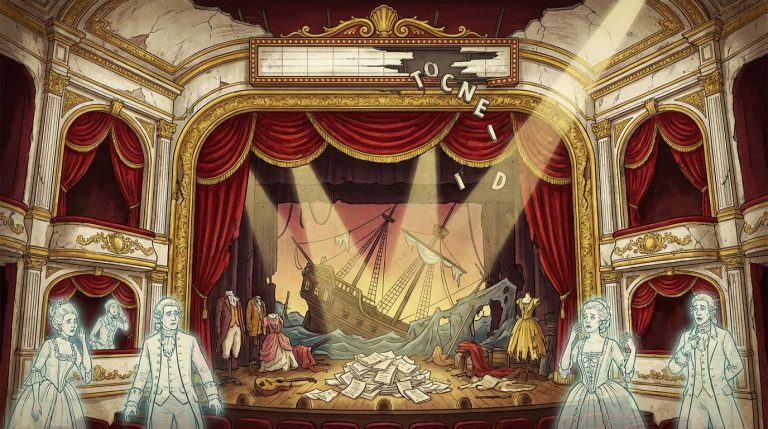
The iron gate is half rust, half memory. Paint clings to its scrolls in thin flakes, like the last bits of costume on an exhausted actor. Behind it, an old theater leans slightly, bricks softened by rain and time, a faint smell of dust and velvet seeping through the cracks. You can almost hear the echo of curtains rising, of shoes on wooden boards, of an orchestra tuning itself back into the past.
Then a yellow machine arrives. One clean gesture, and the echo is gone.
That is what demolition really is: not just a building removed, but a stage erased, a story cut mid-sentence.
The short version: historic preservation is the art and craft of giving old places a future. It is the choice to repair rather than erase, to adapt rather than flatten. When it works, preservation keeps landmarks from demolition by making them useful, safe, and loved again: upgrading their structure, weaving them into current city life, and proving that their continued presence is worth more than the quick money of new construction. At its best, it turns “that old building” into a living set piece for daily life, a physical script of where we came from and how we want to live together now.
The emotional logic of saving old places
Before policy, before funding, before zoning, there is something simpler: how a place feels when you walk into it.
Preservation starts with that feeling. The chill of thick stone walls that keep a room cool on a hot day. The creak of floorboards that hold the weight of many lives. The way late afternoon light catches stained glass and washes the interior in colors that no LED can mimic.
We do not fight to save a warehouse because the brick is technically interesting. We fight for it because of the way the facade holds shadow. Because the loading dock is the perfect place for an outdoor performance. Because the sign, faded and half gone, still names a trade the city no longer practices.
When people fall in love with a building, they defend it. When they cannot feel anything in it, they let the excavators in.
Preservation that ignores emotion fails. Preservation that starts from emotion, then builds a case in law, finance, and design, has a chance of standing against demolition.
Why demolition is so tempting
Demolition is fast. It is clean in a brutal way. It simplifies a site to pure potential: a flat, open, “blank” lot.
Developers look at a crumbling landmark and see risk. Unknown structural problems. Hazardous materials. Complex approvals. Delays. All of these translate into cost.
Cities look at neglected buildings and see complaints. Safety hazards, vandalism, blocked sidewalks, heat loss, lost tax income.
On paper, the new building looks rational. Three more floors, more units, more rent, more “activity.” The spreadsheet does not record the loss of carved stone, of intricate moldings, of odd narrow hallways that surprise visitors.
Demolition wins when the new story looks clearer than the old one.
To save a landmark, preservation has to tell a stronger story. Not sentimental slogans, but a compelling future that is both practical and beautiful. A future where the historic building is not a relic, but a working stage for current life.
What actually keeps landmarks from demolition
At ground level, saving buildings is less romance and more strategy. It lives in law, money, design, organizing, and timing. Emotion is the spark, not the whole fire.
- Legal protection: historic designation, zoning, and review boards that can block or reshape demolition plans.
- Economic logic: proving that reuse, adaptation, or partial redevelopment can be financially viable.
- Technical care: structural repair, material conservation, and sensitive upgrades that make old buildings safe and comfortable now.
- Public will: communities, artists, and local users who refuse to be silent when a landmark is threatened.
None of these alone is enough. A building with legal status but no money decays. A building with a strong developer but no community support becomes a superficial shell. Real preservation balances all four.
Legal status: turning memory into law
Legal tools are not romantic, but they are often the first real shield against a bulldozer.
In many cities, there are levels of legal protection, each with different strength:
| Tool | What it does | How it helps preservation |
|---|---|---|
| Historic designation (local) | Formally recognizes a building or district for its cultural, architectural, or social value. | Triggers design review for changes; demolition becomes harder or subject to strict conditions. |
| National / regional listing | Registers buildings at a larger scale (national, regional, state). | May give access to grants or tax credits; offers prestige but often weaker direct protection. |
| Conservation area or district | Protects groups of buildings with shared character. | Prevents piecemeal erasure and keeps the spatial “story” of a neighborhood intact. |
| Heritage easements | Legal agreements recorded on property title. | Conservation groups gain rights to oversee certain features regardless of future owners. |
| Demolition delay laws | Force a waiting period before demolition. | Buys time for negotiation, alternatives, or public campaigns. |
Law transforms “we care about this place” into “you cannot destroy this without a fight.”
Legal protection does not repair the roof, but it can stop someone from tearing off the entire building.
For designers, directors, and artists, understanding these tools is not optional. If you fall in love with a landmark and want it as a canvas, you need to know if it is protected, and if not, how to push for that status before demolition plans crystallize.
Economic reality: making beauty pay its bills
An old building is a living creature that eats. It eats maintenance budgets, energy costs, insurance, engineering reports.
If the owner sees only cost and no return, demolition begins to look like relief.
Preservation succeeds when it creates a viable economic story for the landmark. This can be quiet and modest or bold and ambitious:
A saved landmark is not a charity case. It is a place with a strong enough future to justify careful repair.
Tools that often shift the equation:
– Tax credits or rebates for rehabilitation work
– Grants for specific repairs: roofs, facades, accessibility
– Low-interest loans for adaptive reuse projects
– Incentives to transfer development rights: a tall new tower somewhere else, in trade for keeping the older structure intact
– Rules that favor reuse over new build in planning decisions
But money is not abstract. People with keys need to decide to work with the building, not against it. This is where good design enters: to show how an existing structure can house new life without losing its old character.
Adaptive reuse: the art of re-casting a building
Imagine an abandoned rail station turned into a market hall. A power plant glowing at night as a performance center. A bank lobby converted into a shared workspace where laptops sit beneath coffered ceilings and heavy chandeliers.
That is adaptive reuse: treating a building like an actor capable of a new role. Same body, different script.
Preservation that simply freezes a place can make it fragile and dependent. Preservation that adapts it can keep it active and visible, which makes demolition politically and socially harder.
Keeping the character, shifting the function
Adaptive reuse is a balancing act between three questions:
1. What makes this building itself?
2. What uses can live comfortably within its existing bones?
3. Where can we cut, open, or add without destroying its identity?
You do not save a historic theater by turning it into anonymous office boxes with a token poster in the lobby. You keep the volume of the auditorium, the curve of the balcony, the texture of the proscenium arch, even if new seating or technical systems must arrive.
You do not erase every small room in a school just for an open plan. You find ways to group rooms, remove some partitions, leave others, and use the seams between old and new as moments of visual drama.
Good adaptive reuse reads like a palimpsest: earlier lines still visible under the new script.
From a set design perspective, these seams are gold. A trace of an old staircase on a wall. A half-covered arch that hints at a different past layout. A mismatched floor pattern where rooms merged. These become design cues, visual metaphors, even narrative hooks in immersive or performance work.
Technical care: making old structures safe and gentle
An old landmark can be beautiful and also unsafe. Cracked beams, loose masonry, no fire separation, poor exits. Preservation is not about romanticizing danger. It is about healing.
Key technical moves that keep buildings standing and in use:
| Area | Typical issues | Preservation-minded approach |
|---|---|---|
| Structure | Weak foundations, corroded steel, decayed timber. | Discreet reinforcement, adding support where needed while keeping visible historic elements where possible. |
| Envelope | Leaky roofs, failing windows, damp walls. | Repair rather than replacement where feasible, using compatible materials and breathable systems. |
| Fire & life safety | Lack of sprinklers, narrow exits, flammable finishes. | Sensitive integration of fire systems, reworking circulation, and carefully upgrading finishes. |
| Accessibility | Stairs only, narrow doors, level changes. | New ramps, lifts, and restrooms, designed as clear contemporary interventions rather than fake historical copies. |
| Energy & comfort | Heat loss, glare, poor ventilation. | Insulation in hidden layers, secondary glazing, and modern mechanical systems, keeping the main character of windows and walls. |
The best work reads like careful costume repair. Reinforced seams hidden in the lining. New fastenings that do not draw attention away from the original fabric.
Why artists, set designers, and theater-makers should care
For anyone working in immersive theater or spatial storytelling, historic preservation is not a distant policy topic. It is your source material. Your largest prop. Your richest partner.
An old factory gives you textures you cannot fake: oil-stained floors, skylights streaked with dust, walls layered with decades of repainting. An old town hall gives you ceremonial scale. An old apartment block gives you corridors and thresholds that already feel like narrative beats.
Destroy these, and you replace them with clean drywall and neutral lighting. To create the same intensity, you then have to fake age, fake wear, fake patina. That can work, but it is never quite the same.
Preservation protects the raw stages that storytellers have not yet used to their full potential.
If you care about immersive experiences, you need to care about what is happening at planning meetings, heritage commissions, and property auctions in your city. The decisions made there shape your available stages for decades.
When preservation becomes a problem
Not all historic protection is wise. Some battles for old buildings ignore current needs entirely, turning structures into monuments to nostalgia rather than living parts of a city.
There are real tensions:
– A preserved facade with no ground-floor activity can deaden a street.
– Overly strict rules on materials can make repair unaffordable, pushing owners toward neglect.
– Freezing a district at a certain time period can erase later layers of history, including those of marginalized groups.
You are not obliged to approve every preservation effort just because you love old buildings. Some proposals lock places in amber, resisting any meaningful change. Others fight for minor artifacts at the expense of housing, accessibility, or public use.
The strongest preservation projects accept that cities must adapt. They keep significant elements, allow intelligent new additions, and accept that not every old brick is sacred.
Community, memory, and who gets to decide
No landmark is neutral. The grand stone courthouse might have presided over unjust trials. The civic theater may have excluded entire communities from its audience. The mill might have relied on brutal labor.
When you save a building, you also choose which histories to keep, and which to highlight. That choice should not belong only to architects or officials.
Local communities, artists, and former users have vital information that rarely appears in architectural drawings: stories of how stairwells were used, where protests began, which spaces felt hostile, which felt safe.
Preservation that ignores lived experience creates beautiful shells around unresolved wounds.
As an artist or designer, you can help shift that pattern. You can program works in preserved buildings that address their histories directly. You can push for interpretation that does not hide the difficult parts behind vague plaques. You can advocate that preservation funds go not only to grand halls but also to modest but significant local sites: social clubs, small cinemas, workers’ housing, community stages.
The narrative power of scars
Demolition erases, but preservation can soften too much, sanding away scars that tell necessary stories. A crack stitched with mortar, a repair evident in mismatched brick, a patched floor where a machine once stood: these are narrative traces.
They can guide set design and spatial storytelling:
– A former prison where cells remain visible, now used for performances about justice.
– An old school with chalk ghosts on the walls, turned into a cultural center that works with young people.
– A warehouse with structural braces exposed, hosting installations about fragility and support.
Polished restoration that hides all of this under clean plaster denies future audiences the chance to feel the tension between past and present.
Strategies when a landmark is under threat
If you hear that a beloved building is scheduled for demolition, time compresses. Every month of delay buys space for new ideas, new funding, new alliances.
There is no single script, but certain moves often matter.
Read the plans before you raise the banners
Many campaigns start with assumptions: “They want to raze everything,” “They do not care about history.” Sometimes that is true. Sometimes it is not.
Before you choose your stance:
– Read the planning application if it is public.
– Look at drawings. Is the whole building going, or part of it?
– Check whether any historic reports were commissioned.
If the developer proposes partial retention, maybe your goal is to strengthen those elements and improve the design, not to block the project outright. An absolutist “no change” stance can backfire, pushing decision makers to disregard you as unrealistic.
Find the building’s allies
One lonely voice rarely stops demolition. A chorus might.
The allies might not be the obvious heritage enthusiasts. They might be:
– Local businesses that rely on the foot traffic the building brings.
– Theater groups who see a performance venue in the structure.
– Residents who remember past uses and feel a personal connection.
– Educators, historians, neighborhood groups.
Collaborations can grow from this. Artists can stage one-night events inside threatened spaces (with permission and safety) to make their value tangible. Designers can produce quick visualizations showing adaptive alternatives. These are not just PR gestures. They are tools that make decision makers see more than a decayed shell.
A vibrant building in the mind is harder to erase than a silent, shuttered one on the street.
Ethics of preservation in a changing city
Saving landmarks is not simply about rescuing the pretty parts of town. It is about deciding who the city serves. If only prestigious buildings in wealthy areas receive protection, preservation becomes a luxury project, reinforcing inequality.
Artists and designers can push back against this. Care for ornate theaters, yes, but also for simple workers’ halls where people organized for basic rights. For early social housing blocks that show a different vision of dignity. For small corner shops that held communities together.
There is a design question here too: how can we rework such buildings without erasing the textures of working life? How do we avoid turning everything into boutique space that excludes the very communities whose histories we claim to honor?
Reversibility and honest additions
One quiet ethical principle in good preservation is reversibility. When we add something new, can it be removed later without destroying what came before?
In practice, this might mean:
– Lightweight internal structures instead of heavy concrete inserts.
– New stair towers attached in ways that can be undone.
– Services run in accessible voids, not chased aggressively into ancient walls.
Another principle is honesty. New materials should read as new. Fake-aging to mimic the old confuses future reading of the building. A glass volume grafted onto a stone hall, clearly of another time, can be more respectful than a pastiche extension pretending to be historic.
For performance and set design, such contrasts can be powerful. Light against heavy. Transparent against solid. Old brick behind a scrim of glass. The building becomes a layered stage where different eras are legible at once.
Preservation as long-term stagecraft
Imagine your city as a continuous performance running for centuries. Buildings are sets, sometimes static, sometimes reconfigured. People change costumes, languages, beliefs. The one constant is that actors need a believable environment on which to project their stories.
Demolition wipes and redraws entire acts too abruptly. Preservation, when handled with care, edits, splices, adjusts. It gives the next director the option to work with earlier scenes, instead of discarding them.
Historic preservation is slow stagecraft at the scale of a city.
For those of us concerned with immersive art, spatial design, or theater that breaks the fourth wall, this slow stagecraft is not abstract. It establishes the textures we will work with decades from now. The choice to save or destroy a modest warehouse today may shape the most affecting performance space of tomorrow.
We do not need to freeze everything. Some buildings can go, and something better can rise. But when a landmark stands at the edge of erasure, the question we should ask is not only “Is this old?” but “What stories can this still carry?”
When the answer is rich, specific, and shared by many, preservation is not nostalgia. It is careful editing. It is protecting the right sets, so that future stories have somewhere truthful to live.